
Ontario’s frost-killed vines signal harvest, on average, by mid-October, but the number that actually decides whether your crop survives the winter is the mean minimum of the coldest month: 13.6°F. That’s far below the 40-45°F storage window potatoes need, which means an unheated shed or garage will freeze the crop solid before spring, not just chill it.
The short answer
Two figures anchor everything that follows. The average first fall frost at the Toronto Pearson station is October 16, according to Environment and Climate Change Canada’s Canadian Climate Normals. The mean minimum temperature of the coldest month at the same reference station is 13.6°F. Those two numbers together tell you when to dig and what kind of space you’ll need afterward.
Start with the frost date, and treat it carefully. It is a mean, not a guarantee. In roughly half the years on record, frost at this station arrived later than October 16, and in the other half it came earlier. Ontario is also not one climate: the Pearson station sits in the Greater Toronto Area, and districts to the north, or at higher elevation, typically see frost weeks ahead of that date. Use October 16 as the midpoint of a window you’re watching, not a date circled on the calendar.
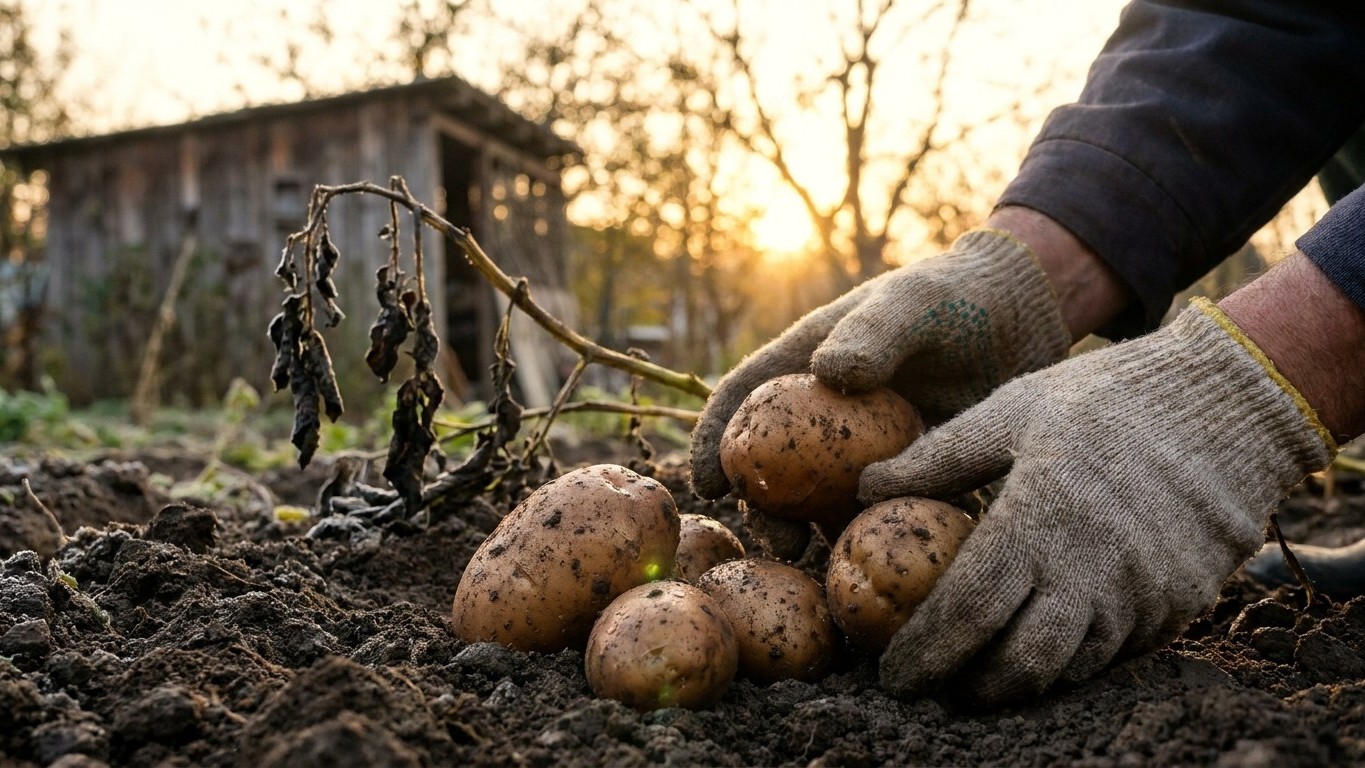
In practice, potato vines die back at or just before that first frost, and that dieback is your cue to lift the tubers. Leaving them in cold, wet ground much past that point invites rot rather than better yield, since the plant has already stopped feeding the tubers once the foliage collapses.
Storage is the harder problem. A mean minimum of 13.6°F in the coldest month means an uninsulated outbuilding in most of Ontario will spend weeks below freezing. Utah State University Extension puts the ideal storage temperature at 40-45°F, and the University of Maine Cooperative Extension gives a tighter figure of 38°F at 95 percent humidity. Neither number survives a Toronto-area January in an unheated shed. That space will freeze, and frozen potatoes turn soft, sweet, and unusable within days of thawing.
The workaround most Ontario growers land on is a basement, a root cellar, or an insulated cold room buffered from the coldest outdoor air but not warmed by a furnace. A space that never sees the extremes of either season, staying reliably in the 38-45°F band through January and February, is what the storage targets actually require here.
Curing, and where
Curing is the step growers skip and later regret. Utah State University Extension specifies 55-60°F with high humidity, held for two to three weeks, before potatoes go into long-term storage. Skip it, and thin-skinned tubers bruise, scar, and rot faster once stacked away for winter.
The trouble in Ontario is timing. Harvest lands around the same window as that first frost, mid-October on average, and by then outdoor air rarely holds a steady 55-60°F, especially overnight. Curing outdoors on a porch or under a tarp works only in the mildest early-harvest years, and even then only during the day. Here’s a sequence that fits the climate instead of fighting it:
- Lift the tubers as soon as the vines have died back, ideally before the first hard frost reaches the soil, and avoid pulling potatoes from ground that’s already frozen at the surface.
- Brush off loose soil by hand. Do not wash the tubers; moisture left on the skin at this stage encourages the rot curing is meant to prevent.
- Move the crop indoors immediately to a space holding 55-60°F. A basement corner away from the furnace, an insulated garage, or an enclosed but unheated porch (early in the harvest window, before nights drop hard) can all work in Ontario’s climate. A detached, uninsulated shed usually cannot, since October nights in most of the province already dip well below that range.
- Hold humidity up during curing by laying tubers in shallow boxes lined with damp burlap or loosely covered cardboard, out of direct sun and airflow that would dry them out.
- After two to three weeks, check the skins. Once they’re set, firm enough to resist a light thumbnail scratch, the batch is ready to move to its winter storage spot.
Storing through this winter
Once cured, the target shifts. Utah State University Extension calls for 40-45°F in the dark for long-term storage, while the University of Maine Cooperative Extension gives 38°F at 95 percent humidity as its benchmark. Both sources agree on the direction: cold, dark, and humid, but not cold enough to freeze and not warm enough to wake the eyes into sprouting.
That’s a narrow band to hold against a Toronto-area winter where the coldest month averages a minimum of 13.6°F. An attached, unheated garage will often track outdoor air closely enough to dip below freezing on the coldest nights, particularly in January, ruining the batch. A heated basement, on the other hand, frequently sits well above 45°F near ductwork or a furnace, which pushes tubers to sprout early and lose firmness before winter is even over.
The spaces that actually work in this climate tend to share one trait: thermal mass that buffers both directions. A below-grade basement room away from heating vents, a root cellar dug into a bank, or an insulated cold room built against an exterior wall can all hold close to the 38-45°F range through the coldest stretch without mechanical help. Where humidity runs low, as it does in most heated basements, growers layer damp burlap over storage bins or set an open pan of water nearby to push conditions closer to the University of Maine’s 95 percent figure.
Darkness matters as much as temperature. Light exposure greens the skin and produces solanine, a compound that makes the tuber bitter and unfit to eat regardless of how well the temperature was managed. Covered bins or a windowless room solve this without any added cost.
What goes wrong here
- Harvesting after the ground has frozen. Waiting past the first frost signal to dig, especially in a year when frost arrives on the early side of the October 16 average, means fighting frozen or waterlogged soil and bruising tubers on the way out. Watch the vines, not the calendar, and lift as soon as they’ve collapsed.
- Curing in a space that’s already too cold. An unheated garage in late October frequently drops below the 55-60°F curing target overnight, even while daytime readings look fine. Move the curing operation to a basement or an interior room if overnight lows are already falling into the 40s.
- Storage that freezes mid-winter. Given a coldest-month mean minimum of 13.6°F, any storage space that isn’t insulated or below grade risks freezing outright in January. Check a thermometer left in the storage space itself, not just the outdoor reading, before trusting a shed or unheated porch through the coldest stretch.
- Storage that runs too warm near heating sources. A basement corner too close to a furnace or hot-water heater can sit well above the 45°F ceiling, triggering early sprouting. Relocate the bins to the coldest corner of the basement, away from ductwork.
- Low humidity shriveling the skins. Furnace-dried basement air often falls well short of the University of Maine’s 95 percent humidity figure, leaving tubers soft and wrinkled by midwinter. A damp burlap layer or an open water pan nearby raises humidity without added equipment.
- Storing tubers that show disease or insect damage. Diseased or insect-damaged potatoes going into storage spread rot to the whole bin. Sort them out before storage, and treat standing crops in the field with appropriate fungicide or appropriate insecticides as needed well before harvest.
Common questions
When should I dig potatoes in Ontario?
Dig once the vines have died back, which typically happens at or just before the average first fall frost of October 16 at the Toronto Pearson reference station. That date is a mean, so watch the plants and the local forecast rather than relying on the calendar alone, especially outside the Greater Toronto Area.
Can I store potatoes in an unheated garage over winter?
Usually not for the full season. With a coldest-month mean minimum of 13.6°F, an unheated garage in most of Ontario will drop below freezing during the coldest weeks, which ruins stored tubers. A basement, root cellar, or insulated cold room holds the 38-45°F range required by Utah State University Extension and the University of Maine Cooperative Extension far more reliably.
How long does curing take before storage?
Utah State University Extension recommends two to three weeks at 55-60°F with high humidity before potatoes move into long-term storage. Shortening that window increases the risk of bruising and rot once the tubers are stacked away.
Why did my stored potatoes sprout early?
Sprouting usually means the storage space ran warmer than the 40-45°F target, often because bins sat too close to a furnace or heating duct in a finished basement. Moving the batch to the coldest, darkest corner of the storage space typically solves it.