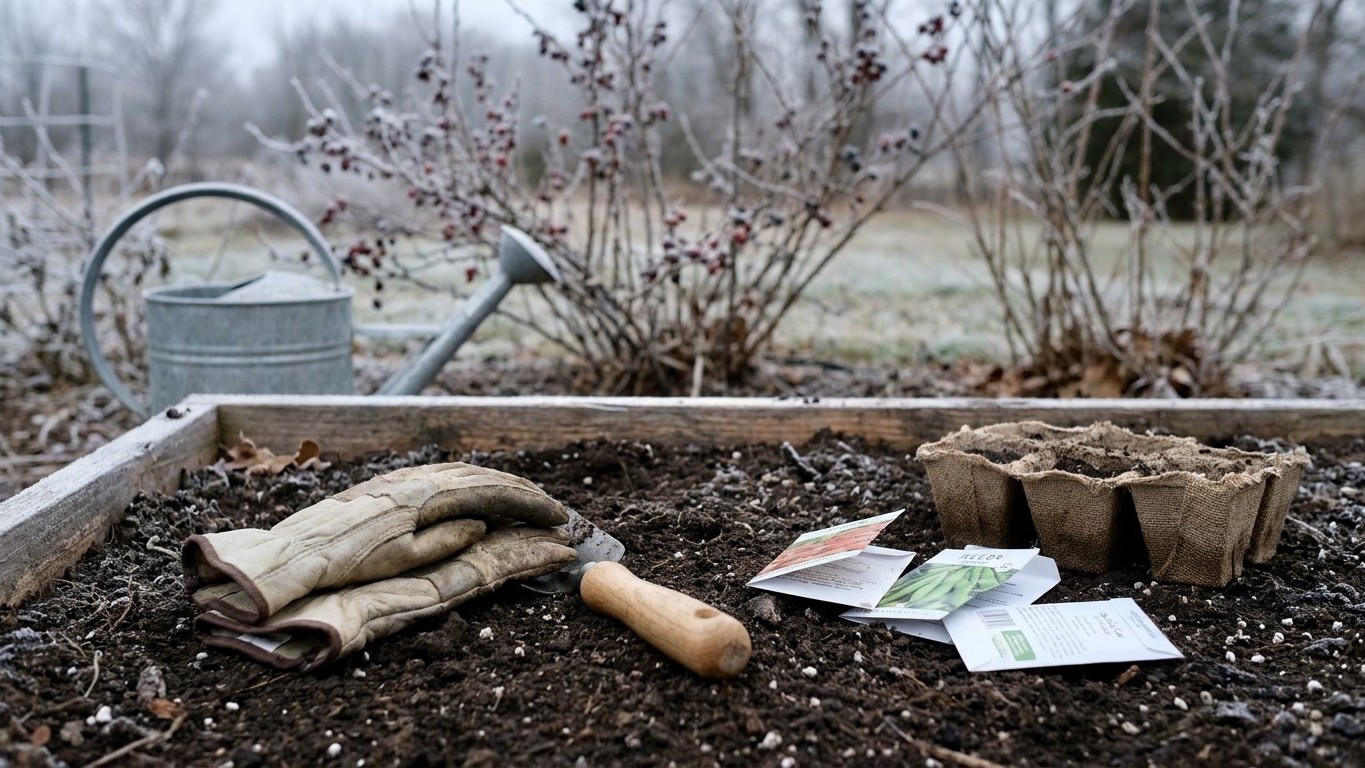

Almost nothing goes into open ground across Pennsylvania this month. The soil is frozen solid in the north and often waterlogged even where it has thawed in the south, and the last spring frost doesn’t arrive until March 29 to April 6 around Philadelphia, later inland. What actually earns a spot on the calendar this month is indoor seed starting, dormant pruning, and a short list of hardy exceptions.
What goes in the ground in February

The decision here isn’t the date on the wall, it’s whether the soil can be worked at all. Frozen ground, or ground so wet it compacts into bricks when you step on it, rules out planting no matter how mild an afternoon feels. Pennsylvania’s last frost window (March 29 to April 6 for Philadelphia, running two to four weeks later across the northern tier and the Alleghenies) sits a full one to two months past this point on the calendar, which is the real reason the outdoor list stays short.
That said, one exception holds up in the milder pockets of the state, mainly the southeast corner near the Philadelphia reference point where USDA hardiness runs toward 7b. If the ground has thawed and drains freely underfoot, garlic cloves and shallot sets missed in fall can still go in. They root through cool soil and won’t push top growth until temperatures climb, so a late planting rarely costs much yield. Anywhere the ground is still locked up, skip it and wait.
Cold frames, low tunnels, and dormant stock
A cold frame or a low tunnel changes the math because it raises soil and air temperature enough to let hardy greens, like spinach and mâche, germinate weeks before open-ground planting would work. Gardeners running unheated tunnels can direct-sow these now and expect slow but steady growth once daylight lengthens.
Bare-root fruit trees, cane berries, and roses can also go into the ground the moment it’s workable, since they’re dormant and won’t notice a cold snap the way an actively growing plant would. Indoors, this is also the month to force rhubarb crowns or chicory roots in a dark, cool basement for an out-of-season harvest, a trick that costs nothing but a bucket and a dark corner.
What to start under cover
Indoor sowing is where February actually earns its keep, and the schedule works backward from the frost window rather than forward from the first of the month. With the last frost landing March 29 to April 6 around Philadelphia (and later the farther north and higher up you garden), the slowest transplants need to go under lights now if they’re going to be full-grown by planting-out time.
Onions, leeks, and celery are the classic long-lead crops. They’re slow from seed, often needing eight to ten weeks of indoor growth before they’re sturdy enough to transplant, so starting them in the first half of the month puts a Philadelphia-area gardener right on schedule for an early-to-mid-April move outside. Gardeners farther north, where frost lingers into May, have more room and can start a week or two later without falling behind.
The two ways this goes wrong both come from ignoring that math. Start onions or leeks too early and they sit under grow lights for months, becoming rootbound and leggy in their cell trays long before the ground is ready for them, a plant that never fully recovers once it’s in the garden. Start too late, especially in the northern counties where the season is already shorter, and transplants go out under-sized, giving up weeks of growing time they never get back. Peppers and eggplant, which are even slower to size up, are usually better held for next month rather than started now, since ten to twelve weeks indoors starting this early would have them straining against their pots long before it’s warm enough to plant them.
What is ready to pick
Little to nothing is coming out of open ground this month across most of Pennsylvania, and there’s no point pretending otherwise. The exceptions are the crops that were planted specifically to shrug off winter.
Kale, and leeks left in the row and mulched heavily in fall, often survive under snow cover and can still be dug or cut once the ground softens enough to reach them; a shovel or garden fork, not bare hands, is the right tool if the top few inches are frozen. Cold frames running spinach or mâche from a late-fall sowing may already be yielding small cuttings, and this is also prime season for indoor sprouts and microgreens grown on a sunny windowsill or under a shop light, which go from seed to harvest in one to two weeks regardless of what’s happening outside.
The other job this month is checking what’s already in storage. Squash, potatoes, and onions kept in a cool basement or root cellar should be inspected now for soft spots, sprouting, or a sweet, fermented smell, any of which means that item needs to be used or composted before it spreads rot to its neighbors. A single soft potato left in a bin can take out half the crate within a couple of weeks.
The jobs that matter this month

This is the busiest month of the dormant season, even though nothing outdoors looks like it’s happening. Fruit trees and cane berries are still dormant, which makes this the window for structural pruning, cutting out crossing branches, water sprouts, and anything damaged over winter, while the plant’s energy is still stored in the roots rather than pushing into new leaves. Prune too late, after buds swell, and the tree wastes energy healing cuts instead of setting fruit.
Seed catalogs move fast this time of year, and popular varieties, especially disease-resistant tomatoes and heirloom peppers, routinely sell out before spring. Ordering now, rather than waiting until the itch to plant hits in April, is the difference between getting the variety you actually want and settling for whatever’s left.
Soil testing belongs on this month’s list too. A basic pH and nutrient test, sent to a lab or done with a home kit, gives enough lead time to correct pH with lime or sulfur before planting season, since those amendments take weeks to change soil chemistry. Turning the compost pile keeps it from going anaerobic over winter and speeds up finished compost for spring beds. Rounding out the list: sharpening and oiling pruners and hoes before they’re needed daily, repairing raised bed frames or fencing while the garden is still empty enough to work in, and sketching out next season’s crop rotation so nightshades and brassicas don’t land in the same bed two years running.
What not to do in February
The most common mistake this month is treating a warm afternoon as a signal rather than a fluke. Air temperature in the 50s for a day or two doesn’t mean the soil beneath it has caught up, and direct-sowing anything warm-season, beans, squash, corn, into that cold soil almost always ends in rot before germination rather than an early start.
A close second is uncovering cold frames, pulling mulch, or removing row cover after a mild stretch, only to have a hard freeze move back in and damage what had started to grow. Pennsylvania’s weather this time of year swings hard enough that a 55-degree Tuesday can be followed by a hard freeze by the weekend; keep protective covers on hand even after a warm spell and be ready to put them back.
The third mistake is feeding nitrogen too early, either to dormant fruit trees or to overwintered greens that haven’t resumed active growth. Dormant plants can’t use it, so the nitrogen either leaches out with snowmelt and spring rain or, worse, pushes a flush of tender new growth right before a freeze kills it back. Hold fertilizer until the plant is visibly growing again, not just until the calendar says spring is close.
Checking this against your own county
Everything above is a statewide starting point, not a fixed instruction, and Pennsylvania’s geography stretches that point pretty far. Elevation in the Alleghenies, and the general north-south divide across the state, can shift these windows by two to four weeks in either direction from the Philadelphia dates used here. A garden in the Poconos or up near the New York border is working with a meaningfully shorter season than one outside Philadelphia.
Before locking in a planting date, check it against local data through Penn State Extension, which tracks county-level frost data and publishes its own planting guidance tuned to specific regions of the state.
Common questions
Can you plant anything outside in Pennsylvania in February?
Only in narrow cases: garlic or shallots into thawed, workable soil, mainly in the milder southeastern counties, plus bare-root trees, cane berries, and hardy greens sown under a cold frame or low tunnel. Open-ground planting of anything else is too early statewide.
Is it too early to start tomato and pepper seeds indoors?
For most of Pennsylvania, yes. With the last frost landing March 29 to April 6 around Philadelphia and later farther north, tomatoes and peppers started now would be oversized and stressed by transplant time. Onions, leeks, and celery are the crops that actually belong under lights this early.
What vegetables can survive a Pennsylvania winter in the garden?
Kale and leeks, especially when mulched heavily in fall, routinely make it through under snow cover. Spinach and mâche sown under a cold frame or low tunnel also hold up and can resume growth as daylight lengthens.
Why does the last frost date matter more than the calendar month?
Because soil and air temperature, not the date, decide whether a seed germinates or a transplant survives. Pennsylvania’s last frost window runs from March 29 to April 6 near Philadelphia and considerably later inland, and every planting decision this month should be measured against that window rather than against the month itself.