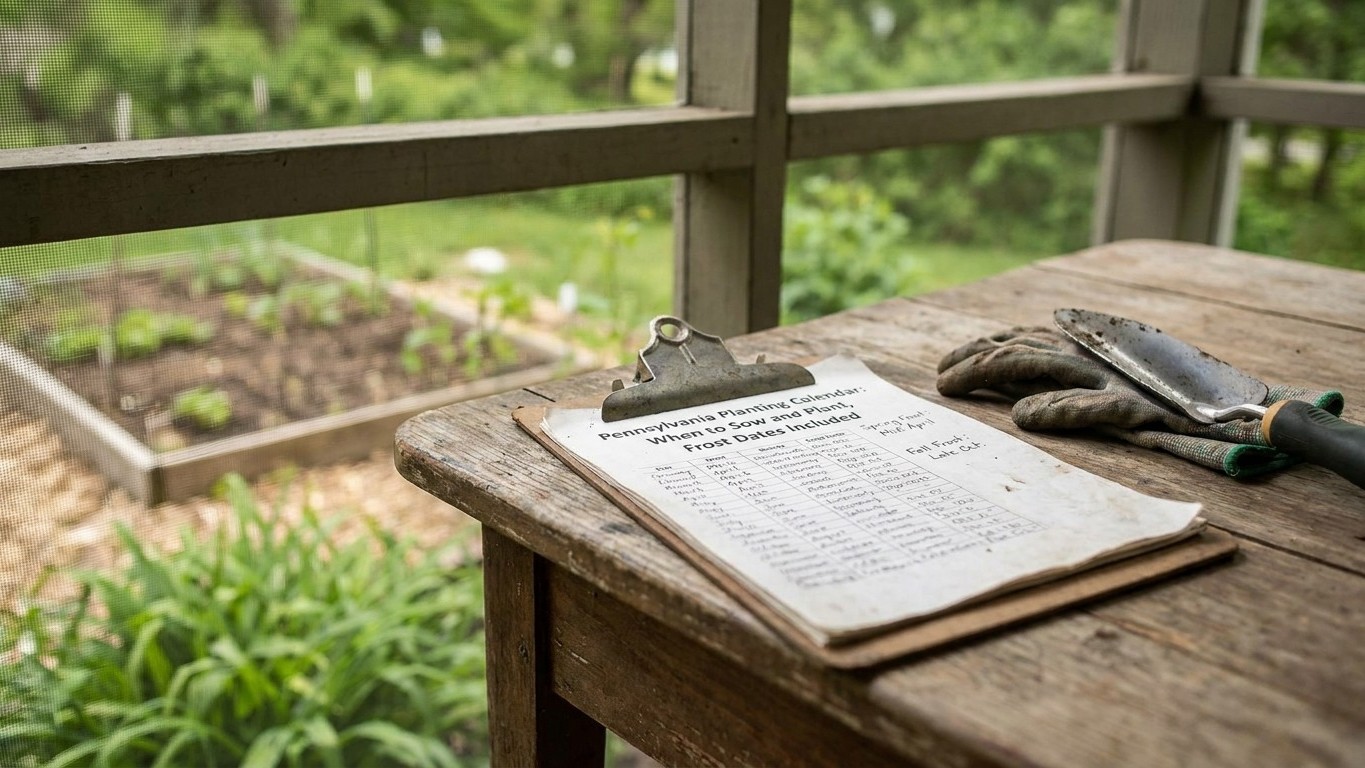

Near Philadelphia, the last spring freeze lands somewhere between March 29 and April 6, and the first fall freeze shows up between November 5 and November 16 — a window that runs two to four weeks earlier than gardeners in the northern tier or up in the Alleghenies ever get. That gap matters more than any statewide average: it’s the difference between a 213-day season and a 232-day one. Everything you plant here, and when, comes out of those two ranges.
The frost window in Pennsylvania

Near Philadelphia, NOAA’s 1991-2020 U.S. Climate Normals put the last spring freeze at 32°F somewhere between March 29 and April 6, the span where a late frost is neither a sure thing nor a rare one. That timing is exactly why What to Plant in Pennsylvania in May is the transitional month before What to Plant in Pennsylvania in June often marks the real start of the warm-season push once that risk has passed. The same data sets the first fall freeze between November 5 and November 16, which makes the weeks beforehand, starting with What to Plant in Pennsylvania in July, then what to plant in Pennsylvania in August, followed by What to Plant in Pennsylvania in September, and continuing through what to plant in Pennsylvania in October, a critical window for getting fall crops established. Everything else on this page works backward or forward from those two ranges.
How the season length adds up
Count forward from the latest likely spring frost, April 6, to the earliest likely fall frost, November 5, and the shortest realistic growing season comes out to about 213 days. Count from the earliest spring frost, March 29, to the latest fall frost, November 16, and a mild year stretches to about 232 days. In practice a Philadelphia-area garden falls somewhere in between: call it roughly 210 to 230 frost-free days depending on the year.
That figure describes one weather station, not the whole state. NOAA is explicit that Philadelphia sits at the mild end of Pennsylvania, and the northern tier and the higher ground of the Alleghenies run two to four weeks later in spring, with fall arriving correspondingly sooner. A garden in Bradford or Somerset County isn’t just starting later in the year, it’s also finishing earlier, which can trim a full month off both ends of the season compared to the Delaware Valley.
Cool-season crops
Peas, spinach, lettuce, and the brassica family (broccoli, cabbage, kale) all germinate in cold soil and shrug off a light frost once they’re up, which is why they go into the ground well before the last spring frost rather than after it. Near Philadelphia, where NOAA’s normals put that date between March 29 and April 6, that means working the soil as soon as it’s dry enough to crumble in your hand, often weeks ahead of the frost-free date rather than on it — a stretch of planning that starts as early as What to Plant in Pennsylvania in January, when indoor seed-starting and cold-frame prep set up the whole early window is exactly why what to plant in Pennsylvania in February matters, and it also connects to — see What to Plant in Pennsylvania in March for the specific crops that fit that early window, and once the frost date itself arrives, What to Plant in Pennsylvania in April for the warm-season crops that follow.
Which crops tolerate the cold and which don’t
Peas and spinach are the two most cold-hardy of the bunch. Both germinate in soil as cool as 40°F and the seedlings hold up under temperatures well below freezing, so they can go in while snow is still a possibility. Lettuce and the brassicas need slightly warmer soil to germinate reliably, but the transplants themselves handle a hard frost once they’ve been hardened off outdoors for a few days. Root crops split the difference: carrots, beets, and radishes germinate slower in cold soil, so rushing them in barely helps, but the mature roots sit through a freeze undamaged.
- Peas and spinach: direct-sow as soon as the ground can be worked, well ahead of the last frost
- Lettuce and brassica transplants: set out once hardened off, still weeks before the last frost
- Carrots, beets, radishes: direct-sow once soil has warmed slightly, still ahead of the frost-free date
- Broccoli and cabbage started indoors: move out once seedlings have true leaves and nights stay above the mid-20s
The northern tier and the Alleghenies, where spring runs two to four weeks behind Philadelphia by NOAA’s data, push all of these dates back correspondingly. A gardener in Erie or Potter County isn’t necessarily working with colder soil in absolute terms, just a slower calendar, and does better watching their own ground thaw than copying a date built around a station in the Delaware Valley.
The real trigger for cool-season planting isn’t the calendar, it’s soil temperature and workability. Wet, cold clay that clumps instead of crumbling will rot pea seed before it germinates, no matter how close the date is to the frost-free window.
Warm-season crops

Tomatoes, peppers, squash, beans, and corn all stop growing, or die outright, at temperatures the cool-season crops shrug off. The frost-free date matters here, but soil temperature matters more: tomato and pepper roots stall below roughly 50°F even when the air never dips to freezing, so setting transplants out right on the frost date often just leaves them sitting still for two weeks. Most gardeners near Philadelphia wait until the soil has warmed and settled past that point, which usually lands in mid-April for tomatoes going out under some protection, and later still for peppers and squash, which want warmer ground.
Tomato varieties and their timing
Days-to-maturity figures on a seed packet are counted from transplant, not from seed, and they shift by a week or two depending on how the season runs. Set a transplant date of mid-April near Philadelphia and the packet figure tells you roughly when the first fruit should color up, with a wide margin before the November frost:
| Variety | Days to maturity | Type | Notable resistance | First ripe (from mid-April set-out) |
|---|---|---|---|---|
| Sakura | 55 days | Indeterminate | Nematodes, ToMV, Fusarium 1&2 | Mid June |
| Edox | 55 days | Indeterminate | Nematodes, ToMV, Fusarium 1&2 | Mid June |
| Valentine | 55 days | Indeterminate | Early Blight | Mid June |
| Glacier | 55 days | Determinate | None listed | Mid June |
| Sun Gold | 57 days | Indeterminate | ToMV, Fusarium 1 | Mid June |
| Juliet | 60 days | Indeterminate | Late Blight, Early Blight | Mid June |
| Supersweet 100 | 60 days | Indeterminate | Verticillium, Fusarium 1 | Mid June |
| Amalfi | 68 days | Determinate | Nematodes, Late Blight, Early Blight | Late June |
| Cherokee Purple | 72 days | Indeterminate | None listed | Early July |
| Big Beef Plus | 72 days | Indeterminate | Nematodes, Gray Leaf Spot, ToMV | Early July |
| Tiren | 75 days | Indeterminate | Verticillium, ToMV, Fusarium 1 | Early July |
| Granadero | 75 days | Indeterminate | Nematodes, Verticillium, ToMV | Early July |
| San Marzano II | 78 days | Indeterminate | None listed | Early July |
| Celebrity Plus | 78 days | Determinate | Nematodes, Gray Leaf Spot, ToMV | Early July |
Even the latest of these, at 78 days, leaves well over a hundred days of margin before the earliest realistic fall frost near Philadelphia, so maturity length is rarely the limiting factor for tomatoes in this climate. Soil temperature and hardening off are the bigger risks.
Work backward from that mid-April set-out date to figure out when to start seed indoors. Tomatoes need six to eight weeks of growing time before they’re ready to transplant, which puts the seed-starting window at roughly mid-February to early March for a mid-April set-out. Peppers grow slower and usually get started a week or two ahead of tomatoes for the same transplant date. Squash, beans, and corn skip the indoor step for most growers, since they resent root disturbance and germinate quickly once soil warms, typically going in two to three weeks after the tomato transplant date rather than alongside it.
The fall planting window
Working backward from the first fall frost is the same arithmetic as counting forward from the last one, just aimed the other direction. Near Philadelphia, NOAA’s normals put that first 32°F freeze between November 5 and November 16. Take a crop’s days-to-maturity figure, add a couple of weeks because growth slows as daylight shortens through September and October, and count back from the earlier end of that frost window to leave a margin for a cold snap.
What that arithmetic looks like
A crop that needs 60 days to mature, with a two-week slowdown allowance, needs roughly 74 days of growing time before frost is likely. Counting back 74 days from November 5 lands around the third week of August as a last realistic sowing date, with earlier being safer given the frost window can run out to November 16 in a mild year or arrive as soon as November 5 in another. A 90-day crop needs a good three weeks more lead time. Count from the earlier end of the frost range, not the later one, unless you’re willing to gamble on a mild fall.
Second plantings of the same cool-season crops that went in during spring work well here: spinach, lettuce, radishes, and quick brassica greens like arugula or mustard all fit a fall slot without needing anywhere close to 90 days. Carrots and beets sown in mid to late summer size up by the time frost arrives and often hold in the ground under mulch past the first freeze.
Several crops actually improve after a light frost rather than being damaged by it. Kale, Brussels sprouts, parsnips, and turnips convert stored starches to sugars when temperatures drop, which is why kale pulled in November often tastes sweeter than the same plant harvested in September. That only holds for a light frost in the low 30s, not the harder freeze that follows once the first fall frost gives way to sustained cold. Harvest tender crops like lettuce and radishes before that point, since they have no starch reserves to convert and just turn to mush.
Reading a planting calendar properly
A state-wide planting calendar built on one weather station is a starting point, not an instruction sheet. The NOAA figures used throughout this page come from a station near Philadelphia, and Philadelphia is the mildest corner of Pennsylvania. Elevation alone can push a frost date around by weeks: gardens in the Alleghenies or the northern tier sit hundreds of feet higher and considerably colder than the Delaware Valley, and NOAA’s own data shows spring arriving two to four weeks later there.
What actually varies within the state
Lake effect near Erie changes the pattern again, moderating fall temperatures longer than inland areas at the same latitude while making spring feel slower to arrive. Cities generate their own heat island, so a rowhouse garden in Philadelphia proper can run a week or two ahead of a rural garden in Chester County only thirty miles out. None of this shows up in a single date range, which is why applying the same exercise to a different state’s topography produces a differently shaped calendar. West Virginia’s planting calendar has to account for a much sharper elevation swing between its river valleys and its high country, and Rhode Island’s planting calendar leans on the moderating effect of being nearly surrounded by water, both pulling their frost windows in different directions than a landlocked, hilly state like Pennsylvania.
A late cold snap after a warm stretch in March is the failure mode that catches gardeners who plant strictly by date. Watch your own soil and your own thermometer instead of the calendar once you’re within a couple of weeks of the frost window. A soil thermometer pushed two inches down costs less than a flat of tomato transplants, and it tells you more than any date range can.
Local help
PSU Extension publishes county-level frost dates, soil testing services, and planting guidance that accounts for exactly the elevation and microclimate differences this page can only describe in general terms. Visit Penn State Extension for your county office, and ask specifically about frost-date data and soil testing rather than relying on a state-wide average. For more on gardening across the state, our Pennsylvania guides cover soil amendments and pest timing specific to the region.
Common questions
Can I just use these frost dates for my county?
Only if you’re near Philadelphia. NOAA’s March 29 to April 6 and November 5 to November 16 windows come from a station in that area, and the northern tier and the Alleghenies run two to four weeks later in spring and correspondingly sooner in fall. Check with PSU Extension for a figure closer to your own county.
I already put my tomatoes out before the last frost. Did I ruin them?
Not necessarily, but watch the forecast closely for the next couple of weeks. A light frost can be outrun with a bedsheet or row cover thrown over the plants overnight, but a hard freeze at or below the mid-20s will kill tomato transplants outright regardless of covering.
What’s the difference between the last frost date and the last freeze date?
They’re often used loosely for the same thing, but a freeze specifically means 32°F, which is the threshold NOAA’s normals are built around. A frost can form on a clear, calm night even when the air temperature reading is a couple degrees above freezing, so tender plants can still get nipped slightly outside the stated window.
Should I start seeds indoors earlier than the calendar suggests to get a jump on the season?
Starting too early usually backfires. Tomato and pepper seedlings held too long indoors get leggy and stressed before the soil is actually warm enough to receive them, and a stressed transplant often does worse than one started on time. Stick to the six-to-eight-week window before your expected set-out date rather than pushing it back further.
Is it too late to plant a fall garden if summer already got away from me?
Possibly, depending on the crop. Fast crops like radishes, spinach, and lettuce can often still be sown into late summer near Philadelphia and mature before the November frost window closes, while anything needing 80 or 90 days is a much tighter gamble. Count back from the earlier end of the fall frost range before committing seed to the ground.
Related guides
- New York Planting Calendar: When to Sow and Plant, Frost Dates Included
- New Jersey Planting Calendar: When to Sow and Plant, Frost Dates Included
- Rhode Island Planting Calendar: When to Sow and Plant, Frost Dates Included