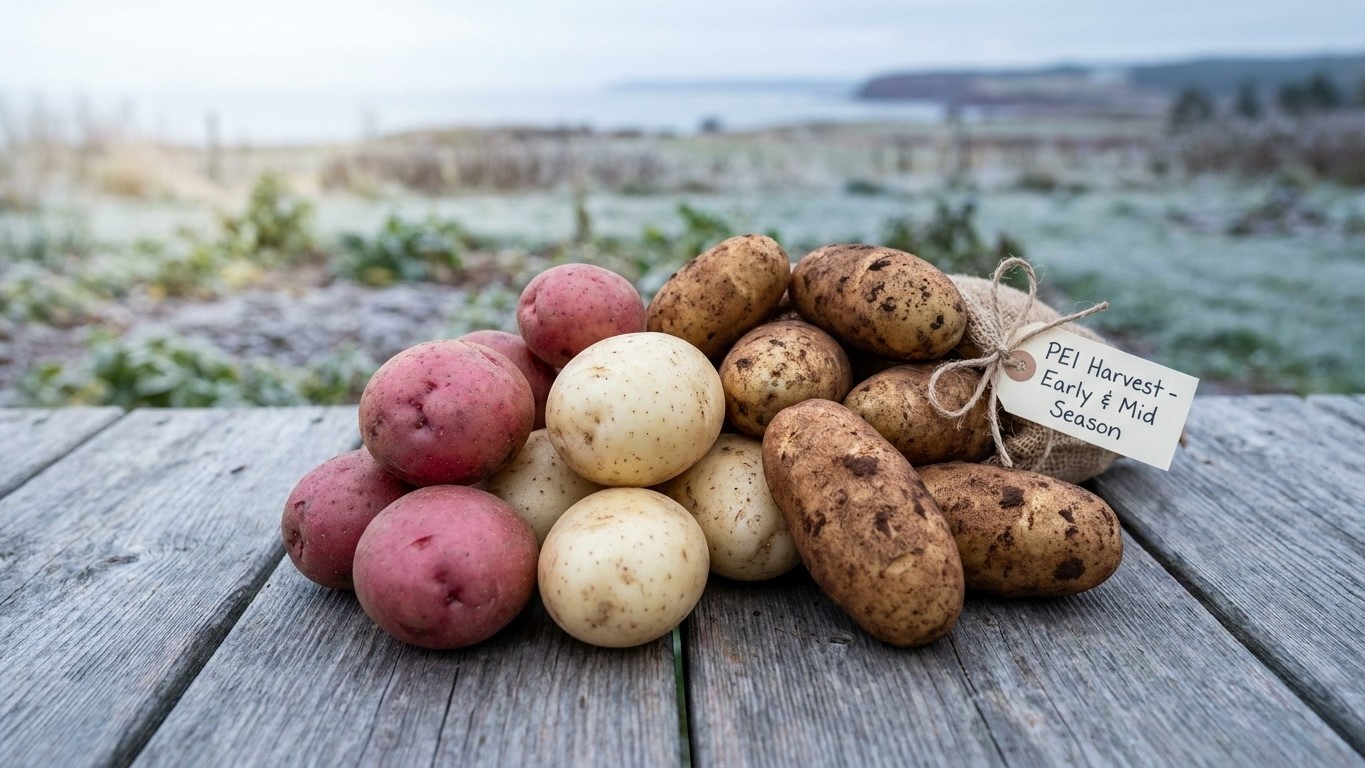

Prince Edward Island’s short, cool maritime season favors early and mid-season potato varieties chosen for boiling or baking use, not long-season types bred for hot inland climates. The reason isn’t tradition, it’s timing: the island’s frost window and its cool summer soils decide which season class of potato actually has time to bulk up before the ground turns cold again.
The short answer
The average last spring frost near Charlottetown lands on May 16, according to Environment and Climate Change Canada’s Canadian Climate Normals for 1981-2010, recorded at station CHARLOTTETOWN A. That single date does more to decide which potatoes belong in a Prince Edward Island garden than any seed catalog description ever will.
Here’s the catch most gardeners miss: a mean frost date is not a safe date. Half of the years on record, frost arrives later than May 16 at that station. So a planting plan built around “mid-May” as a guarantee is really a coin flip. Treat May 16 as the middle of a window, not the edge of one, and build in slack on either side.
Because Charlottetown A is one weather station on one coastline, it doesn’t speak for the whole province. Inland and northern parts of PEI routinely run behind the capital’s readings, sometimes by a couple of weeks. A gardener in Charlottetown and a gardener near Tignish are not gardening on the same calendar, even though they’re both “on the Island.”
Where this points the answer: with a frost date that late and a growing season that stays cool through most of the summer, the varieties that actually finish here are the early and mid-season classes. Utah State University Extension and the University of Maine Cooperative Extension, the two authorities behind the horticultural guidance on this page, both describe potatoes by season class (early, mid-season, late) rather than by a fixed day count, because the same variety finishes at different speeds depending on soil temperature and daylight. Neither source publishes a days-to-maturity number, and neither does this page.
What that means on the ground: pick an early or mid-season potato, intended for boiling or for baking depending on what the fact sheet says it’s suited for, and plant it as soon as the soil itself, not the calendar, says it’s ready.
What actually decides it
Two mechanisms run this whole decision, and they pull in the same direction on Prince Edward Island, which is unusually convenient.
Soil temperature, not the calendar
Potatoes go in the ground once soil temperature reaches 50 F, a threshold that typically arrives 14 to 21 days before the last frost date, per Utah State University Extension’s Potatoes in the Garden fact sheet. That sounds backwards until you remember that seed potatoes tolerate a light frost on emerging foliage far better than they tolerate sitting in cold, wet soil waiting for warmth that hasn’t come yet. A gardener checking a soil thermometer in a raised bed near the coast, where the ground warms faster than a low-lying inland field, may hit 50 F well before someone ten miles inland does, even though both plots share the same “last frost” reference date from Charlottetown A.
Heat ceiling and season length
The other mechanism runs at the opposite end of the season. Tuber set and fill shut down once soil temperature climbs above 90 F, according to both Utah State University Extension and the University of Maine Cooperative Extension’s Bulletin #2077. Watering doesn’t reverse it. Once the soil crosses that line, the plant stops adding size to the tubers underground no matter what happens above ground.
This is the mechanism that should govern a case this page never covers directly. In a province, county, or state where soils regularly cross 90 F in mid-summer, the working answer is to plant early and pull a spring crop before the heat arrives, not to keep watering a late variety through August and hope. Prince Edward Island’s cool maritime summers rarely push soil that high, which is exactly why the island can lean toward mid-season and even some later mid-season varieties that a hotter inland region would have to abandon. Match the variety’s season class against the local count of soil-temperature extremes, not against a generic zone map, and the reasoning transfers to any location.
How to do it
- Check a soil thermometer at planting depth in the specific bed being used, not a regional average, starting roughly three weeks before the local last-frost date.
- Wait until the reading holds at 50 F before cutting or planting seed potatoes; planting into colder soil invites rot rather than an earlier harvest.
- Select certified seed potatoes rather than saved or uncertified stock. Uncertified seed can carry viruses invisibly, and there is no way to inspect a tuber and rule that out. This single choice matters more than any variety name on the label.
- Choose the season class, early or mid-season for most Prince Edward Island gardens, based on the fact sheet’s published guidance rather than a maturity-day estimate no extension source actually provides.
- Match the variety to its published use, boiling or baking, rather than relying on the words “waxy” or “floury,” which don’t appear in the Utah State or University of Maine fact sheets and don’t map cleanly onto how a given variety actually cooks.
- Plant with the frost window in mind, accepting that light foliage frost after emergence is a normal risk this early, not a planting mistake.
- Track soil temperature again in mid-summer. If it approaches 90 F in a particularly warm, exposed bed, that crop is finishing regardless of how the calendar looks, and the harvest should be planned around the soil, not the date.
What goes wrong
- Planting by the calendar instead of the soil. A gardener plants on May 16 because that’s “the frost date,” then loses the crop to a late frost the following week, since frost lands after that mean date about half the time. Remedy: treat May 16 as a midpoint, keep row cover on hand, and let a soil thermometer, not a single date, trigger planting.
- Using saved seed from a previous harvest. Home-saved tubers can carry viruses that show no visible symptoms the first season, then quietly reduce yield the next. Remedy: buy certified seed potatoes each season; it’s the one line item in a potato garden that isn’t optional.
- Assuming a variety is “waxy” or “floury” based on its name. Neither term is used by Utah State University Extension or the University of Maine Cooperative Extension, and leaning on it leads gardeners to guess at cooking behavior instead of checking the variety’s published intended use. Remedy: match the variety to boiling or baking as stated on the fact sheet, not to a texture label picked up secondhand.
- Treating one weather station as the whole province. A planting schedule copied from a Charlottetown-based date and applied unchanged to an inland or northern PEI garden runs weeks off. Remedy: use the station data as a reference point, then adjust locally with a soil thermometer, especially in low-lying or shaded plots that warm slower.
- Chasing a late-season variety because it “yields more.” In a season this short, a late variety may simply run out of warm days before it finishes sizing. Remedy: favor early or mid-season classes here, and reserve later classes for regions where soil temperature data actually supports the longer window.
Common questions
Is May 16 a safe date to plant potatoes on Prince Edward Island?
No. It’s the mean last frost date from Environment and Climate Change Canada’s 1981-2010 normals at the Charlottetown A station, which means frost arrives later than that in roughly half of all years. Use it as a midpoint for planning, not a guarantee, and rely on soil temperature to time the actual planting.
How early can potatoes go in the ground before the last frost?
Once soil temperature reaches 50 F, which typically happens 14 to 21 days before the last frost date according to Utah State University Extension, potatoes can be planted. Foliage that emerges before frost risk has fully passed can handle a light frost; the soil temperature at planting depth is the real limiting factor, not the calendar date.
Why does season class matter more than a specific variety name?
Neither Utah State University Extension nor the University of Maine Cooperative Extension publishes a days-to-maturity figure for potato varieties, so the honest, source-backed way to plan a season is by class, early, mid-season, or late, rather than by a specific day count that would have to be invented.
Does Prince Edward Island ever get hot enough to stop tuber growth?
The mechanism that halts tuber set and fill kicks in once soil exceeds 90 F, per Utah State University Extension and University of Maine Cooperative Extension’s Bulletin #2077. PEI’s maritime summers make sustained soil heat at that level uncommon, which is part of why early and mid-season varieties suit the island well, though a particularly exposed, sandy bed in full sun could still run warmer than a shaded, humus-rich one nearby.