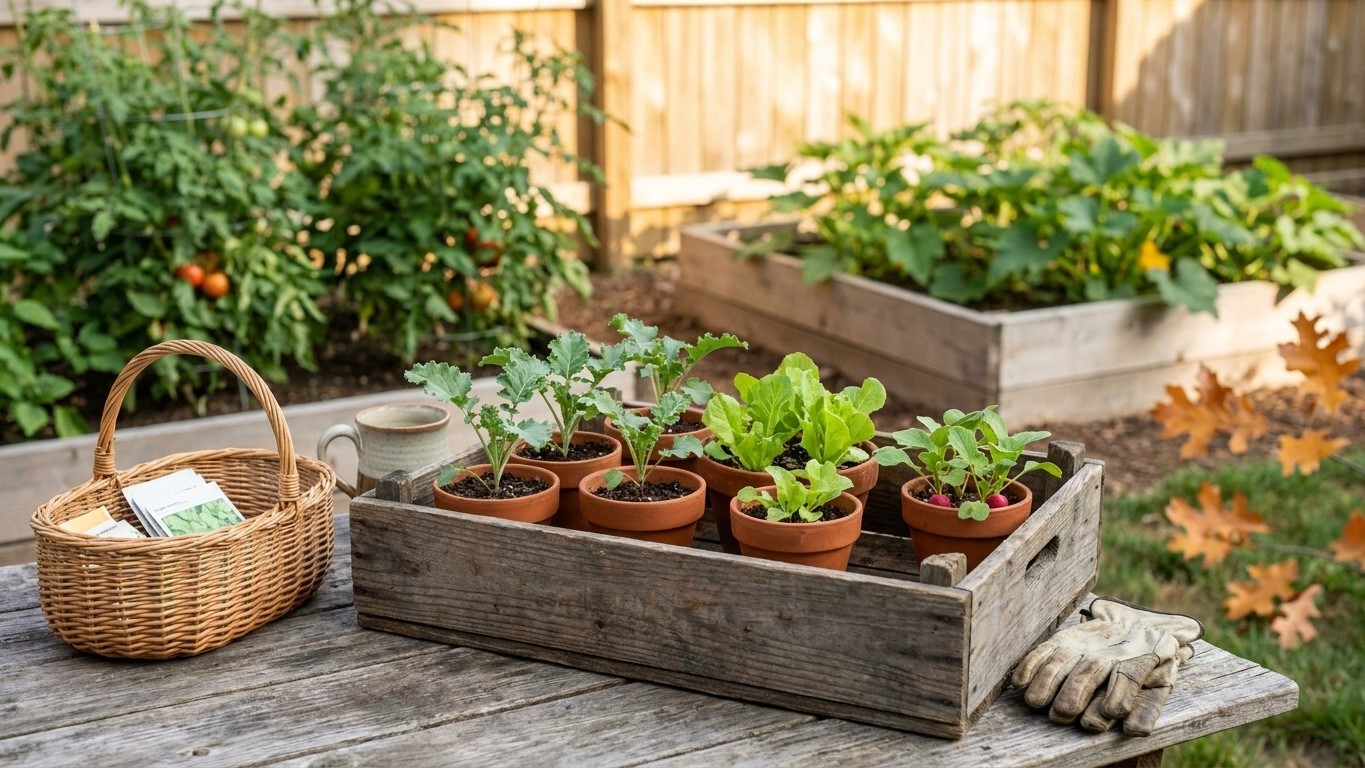

August in South Dakota is the window for fast fall crops, not summer transplants. With the first fall frost landing between September 24 and October 4 at the reference station, you’re working with roughly 50 to 65 days of growing time. That rules out anything slow but leaves plenty of room for radishes, spinach, lettuce, turnips, beets, and a last round of bush beans if you sow in the first week of the month.
What goes in the ground in August

The math that matters this month isn’t the calendar, it’s the days-to-maturity number printed on the seed packet, checked against that September 24 to October 4 frost window. A crop that needs 70 days sown on August 1 is cutting it close even in a mild year; one that needs 90 days is a gamble that will lose more often than it wins. Soil temperature still matters too, but by August it’s rarely the limiting factor in South Dakota, since the ground has been warm for months. The frost clock is what’s closing in.
Radishes are the safest bet of the month. Most varieties mature in 25 to 30 days, which means an early-August sowing can be harvested, and a second sowing after that, before the ground even thinks about freezing. Spinach and loose-leaf lettuce run 30 to 45 days and both tolerate the cool nights that show up later in the month, which actually improves their flavor rather than hurting it. Turnips and quick beets (varieties bred to mature in 45 to 55 days) fit the window with room to spare if planted in the first half of August.
Bush beans are the borderline case. At roughly 50 to 60 days to maturity, a sowing in the first week of August can still produce a harvest before the earliest frost date, but only if the season runs average or later. Anyone gardening in a low spot, a valley, or at higher elevation should treat beans as optional this month, not a sure thing.
What’s a genuine gamble: anything in the squash, melon, or long-season tomato category. These need 70 days or more just to reach harvest, and that’s before accounting for the ripening time squash and winter squash need afterward. Direct-sowing them in August in South Dakota is planting for a loss, not a harvest. Skip them and put that bed space into a second round of greens instead.
What to start under cover
Working backward from the September 24 to October 4 frost window changes what makes sense to start indoors or under a cold frame this month. A crop that takes two weeks to germinate and reach transplant size, plus 40 days to mature after that, needs to go in the ground by early September to have any real shot, which means starting the seedling tray now, in the first half of August.
Kale and collards are strong candidates for this approach. Started indoors or in a shaded cold frame now, they can be set out as transplants in early September and will keep producing well past the first light frosts, since both crops actually sweeten after cold exposure. The same logic applies to Swiss chard, which shrugs off the first frost entirely and can keep the household in greens into fall.
The two failure modes here are worth naming plainly. Start too early in August’s heat and seedlings for cool-season crops like lettuce or spinach can bolt or stress before they’re even transplanted, especially without shade cloth. Start too late, in the last week of August or beyond, and there isn’t enough runway left before that fall frost window closes; the plant reaches transplant size but never reaches harvest size. The safe zone for most fall transplant starts in this state is the first ten days of August, no later.
Garlic and shallots don’t belong in this section yet. Those go in as the ground cools toward fall, not while August soil is still warm, so hold that seed stock rather than planting it early.
What is ready to pick
August is harvest season in South Dakota, and the list is long if crops went in on schedule earlier in the growing year. Tomatoes planted in late spring should be running full production by now, and the difference between a fruit that’s ready and one that needs another few days is mostly about color, not size: wait for full color change through the shoulders, not just the blush that shows first.
Sweet corn, if it was planted on schedule, tells its own story. Silks turn brown and dry, ears feel full when squeezed through the husk, and a quick peel-back check on a few ears (peeling the husk down an inch or two, not stripping it) confirms plump, milky kernels without wasting the whole ear if it’s not quite there yet.
Summer squash and zucchini need daily attention this month, because a fruit that looks small on Monday can be oversized and seedy by Friday. Cucumbers follow the same rule: pick often, because a plant left to hold a few overripe cucumbers will slow down production on the rest of the vine.
Onions signal harvest time by falling over. When the tops yellow and flop, it’s time to pull the bulbs, cure them somewhere dry and airy for a couple of weeks, and get them off the wet ground before rot sets in. Potatoes planted early can be dug now for fresh eating, though the main storage crop usually waits until the tops die back later in the season.
The jobs that matter this month

August rewards the gardener who keeps up with watering rhythm more than any other single task. Deep, infrequent watering, roughly one to two inches a week delivered in one or two sessions rather than a daily sprinkle, keeps root systems strong through the hottest stretch of the year and reduces the blossom-end rot and cracking that shallow watering causes in tomatoes and peppers.
Mulching pays off directly this month by holding that moisture in and by keeping soil temperature down around root zones during the hottest weeks. A two- to three-inch layer of straw or shredded leaves around vegetables cuts water loss and knocks back the weeds that compete for it.
Succession sowing is the job that’s easy to let slide and costly to skip. Every week without a new round of radishes, lettuce, or spinach going in is a week of harvest lost later in September, since the frost window doesn’t wait for a gardener who got behind. Setting a recurring reminder, even a simple one, to sow a short row every 10 to 14 days through mid-August keeps the fall harvest steady instead of all-at-once-then-nothing.
Staking and support work should be finished, not started, by now for anything that’s already sprawling, but it’s worth a walk-through this month to catch tomato branches and pole bean vines that have outgrown their ties and are starting to snap under their own weight.
Pest scouting matters more in August than earlier in the season because populations of squash bugs, cucumber beetles, and aphids peak now, after a full season of reproducing. A five-minute walk through the garden every few days, checking undersides of leaves, catches an infestation while it’s still a hand-picking problem instead of a spray-the-whole-bed problem.
What not to do in August
The classic August mistake in South Dakota is treating warm air as permission to plant warm-season crops that have no chance of maturing. A hot, sunny stretch in mid-August can feel like early summer, but a melon or winter squash seed planted then is racing a September 24 to October 4 frost line it cannot beat. If the days-to-maturity number on the packet doesn’t fit inside that window, the answer is a fall green instead, not a warm-season crop planted on optimism.
Overwatering shallow and often is the second trap. It feels responsible during a hot spell, but frequent light watering trains roots to stay near the surface, where they dry out fast and where blossom-end rot and split fruit become more common. Deep and less frequent is the fix, not more water overall.
Feeding nitrogen late is a mistake that shows up as a problem in September, not August. A high-nitrogen fertilizer applied to tomatoes, peppers, or squash this month pushes leafy growth right when the plant should be shifting energy into ripening fruit, and it can delay maturity right into the frost window. If feeding is needed this late, a lower-nitrogen, higher-potassium formula supports fruit finishing without triggering another flush of leaves.
Letting harvested beds sit empty is the quieter mistake. Every bed cleared of spent bush beans or bolted lettuce in early August is a bed that could carry one more round of radishes or spinach before frost, and leaving it bare all month is wasted growing time in a state where the season is already short.
Checking this against your own county
The frost dates and hardiness range here describe conditions at one reference station, not the whole state. South Dakota’s elevation changes, the moderating effect near larger lakes, and the real difference between its northern counties and its southern tier can shift both the last spring frost and the first fall frost by a week or two in either direction, sometimes more at higher elevation. Treat the August 1 to frost-window math in this article as a starting point to adjust, not a fixed instruction for every yard in the state.
For local planting calendars, soil test recommendations, and frost data specific to a county, South Dakota State University Extension is the direct source to check before locking in a fall planting schedule.
Common questions
Can tomatoes still be planted in South Dakota in August?
Transplanting tomatoes in August is not realistic in South Dakota. Even fast varieties need 55 to 65 days after transplant to fruit, and stacked against a first fall frost between September 24 and October 4, there isn’t enough runway left. Existing tomato plants should instead get attention now for ripening the fruit already set.
Is it too late to plant a vegetable garden in August in South Dakota?
No, but it narrows the choices to fast-maturing crops. Radishes, spinach, loose-leaf lettuce, turnips, and quick beets all fit inside the days remaining before the fall frost window, especially if sown in the first half of the month.
What USDA hardiness zone is South Dakota in?
South Dakota spans USDA Plant Hardiness Zones 3b through 5b, based on the 2023 USDA Plant Hardiness Zone Map using 1991-2020 averages. That’s a wide range across the state, so a zone number alone doesn’t replace checking local frost dates.
When does the first fall frost typically hit South Dakota?
At the reference weather station used for this article, the first fall frost typically falls between September 24 and October 4, based on NOAA NCEI 1991-2020 Climate Normals. Rural and elevated gardens often see frost arrive earlier than this by a week or two, so it’s worth checking local data through SDSU Extension.
Gardeners who plant by the Moon can check the August 2027 moon planting calendar, a tradition rather than a proven method.