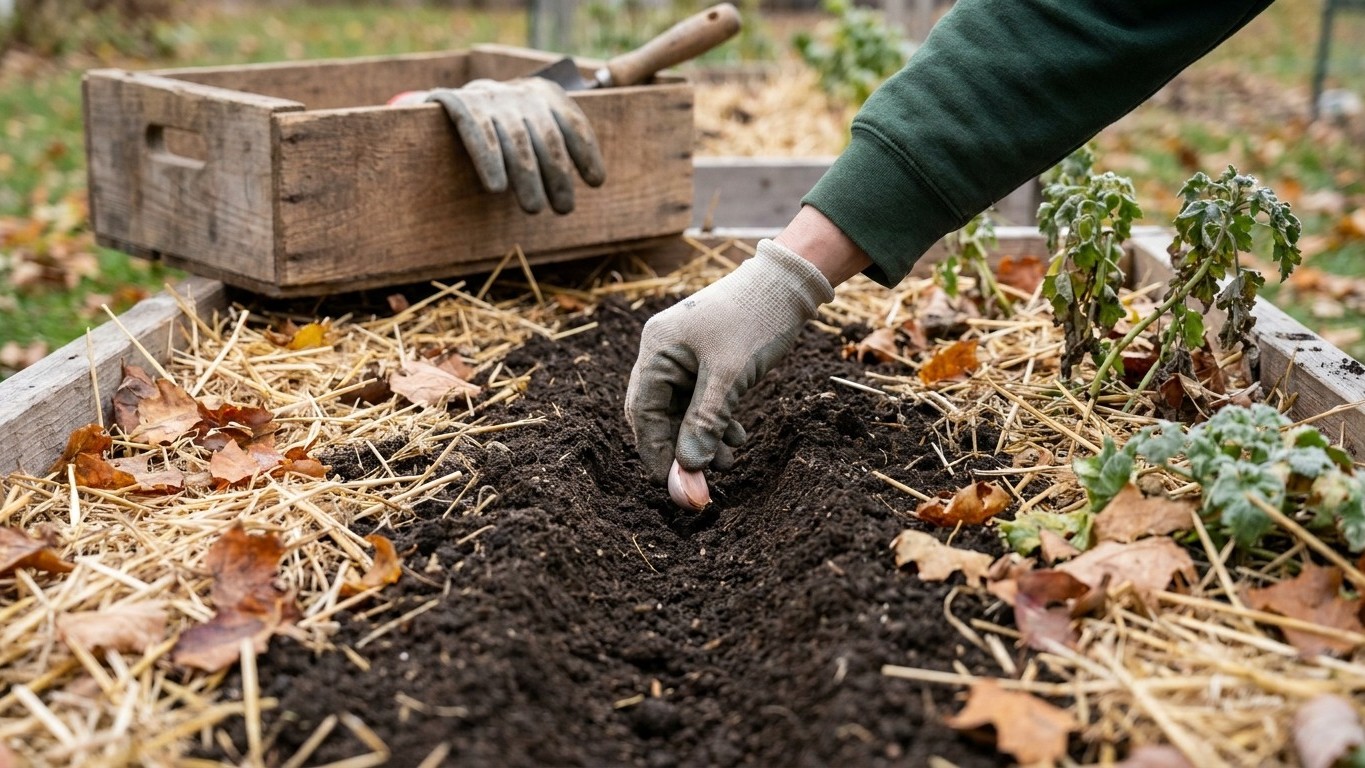

Utah’s growing season is effectively closed by November across most of the state: the first fall frost has typically already landed weeks earlier. What still goes into the ground now is a short list, mostly garlic and shallots, plus bare-root and dormant plantings. The bigger work this month happens indoors, in cold frames, and on paper as next season’s plan.
What goes in the ground in November

The calendar says November, but the soil doesn’t care about the calendar. What decides whether anything can still go into the ground is soil temperature and where a given spot sits relative to the first fall frost window, which runs October 18 to October 29 for the Salt Lake valley station tracked by NOAA (1991-2020 Climate Normals). By the time November opens, that window has usually already closed in the valley, and it closed earlier still at higher elevation.
That timing matters more than usual in Utah because the state’s USDA hardiness zones span 4a to 9a. A 4a mountain valley near Bear Lake or Park City is likely sitting under frozen or nearly frozen ground by now. A 9a pocket around St. George is a different story entirely, with soil that may stay workable for weeks longer. Treat any single date as a description of Salt Lake, not the whole state.
What’s actually safe to plant
Garlic and shallot cloves are the one true “still planting” crop, and only where the ground hasn’t locked up. Push cloves in before hard freeze so roots get a head start before dormancy. Bare-root fruit trees, roses, and deciduous shrubs can go in while fully dormant, since they’re not trying to grow, just settling roots. Cold frames and low tunnels let hardy greens already established, spinach, kale, arugula, keep producing, but that’s protection of existing plants, not new planting. Digging and forcing rhubarb or chicory roots indoors is a legitimate November project too.
| Region type | Typical USDA zone | November ground |
|---|---|---|
| High mountain valley | 4a-5b | Likely frozen or freezing; garlic window already closing |
| Salt Lake valley and similar | 6a-7a | Past first frost; ground workable for a short remaining stretch |
| Southern desert (St. George area) | 8a-9a | Still workable for garlic, shallots, and dormant transplants |
What to start under cover
Once the first fall frost has passed, counting forward stops being useful. What matters now is counting backward from the next frost event, the last spring frost window of April 12 to April 29 for the Salt Lake area, per the same NOAA NCEI record. Most transplants gardeners eventually move outside, tomatoes, peppers, onions, get started 6 to 12 weeks ahead of that window. Count back 8 weeks from April 12 and you land in mid-February. Count back 12 weeks from April 29 and you’re still in early February. November sits roughly three months ahead of that start line, which is too early for nearly all of it.
Two failure modes bracket this. Start too early, and seedlings sit rootbound in small pots for months, weakened long before they ever reach a garden bed. Start too late, and the frost window arrives before plants are hardened off and ready. Neither is a good trade.
What legitimately makes sense under cover this month isn’t tied to that spring frost math at all. Forcing bulbs, paperwhites, amaryllis, potted for indoor bloom, runs on its own clock. Hardy greens and microgreens sown in a heated cold frame or under grow lights don’t wait on a transplant date either; they’re grown for a continuous winter harvest, not a spring outdoor move. Save the tomato and pepper seed packets for later.
What is ready to pick
Once frost has settled in, especially at elevation, there’s honestly little coming out of open garden beds. That’s the plain answer. But it isn’t nothing. Kale, collards, and heavily mulched leeks can still be dug out from under snow in the milder valleys, and their flavor usually improves after a freeze. Brussels sprouts are one of the few crops that genuinely get sweeter once cold has hit them.
Cold frames extend the list: lettuce, spinach, and arugula tucked under glass or plastic can still be cut through much of the month. Indoors, sprouts and microgreens on a kitchen counter fill the gap when nothing outside is producing.
Storage is the other harvest this month, in the sense that it needs checking, not picking. Go through bins of squash, potatoes, and onions on a regular basis. A soft spot, a sprout, or a sour smell on one squash means pulling it now, before the rot spreads to everything touching it in the bin.
The jobs that matter this month

Dormant pruning of fruit trees and cane berries belongs here, once leaves have dropped and the wood is fully asleep. Cuts made in cold weather on dormant wood heal cleanly, without inviting the disease pressure that pruning during active growth can bring. This is also the window for ordering seed. Catalogs move fast over winter, and the specific variety a gardener actually wants can sell out well before spring; ordering now locks it in.
Planning next season’s rotation is easier while last season is still fresh in memory. Mapping which bed grew what, and deciding what follows it, heads off the disease buildup that comes from planting the same family in the same soil year after year. Testing soil now, and adding amendments based on the results, gives lime or organic matter months to work into the ground rather than being rushed in right before planting.
Compost piles slow down in cold weather but don’t need to stall completely. Turning the pile once before a hard freeze locks in keeps it from becoming a solid frozen mass that won’t budge until spring. Tools deserve the same attention: cleaning soil off blades and sharpening edges before they go into winter storage prevents the rust that sets in over damp months in an unheated shed. Beds and fencing are also easier to repair now, while the ground still gives, than in the middle of a frozen January.
What not to do in November
A stretch of warm afternoons is the classic trap. Air temperature can feel like spring while soil temperature is still lagging weeks behind, and any warm-season seed or transplant put into that cold soil now typically just rots rather than grows. The mistake isn’t the plant, it’s trusting the air over the ground.
Uncovering a cold frame or pulling back mulch after a mild spell is the same trap in reverse. Plants that hardened off under cover get exposed right before the next hard freeze arrives, and that freeze does more damage than it would have if the cover had simply stayed put.
Feeding nitrogen this late pushes soft new growth at exactly the wrong moment. That new tissue is the first thing to die in a hard freeze, and the plant wastes stored energy producing growth it can’t protect. Let plants finish shutting down on their own instead. Overwatering before a hard freeze locks in causes a similar problem: trapped moisture around roots and crowns freezes, expands, and cracks plant cells from the inside. Letting soil dry down before a freeze is safer than keeping it saturated. And storage bins deserve a regular check, since one rotting potato left in place will take its neighbors down with it.
Checking this against your own county
A state-wide month is a starting point, not an instruction. Utah’s hardiness zones run from 4a to 9a, and elevation, along with the difference between the northern mountains and the southern desert, shifts frost windows by weeks in either direction from the Salt Lake figures cited here. A high mountain county may already be frozen solid while St. George still has weeks of workable ground left. For a county-level planting calendar, Utah State University Extension is the reliable next stop.
Common questions
Can I still plant garlic in Utah in November?
In much of the state, yes, as long as the ground hasn’t frozen solid. Push cloves in as early in the month as possible; the closer to a hard freeze, the less time roots have to establish before dormancy.
What USDA hardiness zone is Utah?
Utah spans USDA zones 4a to 9a, a wide range driven mostly by elevation. A mountain valley and a southern desert town can differ by several zones even though they’re in the same state.
Is it too late to plant bulbs in November in Utah?
For spring-flowering bulbs planted outdoors, timing depends on whether the ground is still workable; where it is, bulbs can still go in. Indoor forcing bulbs like paperwhites and amaryllis run on their own schedule and aren’t tied to outdoor soil conditions at all.
What vegetables survive winter in Utah gardens?
Kale, collards, and leeks under heavy mulch can survive and still be harvested through much of the winter in milder valleys, and cold-frame lettuce, spinach, and arugula extend that further. Brussels sprouts, left in place, typically taste better after a frost than before it.
Gardeners who plant by the Moon can check the November 2026 moon planting calendar, a tradition rather than a proven method.
Related guides
Elsewhere? See what to plant in November in every state and province.