
December in Vermont means nothing goes into open ground. Soil is frozen solid from the Champlain Valley to the Northeast Kingdom, and snow cover locks in whatever is left of the season. What’s left to do lives under cover, in storage, or in the planning that sets up spring: dormant pruning, seed orders, cold-frame greens, and checking on what’s already tucked away.
What goes in the ground in December
The decision this month isn’t about frost risk anymore. Vermont’s first fall frost lands between October 3 and October 13 in the mildest parts of the state, the Champlain Valley near Burlington, and by December the ground itself has frozen well past that threshold almost everywhere. Frozen soil, not a frost date, is what closes the door. You can’t dig a planting hole in ground that behaves like concrete, and root systems set into partially frozen soil don’t establish, they just sit there and die back with the first hard cold snap.
So say it plainly: for the vast majority of Vermont gardeners, nothing goes into open, unprotected garden soil this month. That’s not a gap in the calendar, it’s just where the season sits.
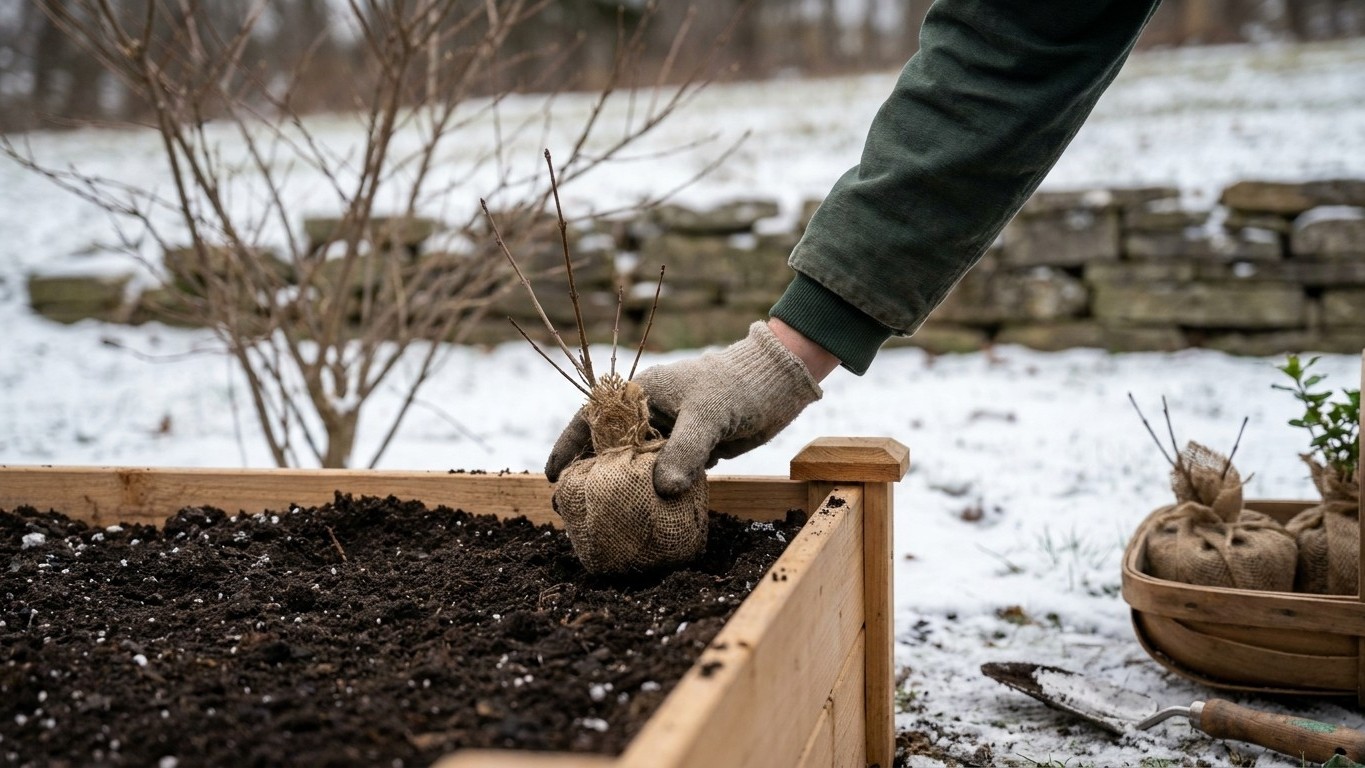
What’s still genuinely possible falls into a few categories. If you’re in a warm microclimate near Lake Champlain and the ground hasn’t fully locked up, a very late planting of garlic or shallots can still go in, though this is a last-ditch move rather than the recommended timing, which really belongs in October. Cold frames and low tunnels are where the real action is: greens already growing under cover keep producing slowly through the cold, protected from the worst of the wind and snow load. Bare-root fruit trees and shrubs, if you have them on hand and the ground is workable, can be heeled into a trench of loose mulch or compost until a proper planting window opens in spring, rather than left exposed.
Indoors, this is prime territory for forcing. Rhubarb crowns dug and brought into a dark, cool basement will push tender, sweet stalks weeks ahead of anything outdoors. Chicory roots, forced the same way, produce Belgian endive. Neither needs light, both need patience, and both give you something to harvest while the garden itself is dormant.
What to start under cover
Working backward from Vermont’s last spring frost, which falls between April 30 and May 10 in the Burlington area and later at higher elevations, most seed-starting math doesn’t point to December at all. Onions and leeks, which need the longest lead time at 10 to 12 weeks before transplanting, still land in late February or March. Peppers and tomatoes, needing 6 to 10 weeks, come later still. Starting any of these in December means weeks of extra time indoors under weak winter light, and that’s exactly the failure mode to avoid: seedlings that outgrow their pots, get leggy reaching for light, and stall out rootbound long before the ground is ready to receive them.
What does make sense under cover this month is smaller-scale and faster-cycling. Microgreens and sprouts run on a schedule measured in days, not weeks, so they’re not tied to the outdoor frost calendar at all. A tray sown this week is ready to eat in seven to fourteen days, and you can keep that going continuously through the winter on a sunny windowsill or under a basic grow light.
Cold frames offer a second option. Hardy greens like spinach and mâche can be sown directly into a cold frame now, where they’ll germinate slowly and sit through the coldest stretch, then take off with the first lengthening days, giving you a harvest well before anything started from scratch in spring. The other failure mode worth naming is starting too late: if you wait until the seed catalogs arrive in February to think about onions, you’ll miss the window entirely and end up transplanting undersized plants that never catch up.
What is ready to pick
Outdoors, the honest answer is close to nothing. Snow cover and frozen ground have shut down active growth across the state, and anything still standing in an open bed is either done for the season or waiting under insulation.
Kale and leeks are the exceptions worth knowing. Both tolerate hard freezes, and if they were mulched heavily before the ground locked up, they can often still be dug or cut from under snow cover, the cold having sweetened rather than ruined them. It’s slow, cold work pulling back snow and frozen mulch, but the payoff is real greens in the depth of winter.
Cold frames extend this further. Greens growing under glass or poly cover, spinach, arugula, mâche, keep producing at a crawl, and a sunny afternoon can be enough to harvest a handful even when the air outside the frame is well below freezing.
Indoors, sprouts and microgreens are the most reliable harvest of the month, ready on their own short cycle regardless of what’s happening outside. Beyond fresh picking, this is also the point in the season to walk through storage. Squash should be firm with no soft spots or mold at the stem. Potatoes need checking for sprouting eyes or soft, wet rot, both of which spread fast if one bad potato sits touching its neighbors. Onions and shallots should feel firm and papery, not spongy. Pulling the failing ones now saves the rest of the batch.
The jobs that matter this month
Winter doesn’t pause the garden, it just changes what the work looks like. Dormant pruning is at the top of the list: apple and pear trees, along with brambles like raspberries, are pruned while they’re fully dormant and the structure of the plant is easy to see without leaves in the way. The catch is timing within the month. Pruning cuts made during extreme cold, well below freezing, can leave wood more vulnerable to dieback at the cut site, so aim for a milder stretch within the season rather than the coldest day available.
Seed ordering belongs here too, and it’s easy to underrate. Popular varieties, especially open-pollinated and heirloom types, sell out from seed companies well before spring planting season arrives. Ordering now means having what you actually want on hand rather than settling for whatever’s left in March.
This is also the natural point to plan next season’s rotation. Walking the garden mentally, or on paper, and mapping which beds held tomatoes, brassicas, or legumes keeps disease pressure down and soil fertility more even. Pair that with a soil test, sent to a lab or run with a home kit, so any amendments you add over winter have time to work into the soil before spring planting.
Compost turns slower in the cold, but it doesn’t stop; giving the pile a turn on a mild day keeps it from going anaerobic under a snow crust. Tools benefit from the downtime too: cleaning off dried soil, sharpening blades, and oiling wood handles now means less scrambling later. Beds, trellises, and fencing damaged by fall storms or freeze-thaw heaving are far easier to repair in December’s calm than in the rush of April.
What not to do in December
The most common misstep this month is trusting a mild afternoon over the calendar. A 45-degree day in the middle of a Vermont December feels like an invitation, but the soil several inches down is still frozen, and anything transplanted or seeded into it won’t establish before the next hard freeze arrives. Air temperature is not soil temperature, and that gap matters more in winter than any other time of year.
Uncovering mulched beds or cold frames too eagerly after a warm spell is a close second. Perennials and overwintering crops that get exposed to a sudden burst of mild air, then get slammed by the next cold snap without their insulation back in place, take a harder hit than if they’d been left covered the whole time. Once mulch is down for winter, it stays down until growth actually resumes in spring, not until the weather feels nice for a day.
Fertilizing is the third trap. Nitrogen applied to dormant plants doesn’t feed active growth, it just sits in the soil or leaches away with snowmelt, doing nothing for the plant and potentially running off into groundwater. Feeding schedules belong in the growing season, not the dormant one.
Finally, walking across frozen or snow-covered garden beds and lawns compacts the soil structure underneath, work that then has to be undone with a broadfork or tiller in spring. Stick to paths and leave the beds alone until they thaw.
Checking this against your own county
Everything above is built around Vermont as a whole, and that’s a starting point, not a set of instructions for your specific garden. Elevation changes frost timing by weeks, not days: a hillside farm in the Green Mountains or a valley in the Northeast Kingdom runs a noticeably shorter season than the Lake Champlain shoreline near Burlington, where the water moderates temperature swings on both ends of the year. The state’s USDA hardiness zones span 3b to 5b, a wide range that reflects just how differently winter behaves depending on where you’re standing.
For local frost data and planting guidance tuned to your county, the University of Vermont Extension is the reliable next stop.
Common questions
Can I still plant garlic in December in Vermont?
Only if the ground hasn’t fully frozen yet, and that’s uncommon outside the mildest microclimates near Lake Champlain. Garlic planted in October has time to root before winter; a December planting is a gamble with much lower odds of success.
Is it too late to start seeds indoors in December?
For most vegetables, yes, it’s actually too early, not too late. Working back from a last frost of April 30 to May 10, tomatoes, peppers, and onions started in December will be leggy and rootbound long before it’s safe to transplant them outside.
What can I harvest from my Vermont garden in December?
Kale and leeks mulched heavily before freeze-up can often still be dug from under snow. Cold-frame greens keep producing slowly, and indoor sprouts or microgreens are ready on their own short cycle regardless of the weather outside.
Should I prune fruit trees in December?
Yes, dormant pruning of apples, pears, and brambles is appropriate this month, but avoid making cuts during the coldest stretches of extreme cold, since wood pruned in deep freeze conditions is more prone to dieback at the cut.