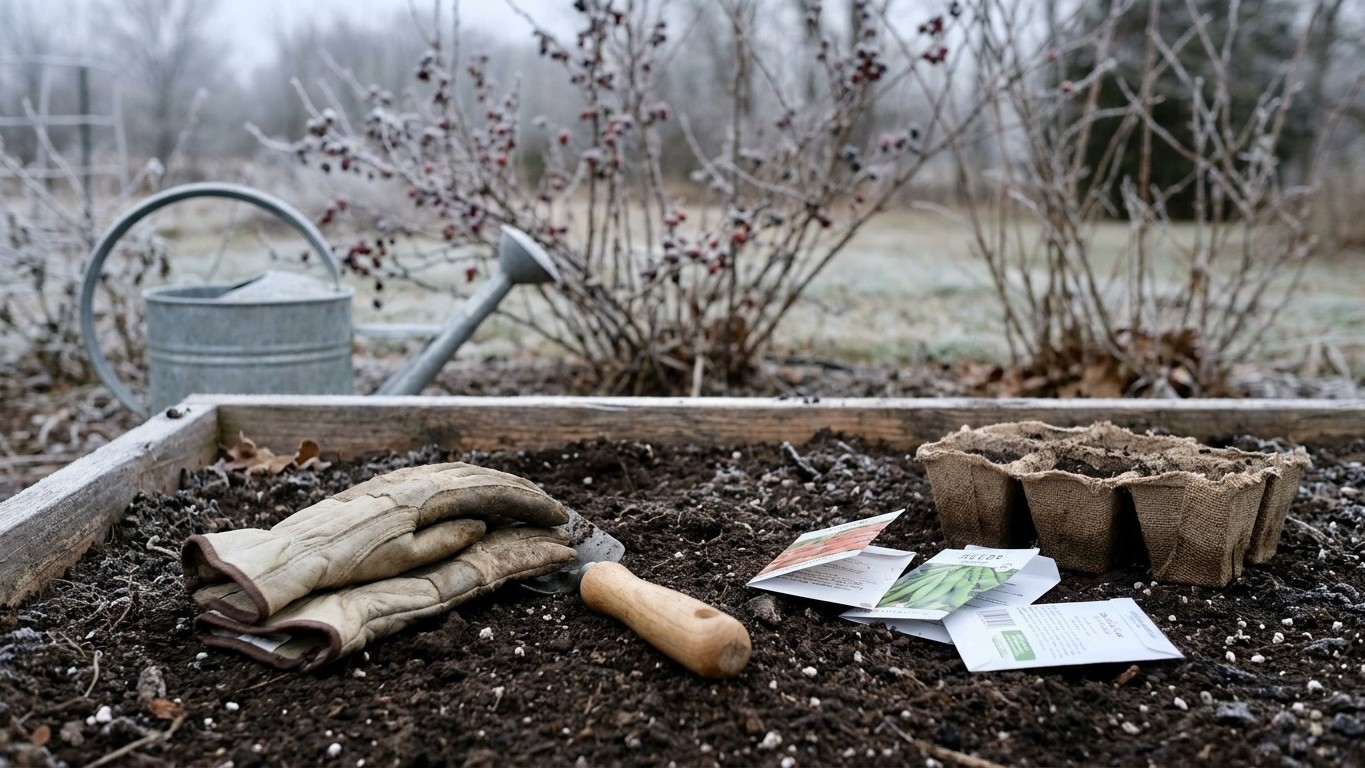

Across Vermont, February ground is frozen solid and usually buried under snow, so nothing goes into the open garden this month. The real work happens indoors and under cover: starting onions, leeks and celery under lights, forcing rhubarb or chicory in a dark basement, pruning dormant fruit trees, and ordering seed before the popular varieties sell out. Outdoor planting is still ten or more weeks away, even in the mildest river valleys.
What goes in the ground in February
Nothing goes into open ground anywhere in Vermont this month, and that’s not a hedge, it’s the honest state of things. Even in Burlington, the warmest pocket of the state thanks to the moderating effect of Lake Champlain, the last spring frost typically falls between April 30 and May 10, based on NOAA NCEI’s 1991-2020 climate normals for that station. February sits roughly ten to twelve weeks before that window opens. In the Green Mountains and the Northeast Kingdom, the ground stays locked up even longer. Soil temperature, not the calendar, decides when a seed or root can go in, and right now that soil is either frozen through or blanketed in snow.
That doesn’t mean the garden is idle. A few things are still possible outside the vegetable bed itself. If a cold frame or low tunnel was set up in fall, it may be sheltering hardy greens like spinach, mache or claytonia that survived under cover, and those beds can be checked and vented on milder days. Bare-root fruit trees and shrubs are sometimes shipped this month by mail-order nurseries, but they need to go into pots or a protected trench, not frozen ground, until the soil thaws. Garlic and shallots, which normally go into the ground in fall, are not a February task in Vermont; if they’re already in the ground from autumn, they’re simply overwintering under mulch and need no attention beyond checking that mulch hasn’t blown away.
Where February earns its keep is indoors. Rhubarb crowns lifted from the garden and brought into a dark, cool basement can be forced for an early crop of pale, tender stalks weeks before the outdoor plants wake up. Belgian endive (chicory) roots dug in fall can be forced the same way, buried in sand or soil in a dark spot, for a harvest of tight, blanched heads. These are the closest things to “planting” that make sense in a Vermont February, and they reward gardeners who thought ahead in October.
What to start under cover
Seed starting this month is about counting backward from the frost window, not forward from a date on a calendar. Using Burlington’s April 30 to May 10 last-frost range as the reference point, a gardener aiming for transplants ready by early May needs to know how many weeks each crop needs indoors before it’s sturdy enough to go out. Onions and leeks are the classic February crops because they want ten to twelve weeks of indoor growth before transplanting, and they tolerate being started a little early without much harm. Celery and celeriac run on a similar clock. Peppers, which need eight to ten weeks and hate any check to their growth, can also go in toward the back half of the month.
| Crop | Typical weeks needed indoors before transplant | Start relative to Burlington’s last frost window |
|---|---|---|
| Onions (from seed) | 10-12 weeks | Now, if aiming for early May transplant |
| Leeks | 10-12 weeks | Now |
| Celery / celeriac | 10-12 weeks | Now |
| Peppers | 8-10 weeks | Later in the month |
The two ways to get this wrong sit at opposite ends of the calendar. Start too early, before the plant has anywhere to go, and by the time frost risk clears in May the seedlings are rootbound, leggy and stressed, struggling to recover once transplanted. Start too late, and short-season Vermont summers won’t give slow crops like celeriac or leeks enough time to size up before the first fall frost arrives, which NOAA NCEI data puts between October 3 and October 13 for the Burlington station. Gardeners further from Lake Champlain, at higher elevation or further north, should treat both ends of that window as arriving later in spring and earlier in fall, which shortens the whole season and argues for starting seed on the earlier side of any range, not the later one.
What is ready to pick
Outdoors, there’s little to nothing coming out of a Vermont garden this month, and no amount of hopeful phrasing changes that. Anything left in open ground has likely been frozen since December. But a few sources of fresh food are still active. Kale, and sometimes leeks, planted in a spot with good snow cover can survive the winter and be dug out on a mild day, snow shoveled aside, the plants surprisingly intact underneath since snow acts as insulation rather than as cold. A cold frame stocked with hardy greens in fall may still be yielding small harvests of spinach or mache on any day the frame can be opened without letting too much heat escape.
Indoors, sprouts and microgreens are the most reliable fresh crop of the month, ready in a matter of days from a jar or a shallow tray on a windowsill, no soil warm-up required. This is also the month to go through the root cellar or pantry with a critical eye. Stored winter squash should be checked for any soft spots or a sweetish smell, both signs it’s starting to break down and should be used first. Potatoes that have started sprouting eyes are still edible once the sprouts are removed, but they’re declining and shouldn’t be left much longer. Onions gone soft at the neck, or showing mold at the root end, are best pulled from storage and either used immediately or composted before they spread rot to their neighbors.
The jobs that matter this month
February carries more weight than its bare garden beds suggest, and skipping these jobs costs real time come spring. Dormant pruning of apple and pear trees is a top priority, done while the trees are fully leafless and the structure of the branches is easy to see; cuts made now, before sap starts moving, heal faster and reduce the risk of disease that comes with pruning once growth resumes. Bramble canes (raspberries, blackberries) also take well to a February pruning, removing spent floricanes and thinning crowded stands before new growth crowds the job out.
Seed ordering belongs on this month’s list too, and it’s easy to underestimate how quickly popular varieties, especially disease-resistant tomatoes and regionally adapted corn, sell out from small seed companies. Ordering now avoids the scramble of settling for whatever’s left in March. This is also a good stretch for planning next season’s crop rotation on paper, tracking which beds grew tomatoes, brassicas or alliums so the same family doesn’t return to the same soil and build up pests or disease.
Soil testing can happen any month the ground isn’t actively frozen at the surface, and results take a few weeks to come back, so sending samples now means amendments can be worked in as soon as the ground opens rather than waiting on lab results in April. Compost piles benefit from a turn if they’re not frozen solid, mixing oxygen back into material that’s been sitting since fall. Tools deserve attention too: pruners, loppers and hoes sharpened and oiled now are ready to go the first mild day, instead of sitting rusted in a shed while the gardener searches for a whetstone. Fences, raised bed frames and cold frame glazing damaged by winter weight or wind are also easier to repair now, before spring planting competes for the same hours.
What not to do in February
The most common mistake this month is reading a stretch of 40-degree days as a signal to start planting cold-hardy crops outdoors. Air temperature swings fast in Vermont; soil temperature, which is what actually determines germination and root health, lags weeks behind. A warm spell in February doesn’t thaw six inches of frozen ground, and seeds sown into it will simply sit and rot rather than sprout.
A related error is pulling mulch off garlic beds or perennial crowns too early after a mild stretch, only to have a hard freeze return and hit newly exposed, de-hardened tissue. Mulch protects by keeping soil temperature steady, not by keeping it warm, and removing it early defeats that purpose. It’s better to leave protective mulch in place until there’s real evidence of consistent thaw, not just a few comfortable afternoons.
Fertilizing is another place timing matters more than good intentions. Applying nitrogen to dormant fruit trees, perennials or lawns this month does the plant no good since it isn’t actively growing and can’t use the nutrients; the fertilizer either leaches away with snowmelt or sits until growth resumes, at which point a fresh, better-timed application would have done the same job with less waste. Finally, walking or working on garden beds while the soil is wet from melting snow compacts it, squeezing out the air pockets roots need later; if a bed is soggy underfoot, it’s better to wait than to step in it.
Checking this against your own county
Everything above is built around Burlington’s climate data, the mildest reference point in Vermont, and it should be treated as a starting line, not a fixed instruction. Elevation change, distance from Lake Champlain and the divide between the milder south and the harder Northeast Kingdom can shift real frost windows by weeks in either direction. A garden in the Champlain Valley may already be a full growing zone ahead of one in the mountains just a short drive away. For local frost data, soil test kits and planting guidance calibrated to a specific county, the University of Vermont Extension is the most reliable next stop.
Common questions
Can I start tomatoes indoors in February in Vermont?
It’s early for most gardeners. Tomatoes typically need six to eight weeks indoors before transplanting after the last frost, which for Burlington falls between April 30 and May 10. Starting in February usually means leggy, rootbound plants by the time it’s safe to move them outside; late February to March is closer to right for most of the state.
Is it too cold to prune fruit trees in February in Vermont?
No, dormant pruning is one of the best February jobs. Trees are fully leafless, their structure is easy to read, and cuts made before sap starts moving heal cleanly with lower disease risk than pruning done later in spring.
What USDA hardiness zone is Vermont in?
Vermont spans USDA Plant Hardiness Zones 3b to 5b, based on the 2023 USDA map built from 1991-2020 normals. That’s a wide range built on one measure, average annual extreme minimum temperature, so a specific location’s zone can differ sharply from the state-wide range depending on elevation and local terrain.
When can I safely plant outdoors in Vermont?
Not in February. Even Burlington, the mildest station in the state, doesn’t clear its last frost window until April 30 to May 10, and areas at higher elevation or further from Lake Champlain run later still. Cold-hardy crops like peas and hardy greens are usually the first to go into open ground, once that local frost window has passed.