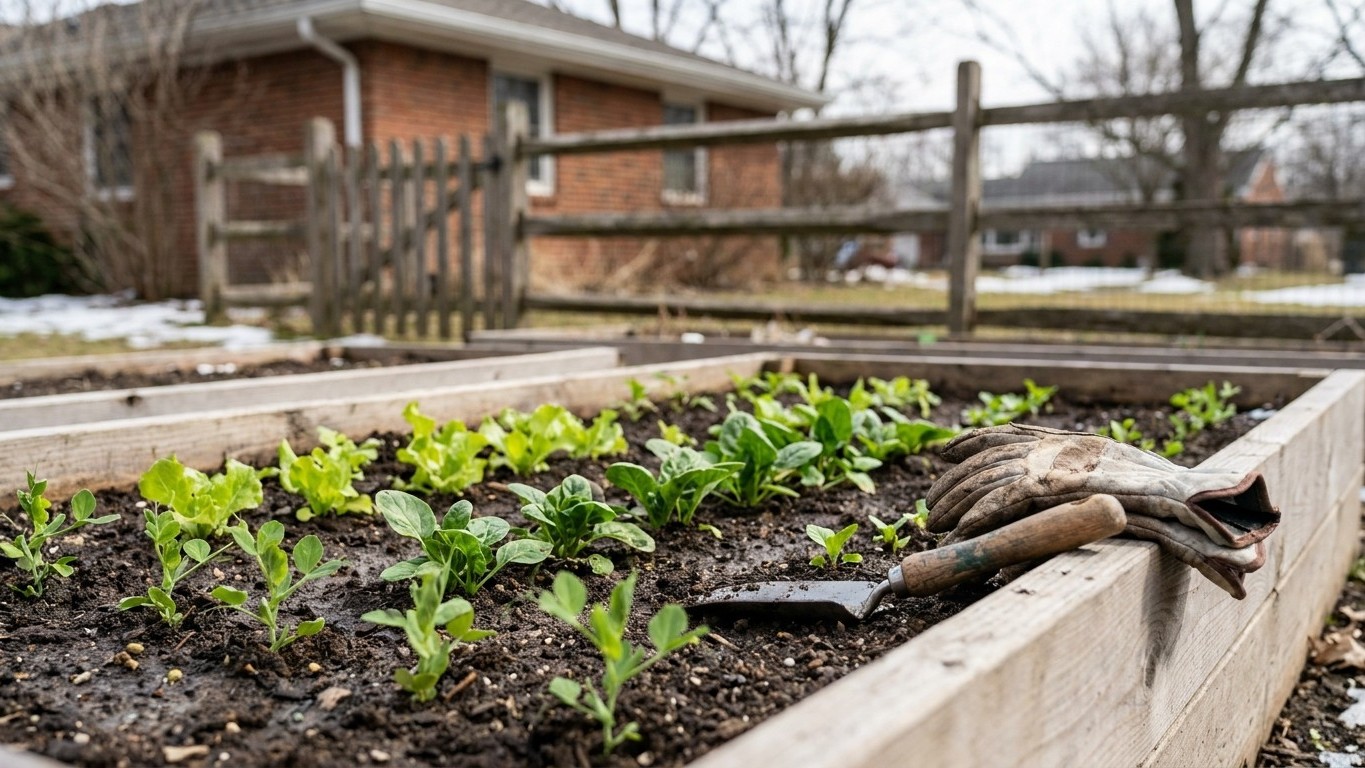

The honest answer for Vermont in March is that almost nothing goes into open ground. Soil across the state is still frozen or snow-covered, and the frost-free window doesn’t open until late April at the earliest. The real work this month happens indoors, under cover, or with pruning shears in a dormant orchard.
What goes in the ground in March
Vermont’s last spring frost falls between April 30 and May 10 in the Burlington area, according to NOAA’s 1991-2020 climate normals for station USW00014742. That means March sits roughly six to nine weeks ahead of the safe planting window, not inside it. Soil temperature, not the calendar, decides when seeds germinate reliably, and Vermont soil in March is typically still locked at or near freezing under a snowpack or a crust of frozen crust and mud.
For most of the state, nothing gets direct-sown outdoors this month. Say that plainly and move on to what actually works. If garlic and shallots went into the ground the previous fall, there’s little to do now beyond checking that mulch hasn’t blown off and exposed the cloves to freeze-thaw heaving. In the Champlain Valley, the mildest corner of the state, soil can start to soften toward the very end of March, and that’s the moment to push a fork into a raised bed to see if it’s workable rather than assuming it based on air temperature.
Cover-based options in the mildest microclimates
Where a raised bed has thawed enough to dig, a cold frame or low tunnel can take a sowing of spinach, mache, or claytonia weeks before open-ground planting would survive. These structures buy roughly two to four weeks of extra warmth over bare soil, enough to let cold-hardy greens germinate while the rest of the yard is still frozen solid.
Bare-root fruit trees, currants, and raspberry canes can go into the ground the moment soil is workable and not saturated, but in most Vermont counties that moment doesn’t arrive until well into April. Forcing rhubarb crowns or Belgian endive roots indoors in a dark basement or under a box is a genuine March project, and it produces something to eat while the garden itself stays dormant.
What to start under cover
Seed starting in March is arithmetic, not guesswork, and it runs backward from that April 30 to May 10 frost window. Onions and leeks need 10 to 12 weeks of growth before they go outside as transplants, which puts their start date squarely in early to mid-March for most of the state. Peppers need 8 to 10 weeks under lights before they can go out, and since peppers actually want the soil to be well past frost-free, closer to late May, that start date also lands in March. Tomatoes, which grow faster, only need 6 to 8 weeks, so starting them at the very beginning of the month often means leggy, rootbound plants by the time it’s safe to set them out.
| Crop | Weeks needed before transplant | Typical indoor start |
|---|---|---|
| Onions, leeks | 10-12 weeks | Early March |
| Peppers | 8-10 weeks | Early to mid-March |
| Broccoli, cabbage | 6-8 weeks | Mid-March |
| Tomatoes | 6-8 weeks | Late March |
The two ways this goes wrong are mirror images of each other. Start too early, and by planting time the seedlings have outgrown their pots, their roots circling in tight coils, their stems stretched and weak from reaching for light. Start too late, and there isn’t enough runway left before the ground warms, leaving stunted transplants that never quite catch up to a properly timed sowing. Brassicas like broccoli and cabbage split the difference, needing 6 to 8 weeks and tolerating cool soil once they go out, which makes mid-March a workable start for most counties.
What is ready to pick
Outdoors, the honest answer is little to nothing. Snow cover and frozen ground rule out fresh harvest in the open garden across nearly all of Vermont in March. What still feeds a household comes from three places: what survived winter in place, what’s stored, and what’s grown indoors on purpose.
Kale and leeks mulched heavily in the fall can sometimes be dug out from under snow, and the cold actually sweetens their flavor rather than ruining it. A cold frame that was seeded in late winter may already be yielding thin harvests of spinach or mache by late March, especially in the Champlain Valley. Sprouts and microgreens grown on a windowsill or under a grow light are the most reliable fresh green in the house this month, ready in a week to ten days from seed with no soil temperature to worry about at all.
Stored crops need a hands-on check now, not a glance. Winter squash that felt solid in November can develop soft spots by March; press gently near the stem end and around the blossom scar, where rot typically starts first. Potatoes should be checked for green sprouting eyes and for any that have gone soft or started to shrink, and onions need a squeeze test at the neck, since a papery outside can hide a mushy center. Pulling the bad ones now protects everything else in the bin.
The jobs that matter this month
March carries real deadlines even without a single seed going into open ground. Dormant pruning of apple and pear trees, grapevines, and raspberry canes should happen before buds swell and break, and in Vermont that window typically runs through this month while the trees are still fully asleep. Pruning after growth starts wastes the plant’s stored energy and invites disease into fresh wounds.
Seed ordering has its own deadline that has nothing to do with weather: popular varieties, especially disease-resistant tomatoes and regionally adapted short-season corn, sell out from seed companies by late winter. Placing orders now, rather than waiting for a warm day to remind you, is the difference between growing what you planned and settling for whatever’s left on the rack.
Soil, compost, and tools
A soil test taken as soon as ground is accessible gives results back in time to amend before planting season, and lime in particular needs weeks to months to change pH, so applying it in March rather than May actually matters. Turning a compost pile that’s been sitting since fall speeds up the breakdown and gets finished compost ready for spring beds instead of half-cooked material. This is also the moment to clean rust off tools, sharpen pruners and hoes, and check that beds, trellises, and fencing survived the winter’s freeze-thaw cycle before the ground softens and repairs get muddier.
Rotation planning belongs on paper now too: deciding which bed grew tomatoes last season so nightshades don’t repeat there, and which bed is due for nitrogen-hungry brassicas after a season of soil-building peas or beans.
What not to do in March
The biggest mistake in a Vermont March is trusting the air. A run of 50-degree afternoons can feel like spring, but air temperature and soil temperature are not the same thing, and soil warms far slower than the breeze that’s fooling everyone into thinking it’s planting time. Direct-sowing warm-season crops like beans, squash, or corn now, even in a warm spell, sends seed into ground too cold for germination, where it simply rots.
Pulling mulch off garlic beds or perennial plantings after one mild week is another common error. Vermont’s frost window runs into early May in the mildest spots and later in higher elevations, so a warm stretch in March is almost never the last cold weather coming. Uncovering too early exposes tender new growth to a hard freeze that mulch would have blocked entirely.
Feeding nitrogen at the wrong moment causes its own problems. Applying a heavy nitrogen fertilizer to dormant perennials or fruit trees in March can push soft, early growth that then gets hit by a later frost, killing tissue the plant worked hard to produce. Soil amendments like lime and compost are fine now; fast-release nitrogen is better held until closer to active growth.
Working wet or thawing soil is the last trap. Vermont’s mud season, when the top few inches thaw while the ground below stays frozen, is notorious for a reason: stepping on or tilling that saturated layer compacts it into something closer to concrete once it dries, and that compaction can take a full season to undo.
Checking this against your own county
A state-wide March calendar is a starting point, not an instruction. Vermont’s elevation changes, the moderating effect of Lake Champlain, and the harder winters of the Green Mountains and the Northeast Kingdom all shift these windows by weeks in either direction. A garden in the Champlain Valley may be workable while one at higher elevation, even fifty miles away, is still under snow.
For a planting calendar tuned to local conditions and county-level frost data, the University of Vermont Extension is the reference to check before finalizing any date on this page.
Common questions
Can I plant peas in Vermont in March?
Peas tolerate cold soil better than most crops, but Vermont ground in March is typically still frozen or waterlogged for most of the state. Peas can usually go in as soon as soil is workable and not saturated, which for most counties lands in April rather than March.
Is it too early to start tomato seeds in March?
It depends on where in March. Tomatoes need only 6 to 8 weeks before transplanting outside, and since the frost-free window doesn’t open until late April to early May, starting in the first week of March often produces overgrown, rootbound seedlings. Late March is a safer start for most counties.
What USDA hardiness zone is Vermont?
Vermont spans USDA Plant Hardiness Zones 3b through 5b, based on the USDA’s 2023 map built on 1991-2020 average extreme minimum winter temperatures. That’s a wide range across one state, and it means a zone-based recommendation for the mild Champlain Valley won’t hold true for the colder Northeast Kingdom.
When does frost season actually end in Vermont?
Around the Burlington area, the last spring frost falls between April 30 and May 10, per NOAA’s climate normals. Higher elevations and the Northeast Kingdom typically run later than that, so treating early May as a universal safe date across the whole state is a common and costly mistake.