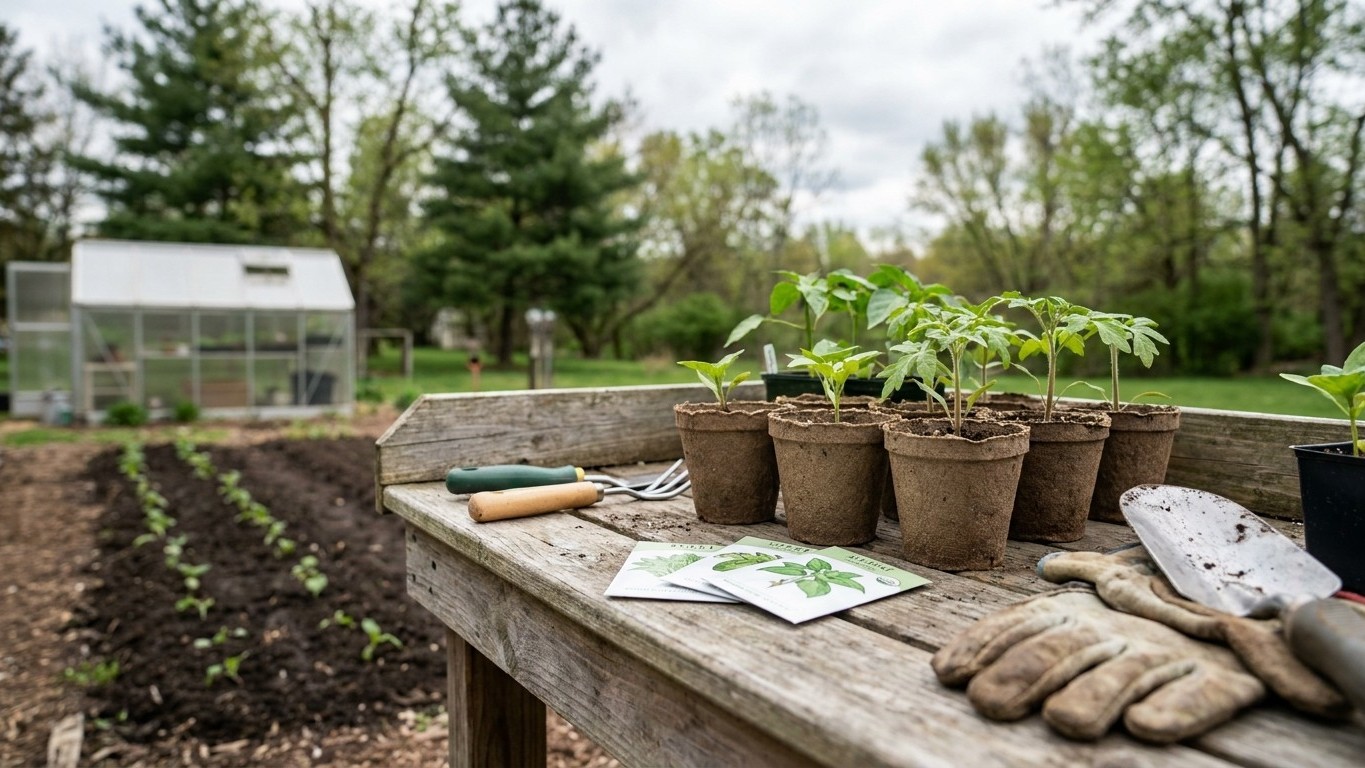

Vermont’s average last spring frost falls between April 30 and May 10 in the Champlain Valley, and later almost everywhere else in the state, which means April itself sits inside the frost window rather than past it. That makes this a month for cold-hardy crops in the open ground, indoor seed starting, and bare-root planting, not a green light for tomatoes or squash outdoors.
What goes in the ground in April
The frost math decides everything here, not the sight of a warm afternoon. With the average last freeze landing between April 30 and May 10 around Burlington, and running later still in the Green Mountains and the Northeast Kingdom, April soil in most of Vermont is cold, often still frozen at depth in early weeks, and frequently too wet to work without compacting it. That rules out any tender crop planted directly outside. It does not rule out everything.
Cold-tolerant crops can go into open ground as soon as soil is workable, meaning it crumbles rather than clumps when squeezed. That includes peas sown directly, onion sets and shallots, spinach, and radishes. Garlic planted the previous fall keeps growing regardless of frost. Hardened-off transplants of kale and collards can handle a light freeze once they’ve spent a week outside in a sheltered spot getting used to real air. None of these need protection once soil temperature climbs into the mid-40s, which for the Champlain Valley often happens by mid to late April and later at elevation.
Bare-root and dormant planting
April is the classic window for bare-root fruit trees, brambles, asparagus crowns, and rhubarb divisions, planted while they’re still dormant and before buds break. This is also the month to move or divide perennial herbs like chives and sorrel while they’re barely stirring. A cold frame or a low tunnel buys real ground for lettuce and mustard greens weeks before the open bed is safe, and it’s worth building one if the goal is fresh greens before May.
What stays off the list entirely: tomatoes, peppers, corn, beans, cucumbers, squash, and anything else that dies at 32 degrees. Planting them now, even under a warm sky, means replacing them after the next hard freeze.
What to start under cover
Seed-starting timing works backward from the frost window, not forward from a date on the wall. Tomatoes and peppers need six to eight weeks indoors before they go outside, and since Vermont’s last frost lands April 30 to May 10, that puts their ideal indoor start in early to mid-March. Starting them in April still works for a slightly later transplant, but it’s cutting it close for anyone hoping for an early harvest.
Broccoli and cabbage need five to seven weeks under lights, and because they tolerate a light frost, they can move outside two to three weeks before the average last freeze rather than after it. That makes early April a reasonable start for a second round if a first batch already went in earlier.
The crops that fit April best
Cucumbers, squash, and melons only need three to four weeks indoors before transplanting, since they resent root disturbance and grow fast once started. Sown in mid to late April, they’re ready to move out right around the frost window closing. Basil and other tender herbs run on a similar four-to-six-week clock and fit April well too.
| Crop group | Weeks indoors before transplant | When to move outside |
|---|---|---|
| Tomatoes, peppers | 6-8 weeks | After last frost, soil warm |
| Broccoli, cabbage | 5-7 weeks | 2-3 weeks before last frost |
| Cucumbers, squash, melons | 3-4 weeks | After last frost |
| Basil, tender herbs | 4-6 weeks | After last frost |
The two failure modes show up every year in Vermont gardens. Start tomatoes too early and they turn leggy and rootbound waiting for soil to warm, since a six-week head start on paper can stretch to ten weeks in a cool spring. Start cucurbits too early and the plants outgrow their pots before it’s safe to set them out, arriving in the ground stressed and stunted instead of vigorous.
What is ready to pick
The open garden gives up little in April, and it’s honest to say so before covering what does still come out of the ground and the pantry. Parsnips left in the soil over winter are the one true April harvest for many Vermont gardeners: the cold converts their starches to sugar, and once the ground thaws enough to dig, they come out sweeter than any parsnip pulled in fall. Rhubarb crowns are waking up but rarely give a real stalk harvest until closer to May in most of the state.
Overwintered kale, if it made it through under snow cover, often resumes growth with the first mild stretch and can be picked in small amounts, leaf by leaf, without stopping the plant’s recovery. A cold frame that held spinach, mache, or lettuce through winter is likely the most reliable green source in the garden this month.
Indoors and in storage
Sprouts and microgreens grown on a windowsill fill the gap for anyone wanting fresh greens without waiting on the weather, ready in one to two weeks from seed. Vermont’s sugaring season also runs into early April in many years, though that’s sap coming off the trees, not produce out of a garden bed.
Stored crops need a hard look now. Winter squash held since fall should be checked for soft spots near the stem, potatoes for sprouting eyes and green shoulders, and onions for any that have gone soft at the neck. Anything showing early rot should be pulled and used immediately or composted, since one going bad speeds up the ones next to it.
The jobs that matter this month
Dormant pruning of fruit trees, grapes, and cane berries needs to happen before buds swell, which makes early April the last comfortable window in most of Vermont. Wait until leaves emerge and the cuts cost more sap and more of the season’s growth. This is also the moment to finish ordering seed for anything still needed, since the varieties gardeners actually want tend to sell out by the time the ground is finally ready.
Soil testing pays off now specifically because there’s still time to act on the results before planting starts in earnest. A test that shows low phosphorus or an off pH can be corrected with amendments worked in over the coming weeks, something that’s much harder to fix once beds are full of growing plants. Turning the compost pile speeds up decomposition as temperatures rise, and finished compost worked into beds now gives it weeks to integrate before anything tender goes in.
Maintenance that’s easy to skip and shouldn’t be
Tools left dirty and dull over winter cost time all season. Cleaning and sharpening pruners, hoes, and shovel edges now takes an afternoon and saves frustration later. Raised beds, cold frames, and fencing damaged by winter frost heave or snow load need repair before they’re holding plants, not after a tomato cage collapses in June. Checking stored crops for rot, mentioned above, belongs on this list too, since it’s a job that only gets worse the longer it’s postponed.
None of this is filler work. Skipping the pruning window means a season of overgrown, less productive trees. Skipping the soil test means guessing at fertilizer all summer. April’s real value is in what gets set up now for the months that follow.
What not to do in April
The most common mistake in Vermont gardens this month is planting warm-season crops outside because a stretch of 70-degree afternoons made it feel like summer. Air temperature and soil temperature are not the same thing, and soil this early often sits 15 to 20 degrees cooler than the air above it. A tomato transplant set into 50-degree soil doesn’t die immediately, but it stalls, and a stalled tomato rarely catches up to one planted three weeks later into warm ground.
Uncovering perennials, pulling mulch off strawberry beds, or removing row cover after one mild week is the second classic error. Vermont’s frost window runs into early May in the mildest spots and later everywhere else, and a late freeze after early exposure can kill back new growth that had just started pushing.
Feeding nitrogen too early is the third mistake, particularly on perennial beds and fruit plantings. Nitrogen applied before real growth starts either leaches away before roots can use it or pushes soft, frost-tender growth right when a freeze is still likely. The better move is waiting until new growth is a few inches along, then feeding once, rather than feeding early and hoping for the best. Working wet clay soil belongs on this list too: squeezing a handful that stays in a ball instead of crumbling means it’s still too early to till or dig.
Checking this against your own county
A state-wide frost window is a starting point, not an instruction. Burlington’s April 30 to May 10 average last frost describes the Champlain Valley, the mildest corner of Vermont thanks to Lake Champlain’s moderating effect. Move into the Green Mountains or up into the Northeast Kingdom and that window runs measurably later, sometimes by two weeks or more, while elevation alone can shift a local frost date by several days for every few hundred feet of gain.
The most reliable next step is checking both elevation and local frost history against the University of Vermont Extension, which tracks conditions at the county level and adjusts for exactly these variables.
Common questions
Can tomatoes go outside in Vermont in April?
No. Vermont’s average last frost runs from April 30 to May 10 around Burlington and later inland, so tomatoes set out in April face a near-certain freeze. Start them indoors instead and transplant after the frost window closes and soil has warmed.
Is it too early to plant peas in April?
Peas tolerate cold well and can go into the ground as soon as soil is workable, often weeks before the last frost. They’re one of the safest direct-sown crops for early April in most of the state.
What USDA hardiness zone is Vermont?
Vermont spans USDA Plant Hardiness zones 3b to 5b, based on the USDA Plant Hardiness Zone Map’s average annual extreme minimum temperature. That’s a wide range across one state, and the specific zone at any address depends heavily on elevation and proximity to Lake Champlain.
Why does Burlington’s frost date not match my county?
The published frost window comes from a single weather station on Lake Champlain, the mildest part of Vermont. Higher elevations, the Green Mountains, and the Northeast Kingdom all run colder and see their last frost later, sometimes by weeks rather than days.