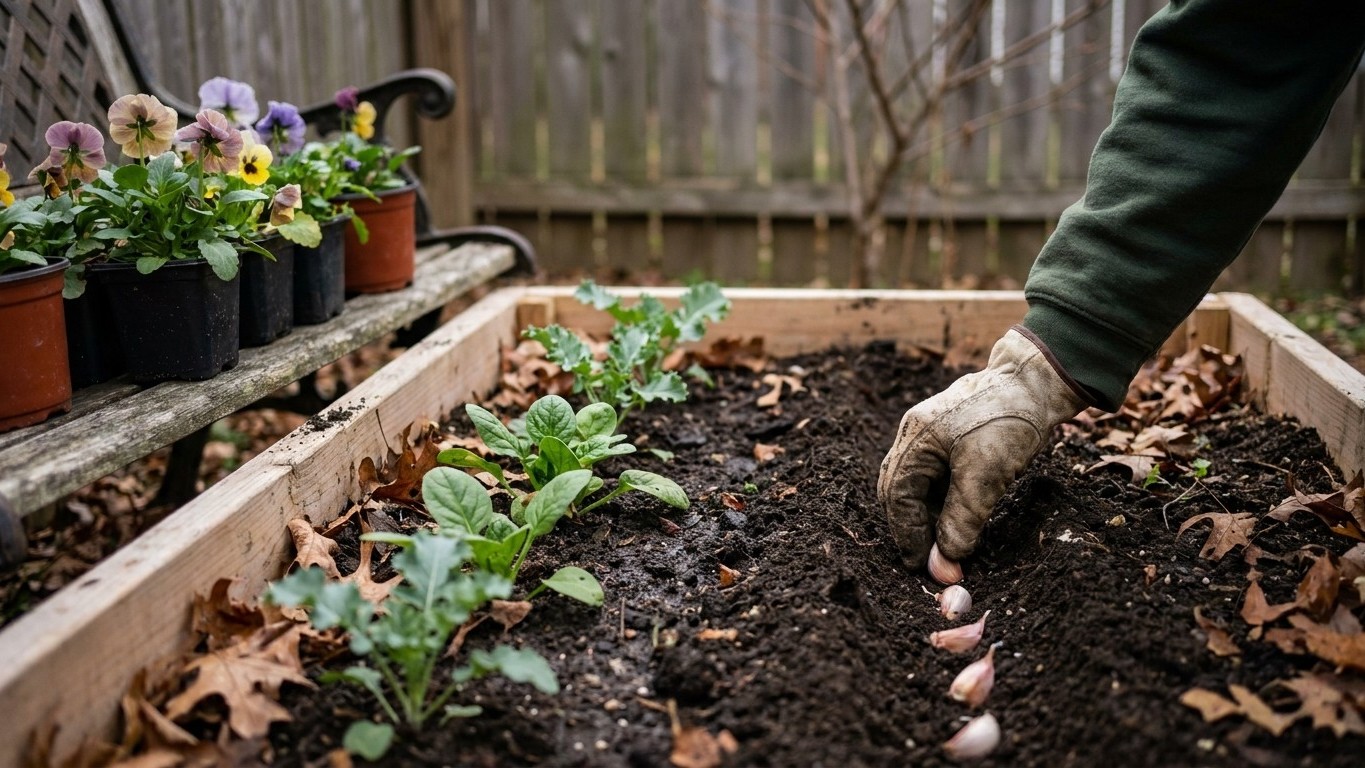

October in Vermont is the month the first fall frost actually arrives, not the month you’re racing to beat it. NOAA’s 30-year averages put that first 32°F freeze at October 3 to October 13 around Burlington, the mildest corner of the state. That means garlic and shallots go in the ground now, cold-hardy greens move under cover, and most everything else outdoors is either finishing up or already gone.
What goes in the ground in October
The decision this month isn’t the calendar. It’s whether the soil is still workable and whether the crop can handle a freeze that, in much of the state, has already happened or is days away. Burlington’s average first frost lands October 3 to 13; away from Lake Champlain’s moderating effect, in the Green Mountains and the Northeast Kingdom, that date comes noticeably earlier. So the honest starting point is this: if your yard has already seen a hard frost, tender crops are done. Don’t gamble on lettuce or beans surviving a second freeze just because a warm afternoon fooled you.
What still goes in, frost or not, is garlic and shallots. Both need six to eight weeks of cool soil to root before the ground locks up, and October is prime timing across most of the state’s hardiness range of zone 3b to 5b. Push individual cloves root-down, 2 inches deep, and mulch after planting, not before the ground has chilled.
Cold-hardy greens, spinach, mache, and claytonia, can still be direct-sown under a cold frame or low tunnel where the soil hasn’t frozen. They germinate slowly in cold soil but will sit through winter and resume growth in spring, giving an early harvest before anything else is close.
This is also the window for bare-root and dormant plantings: fruit trees, berry canes, and hardy shrubs go in while the ground can still be dug, settling their roots before real winter locks them down. And if you’ve got a cover crop of winter rye or clover you wanted down before frost stops germination, get it in the ground as early in the month as the soil allows.
What doesn’t go in: anything tender. Tomatoes, peppers, squash starts, basil, all of it is finished the moment frost touches it. Don’t replant these expecting a second chance.
What to start under cover
Counting backward from the frost window changes the math here more than any fixed date could. If your area is already inside or past the October 3 to 13 frost band, there’s no realistic path to starting a crop that needs 8 to 10 weeks of active growth before winter shuts it down outdoors. That kind of sowing belongs to late summer, not now.
What still works under cover is different in purpose: crops sown now aren’t racing to maturity before frost, they’re settling in to survive winter and grow again once days lengthen. Spinach, mache, and claytonia sown in a cold frame or unheated greenhouse in early October will sit at a small size through the coldest months, then take off in late winter or early spring, well ahead of anything you could sow outdoors after the ground thaws.
The two failure modes both come from ignoring that frost window. Start too early, before soil has cooled from summer heat, and cold-season greens bolt or struggle with poor germination in warm soil. Start too late, after the ground is already freezing at night, and seeds sit dormant without rooting, then rot with the first thaw-freeze cycle.
Indoors, this is also a reasonable month to pot up bulbs for forcing, amaryllis and paperwhites need 8 to 12 weeks of cool, dark rooting before bloom, so starting now lines up with a midwinter flower rather than a rushed one. It’s not a food crop, but it’s real windowsill payoff during the months when nothing else is happening.
What is ready to pick
Outdoors, October is harvest-and-store month, not a season with much new coming ripe. Winter squash, if it’s still in the field, needs to come in before a hard freeze damages the skin, check that the stem has dried and corked over and that a fingernail can’t easily pierce the rind. Apples and pears, common across Vermont’s home orchards, are typically finishing their harvest window through the month depending on variety.
Brassicas actually improve here. Kale, Brussels sprouts, and collards convert starches to sugars after a light frost, so leaving them in place through the first freeze or two produces a sweeter harvest than picking early. Leeks and parsnips do the same, and both can stay in the ground under mulch well past the point most other crops are done, to be dug as needed.
Root cellars and storage areas need checking now, not later. Potatoes, onions, and winter squash brought in from earlier harvests should be inspected weekly: pull anything soft, sprouting, or showing mold before it spreads to the rest of the bin. One rotting onion in a mesh bag can take down half a dozen neighbors within days.
Indoors, sprouts and microgreens on a windowsill or under a grow light are the most reliable fresh green this month produces, ready in one to two weeks with no dependence on outdoor temperature at all.
The jobs that matter this month
Garlic planting is the headline task, and it has a real deadline: miss the six-to-eight-week root-in window before the ground freezes solid, and next year’s harvest suffers. But it’s far from the only job that pays off now and costs you later if skipped.
Dormant pruning of fruit trees and berry canes can begin once leaves drop, cutting when the plant is inactive reduces disease spread and stress compared to pruning during active growth. Raspberry and blackberry canes that fruited this season should come out at the base, they won’t produce again and just compete with next year’s growth for light and nutrients.
Seed catalogs start moving fast this time of year, and ordering before the good varieties sell out is a job that costs nothing to do early and real disappointment to skip. Pair that with a soil test now, results come back in time to plan amendments for spring rather than scrambling in April when everyone else’s samples are also in the queue.
Compost turned now, before it freezes solid, breaks down faster and is more likely to be usable by spring. Beds and fencing damaged over the growing season are easier to repair while the ground is still soft enough to set posts or dig footings.
Tools deserve attention too: cleaning soil off blades, oiling moving parts, and sharpening pruners and hoes before they sit unused all winter prevents rust and dulling that otherwise shows up as a frustrating surprise come spring.
Mulch matters, but timing matters more. Wait until the ground has actually frozen before mulching perennials and garlic beds, mulch applied too early on unfrozen soil traps warmth and invites rodents looking for winter shelter.
What not to do in October
The classic mistake is trusting the air instead of the soil. A run of 60-degree afternoons doesn’t mean the growing season has reopened, and planting warm-season starts into soil that’s already cooling from summer heat just wastes the transplant. Soil temperature lags air temperature by weeks; a warm week in October doesn’t undo a season’s worth of cooling ground.
Uncovering cold frames or removing row cover after a mild stretch is another common misstep. That warm spell is often followed by a sharper freeze than the one you were protecting against in the first place, and plants that had started to hang on suddenly get hit at full exposure.
Nitrogen fertilizer is the wrong input right now. Feeding nitrogen to perennials, fruit trees, or garlic beds this late pushes soft new growth that has no time to harden off before winter, leaving it vulnerable to freeze damage that wouldn’t have happened if the plant had gone dormant on schedule. If soil needs amending, do it with compost or a soil test-guided mineral amendment, not a nitrogen feed.
Planting garlic too early, before soil has cooled into the 50s, risks premature top growth that gets damaged by the first hard freeze. Planting it too late, after the ground has already started to freeze, means cloves don’t root in properly before dormancy. Both timing errors show up as a weaker harvest, not as an obvious mistake in the moment.
Checking this against your own county
A state-wide frost window is a starting point, not an instruction. Burlington’s October 3 to 13 average first frost reflects Lake Champlain’s moderating effect, one of the mildest microclimates Vermont has. Move into the Green Mountains, gain elevation, or head into the Northeast Kingdom, and that first freeze routinely arrives earlier, sometimes by two weeks or more, while low-lying frost pockets away from any lake can catch a freeze even sooner than the regional average suggests.
Before treating any date here as a plan for your own garden, check it against the University of Vermont Extension, which tracks local frost data and planting guidance specific to Vermont’s counties and elevations.
Common questions
Can I still plant garlic in Vermont in October?
Yes, October is the standard window for planting garlic and shallots across most of the state, giving cloves six to eight weeks to root before the ground freezes solid.
Has the first frost already happened by October in Vermont?
In the Burlington area, the average first fall frost falls between October 3 and 13. Higher elevations and areas away from Lake Champlain typically see frost earlier than that window.
What vegetables get sweeter after a frost in Vermont?
Kale, Brussels sprouts, collards, leeks, and parsnips all convert starches to sugars after light frost exposure, making a slightly later harvest preferable to picking before the first freeze.
Is it too late to start a fall cover crop in October?
It depends on how early in the month and how far north you are. Winter rye and clover can still germinate if sown early enough that soil hasn’t started freezing overnight, but this window closes fast as the month goes on.