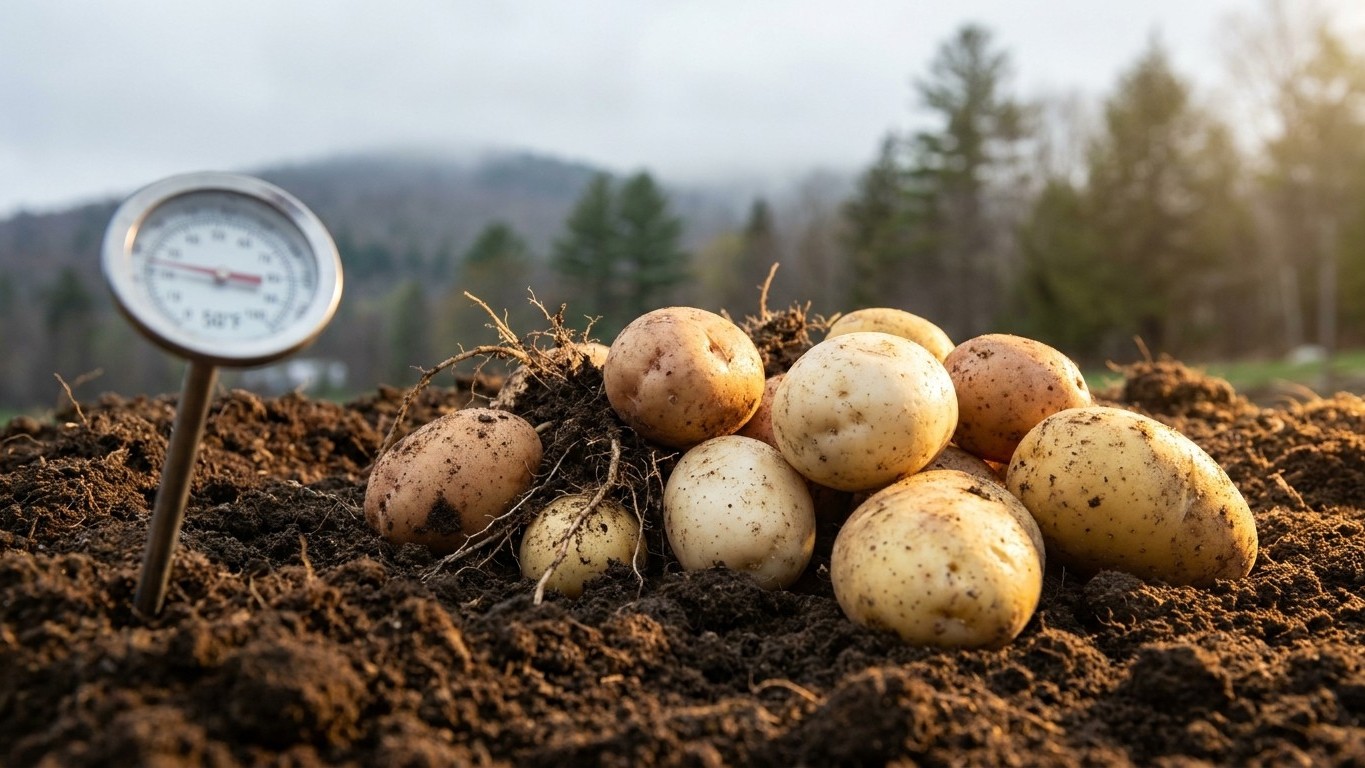

Vermont’s growing window runs from the day soil hits 50°F to the day it climbs past 90°F, and that span decides which potatoes actually finish. According to the University of Maine Cooperative Extension and Utah State University Extension, early and mid-season potatoes are the safer fit for most of the state, because they set and fill tubers before summer soil heat shuts the process down. Late-season types can work in the mildest valleys, but they carry more risk everywhere else.
The short answer
Start with what NOAA NCEI actually measured at station USW00014742 in Burlington: the last spring frost, using the 1991-2020 Climate Normals 32°F freeze probability band, falls between April 30 and May 10. That’s the mildest corner of Vermont, sitting right on Lake Champlain, and it’s the reference point most seed catalogs and planting charts implicitly use when they talk about “Vermont.” Anywhere higher in elevation, in the Green Mountains or the Northeast Kingdom, that window opens later and closes sooner.
Layer the heat mechanism on top of that frost date, and the picture gets sharper. Utah State University Extension and the University of Maine Cooperative Extension both describe the same limit: tuber set and fill stop when soil temperatures climb above 90°F, and once that happens, no amount of watering brings it back. Potatoes go in the ground as soon as soil reaches 50°F, which lands 14 to 21 days before the last frost date, not after it. That means Vermont gardeners are planting into cold, sometimes still-frosty ground on purpose, because the other end of the season, the heat ceiling, is the one that actually punishes lateness.
Put those two facts together and the answer to “which varieties suit Vermont” stops being about brand names and starts being about season class. Early and mid-season potatoes reach the point of tuber bulking while soil temperatures are still moderate, well before any stretch of 90°F soil becomes likely. Late-season potatoes need more weeks of active bulking, which pushes that critical window later into summer, exactly when soil temperatures in a hot, dry stretch are most likely to cross the ceiling. Neither Utah State nor the University of Maine publishes a days-to-maturity figure for any variety, and that’s worth taking at face value rather than filling in with a number from a seed catalog. What they publish instead is the season class, and that classification is the actual planning tool.
For most of Vermont outside the immediate Champlain Valley, that means leaning toward early and mid-season potatoes as the default, and treating late-season varieties as a bet you only place in the warmest, longest-season pockets of the state, with a certified seed source and a clear plan for what happens if August turns hot and dry.
What actually decides it
Three mechanisms stack on top of each other here, and none of them work the way a simple planting calendar suggests.
The 50-degree planting trigger
Potatoes don’t get planted by the calendar. They get planted by soil temperature, and 50°F is the threshold both extension sources point to. Because Vermont soils in the Green Mountains and Northeast Kingdom warm more slowly than the Champlain Valley’s, that 50°F mark arrives on a different day depending on elevation and exposure, even in gardens that share the same last-frost date on a regional map. A south-facing raised bed in a valley can hit 50°F well before an open field at higher elevation, and the gardener working from a soil thermometer, not a wall calendar, is the one who plants at the right moment.
The 90-degree tuber ceiling
This is the mechanism that decides the whole crop, and it’s the one gardeners tend not to guess correctly. Once soil temperature climbs above 90°F, tuber set and fill are inhibited, according to both Utah State and University of Maine Extension. Watering more doesn’t reverse it. This is why season class matters more than variety name: an early or mid-season potato does most of its bulking before soil temperatures typically reach that range, while a late-season variety is still trying to size up tubers deep into the warmest stretch of summer, right when the ceiling is most likely to be hit.
Elevation changes the calendar, not the rule
The mechanism itself, cold trigger at one end, heat ceiling at the other, doesn’t change anywhere in Vermont. What changes is the length of the window between them. A garden near Lake Champlain gets a longer stretch between the 50°F planting point and any run of dangerously hot soil, so it can carry a wider range of season classes. A garden higher in the Green Mountains or in the Northeast Kingdom gets a shorter window on both ends: soil warms to 50°F later, and depending on the site, the safe bulking period is compressed. A reader gardening at 1,800 feet in Caledonia County should reason through this same two-threshold logic, not copy a Burlington planting date.
How to do it
- Buy a simple soil thermometer and start checking a planting bed in early spring, rather than relying on a fixed calendar date.
- Plant potatoes as soon as soil temperature reaches 50°F, which will typically fall 14 to 21 days before your area’s last frost date, not after it.
- Choose early or mid-season varieties as the default for most Vermont sites, saving late-season types for the mildest, longest-season gardens.
- Source certified seed potatoes rather than grocery-store tubers or unverified home-saved stock. Uncertified seed carries virus, and that single fact does more to protect a crop than any amount of extra fertilizer or watering.
- Track soil temperature again as summer develops, watching for stretches where it climbs toward the 90°F range during tuber bulking.
- If a heat spell threatens to push soil above 90°F while tubers are still sizing, plan an earlier harvest rather than trying to push the crop through the heat.
- Adjust every one of these steps for elevation. A site in the Green Mountains or Northeast Kingdom will hit 50°F later in spring than a Champlain Valley garden, and its safe bulking window will close earlier relative to summer’s calendar heat.
What goes wrong
- Planting by the frost date instead of soil temperature. Gardeners who wait for a fixed “safe” date after the last frost often miss the 14-to-21-day window before it, when soil has already reached 50°F. The remedy is a soil thermometer, not a calendar reminder.
- Choosing a late-season variety in a short-season garden. Late types need more weeks of active bulking, and in higher-elevation Vermont sites that pushes tuber fill into the part of summer most likely to see soil temperatures cross 90°F. The remedy is defaulting to early or mid-season varieties unless the site is a proven exception.
- Using uncertified seed potatoes. Grocery-store potatoes and untested home-saved seed can carry virus that no amount of good soil or watering will fix once it’s in the plant. The remedy is buying certified seed potatoes from a known source every season.
- Assuming the whole state shares Burlington’s frost dates. The April 30 to May 10 window comes from a Lake Champlain-adjacent station, the mildest corner of Vermont. Gardens in the Green Mountains or Northeast Kingdom run a shorter season, and treating the Burlington figure as statewide leads to planting too late relative to the local 50°F mark. The remedy is checking soil temperature locally rather than importing a date from a milder region.
- Trying to rescue a heat-stressed crop with more water. Once soil crosses 90°F during tuber set and fill, irrigation doesn’t reverse the inhibition. The remedy is watching soil temperature during bulking and harvesting early rather than waiting out a heat spell.
Common questions
Do late-season potatoes ever make sense in Vermont?
In the mildest, longest-season pockets, generally in the Champlain Valley near the reference conditions NOAA NCEI recorded at the Burlington station, a longer window between the 50°F planting trigger and any 90°F soil stretch can accommodate a late-season variety. Elsewhere in the state, the shorter window favors early and mid-season types as the safer default.
Can I use grocery-store potatoes as seed?
Uncertified seed, including grocery-store tubers, carries virus risk that certified seed programs are specifically designed to screen out. Buying certified seed potatoes each season is the direct remedy, and it matters more than most other decisions a gardener makes about the crop.
What temperature actually matters more, air or soil?
Soil temperature is the figure that decides planting time and the figure that decides when tuber set and fill are inhibited, according to Utah State University Extension and the University of Maine Cooperative Extension. Air temperature and calendar frost dates matter mainly as a rough guide to when soil is likely to reach those thresholds, not as the trigger itself.
Is there a specific days-to-maturity number I should plan around for a given variety?
That figure isn’t published by either Utah State University Extension or the University of Maine Cooperative Extension, the two sources behind the guidance on this page. What they do publish is season class, early, mid-season, or late, and that classification is the reliable planning tool instead of a specific day count.