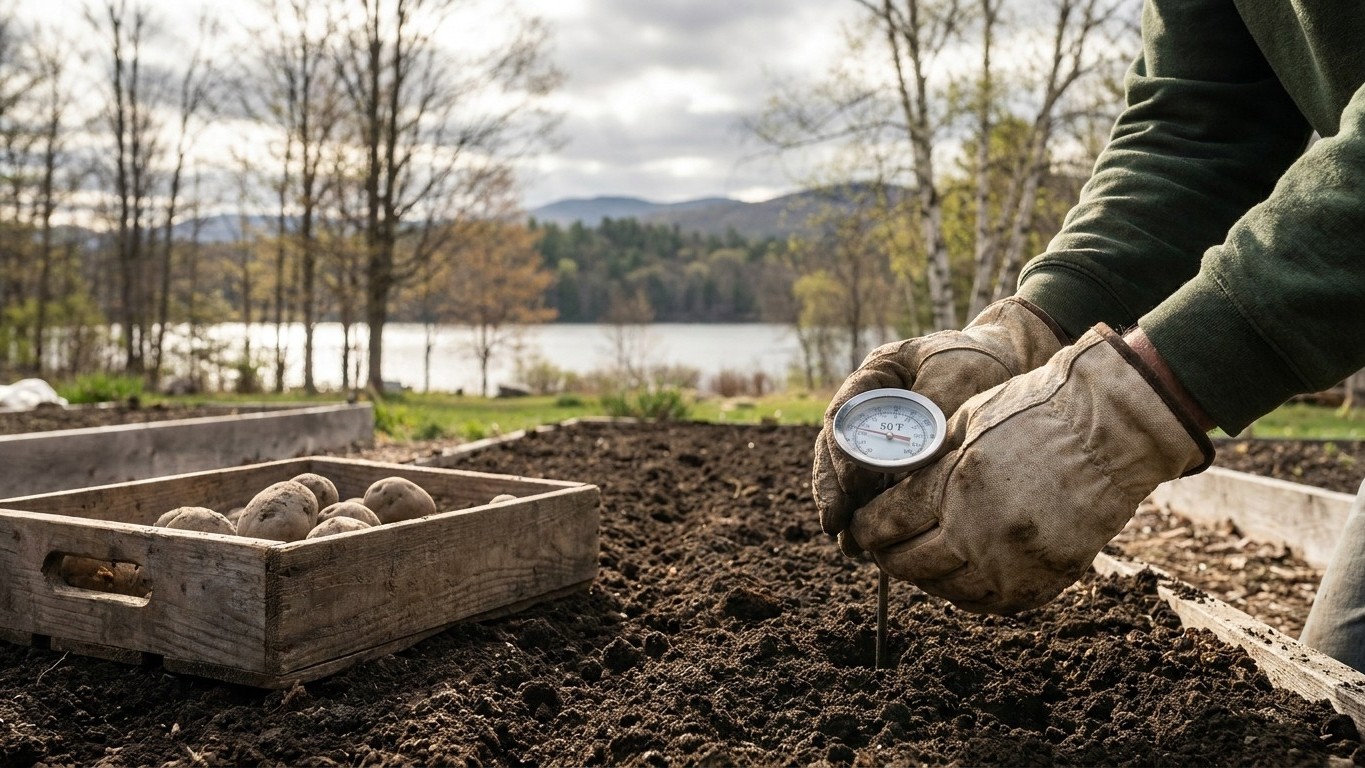

In Burlington, Vermont, the answer comes from soil temperature working backward from a frost window. NOAA lists Burlington’s last spring frost as falling between April 30 and May 10. Potatoes go into the ground 14 to 21 days before that date, once soil reaches 50°F, which typically lands in mid-to-late April around Lake Champlain. Away from the lake, in the mountains and the Northeast Kingdom, that same math shifts later because the frost window itself runs longer.
The short answer
For Burlington, the reference figure is clear: NOAA NCEI’s 1991-2020 Climate Normals, drawn from station USW00014742, put the last spring frost between April 30 and May 10. Count back 14 to 21 days from that window and you land somewhere in mid-to-late April as the target planting stretch, according to guidance published jointly by Utah State University Extension and the University of Maine Cooperative Extension’s Bulletin #2077. Both sources agree on the mechanism: potatoes go in once soil hits 50°F, not on a fixed calendar day.
That 14-to-21-day head start before frost isn’t reckless. Seed potatoes sit dormant in cool soil and don’t push up shoots until the soil itself warms, so an early planting date doesn’t expose tender growth to a late freeze the way it would with, say, tomato transplants. The plant’s vulnerable green growth typically emerges after the soil has already climbed past the frost risk zone.
Burlington’s frost window is the mildest in the state, and that’s the catch worth repeating. The city sits directly on Lake Champlain, and that body of water buffers spring temperature swings the way a large body of water always does, holding on to fall warmth and slowing spring’s arrival, but narrowing the range between “still frosty” and “reliably warm.” Climb into the Green Mountains, or head north and east into the Northeast Kingdom, and the frost-free window opens later and closes earlier. A gardener in Burlington using the April 30-May 10 figure as a stand-in for the whole state will plant too early somewhere like Craftsbury or Peacham, where frost risk lingers well past that date.
So the honest short answer has two parts. Near Burlington, count back 14 to 21 days from the April 30-May 10 window and watch the soil thermometer rather than the calendar. Everywhere else in Vermont, that same 14-to-21-day math still applies, but it has to be run against a local last-frost date, not Burlington’s, because NOAA’s normals are station-specific and Burlington’s station reflects a lakeside microclimate that much of the state doesn’t share.
What actually decides it
Soil temperature, not the frost date itself
The frost date is a planning anchor, not the actual trigger. What decides planting day is a thermometer pushed 4 inches into the soil reading 50°F, according to Utah State University Extension and the University of Maine Cooperative Extension. Air temperature can hit 60°F on a sunny afternoon while the soil underneath, still cold from winter, sits in the low 40s. Clay-heavy ground, common in parts of Vermont’s Champlain Valley, warms slower than sandy loam because it holds more moisture, and wet soil takes longer to heat than dry soil. Two gardens ten miles apart, at the same elevation, can hit 50°F soil a full week apart depending on drainage and soil type. That’s why the 14-to-21-day window before frost is a range, not a single date: it absorbs the variation that soil type and drainage introduce even within one town.
The 90°F ceiling on the other end
The frost date sets the early boundary. The heat ceiling sets the late one. Once soil temperatures climb above 90°F, tuber set and tuber fill both stall, and that’s a mechanism that watering does not reverse, per Utah State University Extension. This matters more in some parts of Vermont than others. A gardener in a low-lying valley pocket that regularly bakes in July heat is working against a hard physiological limit that no amount of irrigation solves, while a gardener at higher elevation, or one whose plot sits in afternoon shade, may never see soil hit that ceiling at all. The practical result: where summer heat runs high, the better strategy is planting as early as the 50°F soil threshold allows and digging a spring-set crop before the hottest stretch of summer arrives, rather than counting on a full season of steady tuber growth straight through August.
Put those two mechanisms together and you get the actual decision framework. It isn’t “plant on this date.” It’s “plant once soil clears 50°F, and pick a season class that finishes its tuber bulking before local soil regularly tops 90°F.” That reasoning holds whether the garden in question is in Burlington’s Intervale, the Mad River Valley, or a hillside plot the frost-date tables never mention by name.
How to do it
- Pull the last-frost figure for the station nearest your garden, not a statewide average, since Burlington’s April 30-May 10 window reflects a lakeside microclimate that mountain and Northeast Kingdom locations don’t share.
- Count back 14 to 21 days from that local last-frost window to mark the earliest realistic planting stretch on your calendar.
- Check actual soil temperature with a probe thermometer inserted about 4 inches deep, in the morning, over several consecutive days rather than relying on a single reading.
- Source certified seed potatoes rather than saving tubers from a previous harvest or buying grocery-store potatoes; uncertified seed carries virus that a healthy-looking tuber can’t reveal by eye.
- Cut larger seed potatoes into pieces with at least one eye each, and let the cut surfaces callus for a day or two before planting, if your seed source and local extension guidance call for it.
- Plant once the soil consistently reads 50°F, working within your 14-to-21-day pre-frost window rather than waiting for a fixed date.
- Match the variety’s season class, early, mid-season, or late, to how hot your specific location runs in midsummer, favoring earlier classes where soil regularly climbs toward the 90°F ceiling.
What goes wrong
- Planting by the calendar instead of the thermometer. A gardener who plants on a fixed date every season, ignoring a cold, wet spring, puts seed into soil still well under 50°F, where it can rot before sprouting. The fix is simple: check the soil with a probe thermometer instead of trusting the date alone.
- Using saved or grocery-store potatoes as seed. Tubers that look fine can carry viruses invisible to the eye, and those viruses reduce yield in ways that show up only after the season is lost. Certified seed potatoes, sourced from a supplier that tests for virus, remove that risk entirely.
- Treating Burlington’s frost date as a statewide figure. NOAA’s April 30-May 10 window comes from a single lakeside station. Applying it to a garden in the Green Mountains or the Northeast Kingdom means planting too early, right into a frost risk that Burlington itself doesn’t carry. Pull the normals for the station closest to the actual garden.
- Choosing a late-season variety in a hot, low-elevation pocket. Where soil regularly tops 90°F in midsummer, a variety that needs the full season to bulk up its tubers runs straight into the heat ceiling that stalls tuber fill. Shifting to an early or mid-season class, planted as soon as soil clears 50°F, gets the crop through its bulking phase before the worst heat arrives.
- Trying to water through heat stress. Once soil crosses 90°F, tuber set and fill stop regardless of soil moisture, per Utah State University Extension. Extra irrigation doesn’t restart the process; the only real remedy is timing the crop earlier next season so it finishes before that ceiling is reached.
Common questions
Does the 14-to-21-day rule change depending on where in Vermont I garden?
The 14-to-21-day count-back itself doesn’t change, but the date it’s counted back from does. Burlington’s last-frost window sits at April 30-May 10 according to NOAA. A garden in the mountains or the Northeast Kingdom needs its own local last-frost figure, since those areas run a shorter frost-free season than the lakeside station Burlington’s normals are drawn from.
Can I just plant potatoes early to avoid the summer heat ceiling entirely?
Yes, and that’s the strategy both extension sources point toward for hot, low-elevation ground. Planting at the earliest point soil hits 50°F, within the 14-to-21-day pre-frost window, lets the crop move through tuber set and fill before soil regularly climbs above 90°F later in summer.
What’s the difference between an early, mid-season, and late variety if there’s no days-to-maturity number?
Neither Utah State University Extension nor the University of Maine Cooperative Extension publishes a fixed days-to-maturity figure for varieties, so the season class is the reliable comparison point. Early varieties finish their growth cycle fastest, late varieties take the longest, and choosing among them is really about matching that pace to how much frost-free, sub-90°F growing window your specific location offers.
Is it worth the extra cost to buy certified seed potatoes instead of saving my own?
It is, because the risk saved seed carries isn’t visible. A tuber that looks completely healthy can still carry a virus, and that virus reduces yield without any outward sign until harvest disappoints. Certified seed has been tested for that risk, which is the entire reason it costs more than saving your own.