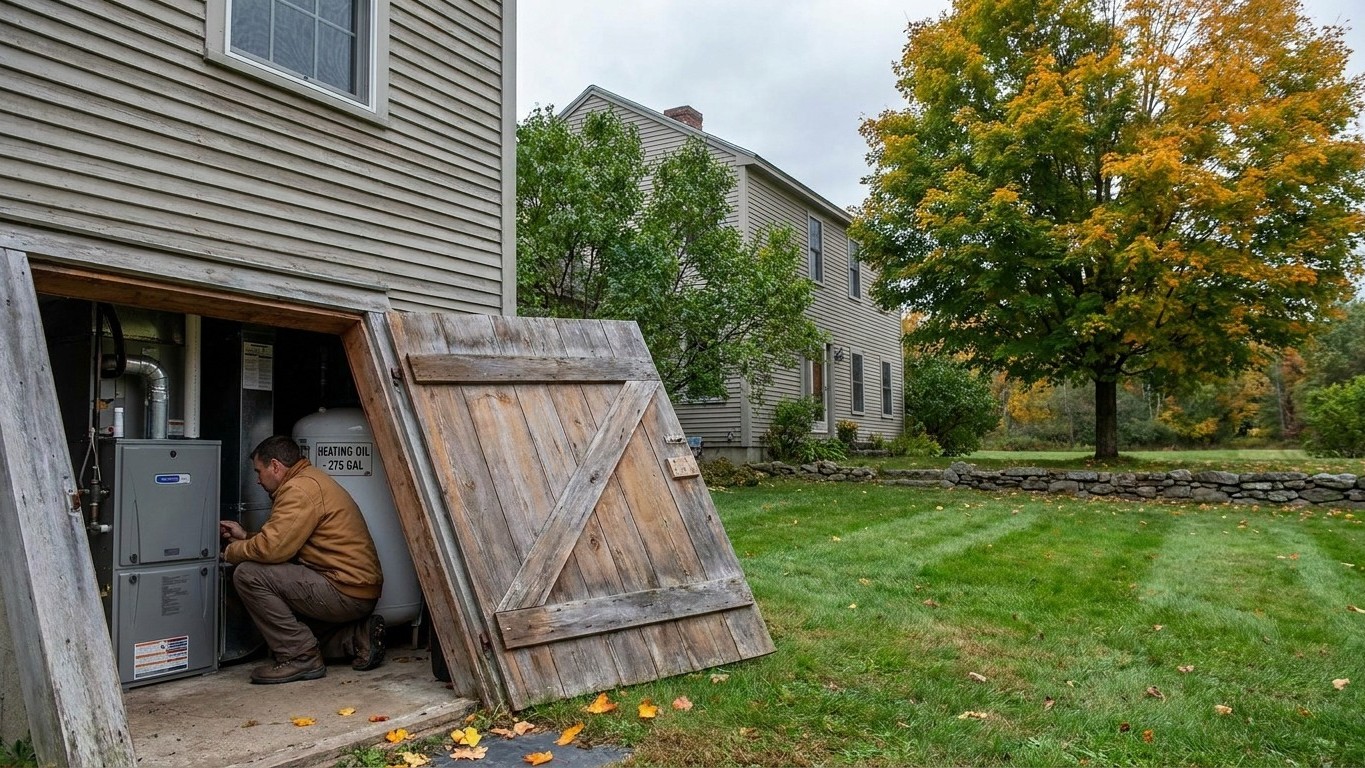

Heating demand in New Hampshire kicks in during September, when the state’s average temperature first dips below the 65°F mark used to calculate heating degree days. The season then runs roughly nine months, peaking hard in January, before finally releasing its grip in June.
When the heating season starts in New Hampshire
At Manchester’s reference weather station, September is the first month where the normal mean temperature, 64.3°F, drops below the 65°F baseline that the National Oceanic and Atmospheric Administration uses to count heating degree days. That threshold isn’t arbitrary or invented for this article; it’s the same base NOAA applies nationwide to measure how much a building needs heating on any given day. Once a month’s average dips under it, the heating season is officially underway, at least by the numbers.
January carries the heaviest load, with 1,221 heating degree days, the coldest point in New Hampshire’s climate normal cycle. The season doesn’t let go until June, when the average temperature finally climbs back above 65°F. That’s about nine months of the year where some level of heating is statistically expected, even if the shoulder months barely register.
None of this means anyone should mark a date on the calendar. A monthly normal is an average pulled from thirty years of data, not a forecast for this particular fall. The first real cold snap in New Hampshire almost always arrives before September’s mean temperature would suggest, sometimes by weeks. Homeowners in the Monadnock region or up near the White Mountains often feel that first bite earlier than the state’s most populous corridor around Manchester and Nashua.
The monthly breakdown below shows how unevenly the season loads up, with the heaviest months doing most of the work and the shoulder months barely registering.
| Month | Heating Degree Days |
|---|---|
| January | 1,221 |
| February | 1,030 |
| March | 884 |
| April | 509 |
| May | 222 |
| June | 46 |
| July | 3 |
| August | 7 |
| September | 98 |
| October | 402 |
| November | 706 |
| December | 1,042 |
How hard the winter works here
Add up every day of the year New Hampshire’s temperature sits below 65°F, weighted by how far below it falls, and you land at roughly 6,172 heating degree days annually at the Manchester station. That number is a stand-in for fuel use. Heating degree days don’t burn anything themselves, but they track closely with how much a furnace, boiler, or heat pump has to run to keep a house comfortable. Roughly double the degree days, roughly double the fuel burned for an identical house.
What that figure doesn’t tell you on its own is the shape of the season, and that’s exactly what the monthly table above fills in. Two places can share the same annual total while feeling completely different to live in: one might spread a moderate chill across a long, mild stretch, while another packs the same total heat loss into a short, punishing freeze. New Hampshire’s pattern runs toward the latter. January and December alone account for a large share of the annual total, meaning the deep-winter months do outsized work compared with the long, gentle taper through fall and spring.
That front-loaded intensity matters for anyone planning fuel deliveries, budgeting a heating season, or deciding whether an older system can keep pace. A furnace that struggles in January isn’t failing gradually, it’s getting hit with the heaviest demand of the entire year in a compressed window.
What most homes in New Hampshire actually heat with
Federal survey data on how New Hampshire households heat their homes shows a state still leaning heavily on fuel oil, alongside a meaningful share running boilers rather than forced-air furnaces.
| System or Fuel | Share of Homes |
|---|---|
| Furnace (main equipment) | 53% |
| Steam or hot-water boiler (main equipment) | 25% |
| Fuel oil or kerosene (main fuel) | 40% |
| Natural gas (main fuel) | 28% |
| Propane (main fuel) | 15% |
| Electricity (main fuel) | 9% |
Central heat pump data for the state wasn’t published in enough volume to report a reliable figure, which says something about how recently that technology has caught on here relative to older systems already in place.
A furnace being the most common setup doesn’t make it the best choice for a particular house today. It mostly reflects what was affordable and available when a given generation of New Hampshire homes went up, which for a lot of the state’s older housing stock meant oil-fired systems installed decades before natural gas lines reached rural towns. Furnaces move heat fast through ductwork and respond quickly to a thermostat, but that speed depends entirely on sealed, well-insulated ducts. Boilers, still common in a quarter of homes here, push heat through radiators or baseboards more slowly and evenly, but they punish neglect in one specific way: skip annual bleeding of trapped air from the lines, and you’ll get cold spots or clanking radiators no thermostat adjustment will fix.
Run it once before you need it
The worst night to discover a heating problem is the first genuinely cold one, when every technician within fifty miles is already booked solid. The fix is running the system weeks ahead, sometime in September, before the real demand hits.
- Turn the thermostat up a few degrees above room temperature and let the system run a short cycle. Stand near the unit and listen for banging, rattling, or a burner that won’t stay lit.
- Expect a faint burning smell the first time heat kicks on for the season. That’s dust burning off the heat exchanger or coils, and it should fade within an hour. A smell that lingers or smells like something other than dust is worth a call.
- Check the air filter and replace it if it’s visibly gray or clogged. A restricted filter forces the system to work harder for less heat delivered to the room.
- Clear at least a couple feet of space around vents, radiators, and baseboard units, and around any outdoor heat pump component. Furniture, curtains, and stored boxes blocking airflow are one of the simplest, most overlooked drags on efficiency.
- Test every carbon monoxide alarm in the house by pressing the test button, and replace batteries if it’s been a year. Combustion heating systems, whether furnace or boiler, produce carbon monoxide, and a working alarm is the cheapest insurance in the house.
- If the system short-cycles, won’t hold a flame, or trips a breaker, stop and call a licensed technician rather than troubleshooting further. Some fixes are a five-minute filter swap; others involve gas lines or electrical components that aren’t worth a DIY attempt.
Even a system that passes every one of these checks isn’t necessarily delivering all its heat where it’s supposed to. According to the U.S. Department of Energy, in a typical house, about 20%-30% of the air that moves through the duct system is lost due to leaks, holes, and poorly connected ducts. A furnace can be running perfectly and a room can still stay cold simply because the ductwork feeding it is leaking heat into a crawl space or attic along the way.
What turning it down is actually worth
The Department of Energy puts a specific figure on the practice of dialing back the thermostat: “You can save as much as 10% a year on heating and cooling by simply turning your thermostat back 7-10°F for 8 hours a day from its normal setting.” That’s not a per-degree discount and it’s not a heating-only number, it covers heating and cooling combined over a full year.
In a state where the heating season stretches across roughly nine months, that setback window has a lot more hours to work with than it would somewhere with a short, mild winter. A programmable or smart thermostat set back overnight or during a workday in New Hampshire is quietly running through that math for the better part of three-quarters of the calendar year, which is a longer runway than most of the country gets to bank the same savings.