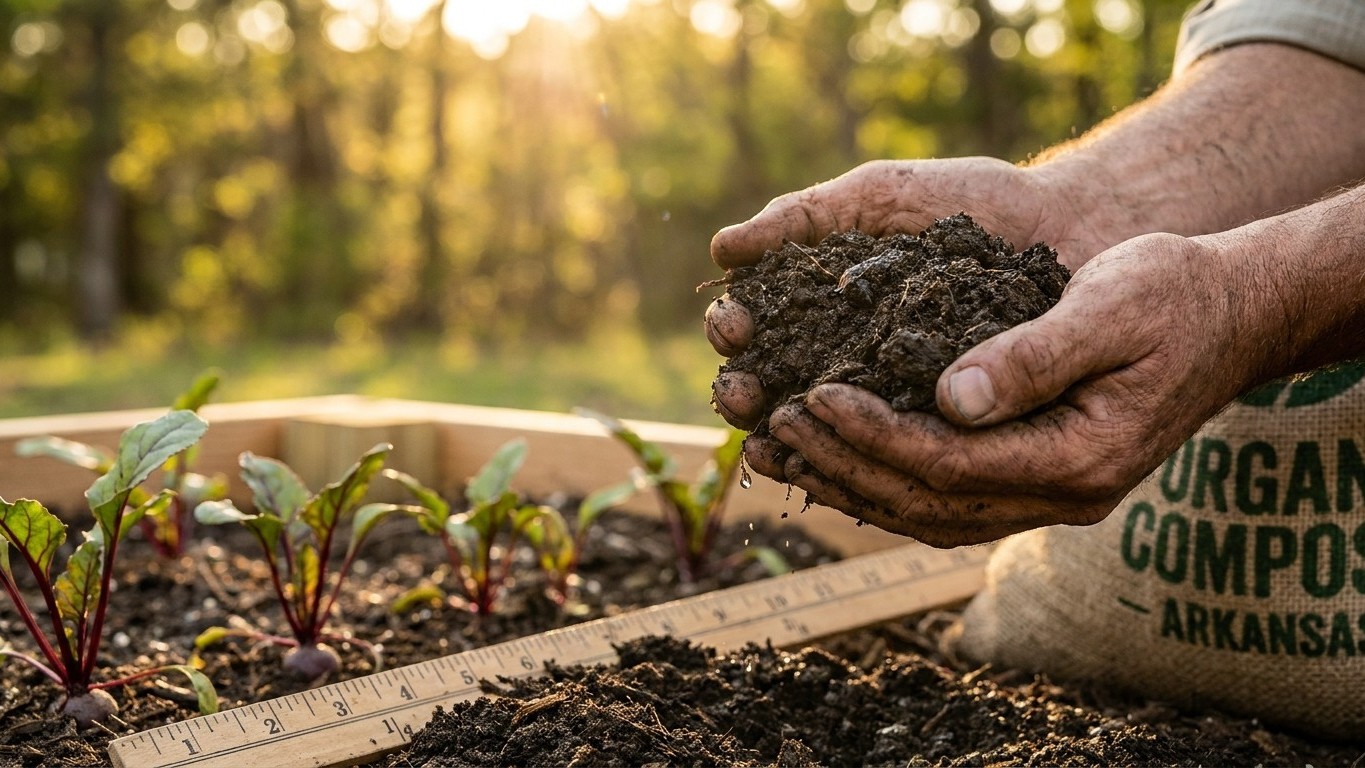

Beets can grow well in Arkansas gardens, but the state’s representative soil runs slightly acid, silt-heavy and somewhat poorly drained, and the sowing window ahead of the last frost is tight enough to shape whether roots bolt or turn woody. Getting a crop that’s round, sweet and tender rather than forked, split-stalked or fibrous comes down to three moving parts: what’s under the seed, when it goes into the ground, and how the first six weeks of root growth line up with a spring that doesn’t hold still.
The short answer
Arkansas’s official state soil is the Stuttgart series, an Alfisol formed under forest cover, and its surface horizon runs about 30 percent sand, 16 percent clay and 54 percent silt, with organic matter around 1.8 percent and a surface pH near 5.6. It’s classed as somewhat poorly drained. That profile is a silt loam leaning toward heavy, holding water longer than beets like and carrying only a light acid edge, not the neutral to slightly acid range beets tend to reward best.
Utah State University Extension’s guidance on beets is specific about the soil beets actually want: deep, sandy, well-drained ground rich in organic matter, built up with no more than 1 inch of composted organic matter per 100 square feet. Stuttgart series ground is close on the organic-matter front once amended, but it starts short on drainage and heavier on silt than sand. A gardener working ground close to that profile is likely dealing with a bed that sheds water slowly after rain, which matters twice over for beets: standing moisture can rot developing roots, and a crust that forms as silt-heavy soil dries can trap emerging seedlings before they ever break through.
The heat side of the equation matters just as much as the drainage side. Utah State’s research flags 85 F as the threshold above which water-stressed beet roots turn woody, and Arkansas summers clear that mark with regularity well before most beets would still be sitting in the ground if sown late. A specific day-count above 90 F for a reference city isn’t part of the data set behind this page, so it won’t be invented here, but the practical point stands regardless of the exact tally: Arkansas heat arrives early enough and stays long enough that timing the crop to finish before the hot stretch matters more than chasing a precise number would. For a closer look at how to work backward from that heat arrival to a workable sowing window, see When to Sow Beets in Arkansas.
None of this describes every backyard in the state. Arkansas spans hundreds of mapped soil series, and river-bottom ground, hill-country clay and anything a builder graded or filled decades ago can look nothing like the Stuttgart profile. Treat these numbers as a description of what the region’s soil tends to do, not a stand-in for a test of the actual bed a beet seed is going into, and see Beet Soil in Arkansas for a closer look at how local conditions can vary.
The six weeks that decide it here
Beets are sown directly in the ground, not transplanted, and the standard practice of sowing 2 to 3 weeks ahead of the last frost puts the first six weeks of root development inside a fairly well-defined slice of the Arkansas calendar. NOAA’s 1991-2020 climate normals put the last spring frost for the state’s reference station in a band running from March 12 to March 28. Sowing 2 to 3 weeks ahead of that band means seed can go in as early as late February in a mild year, later into March in a cooler one, with the first six weeks of growth then unfolding through March and into April.
That stretch of the calendar is where Arkansas spring earns its reputation for not committing to one pattern. Cold fronts can drop through and bring a run of chilly, wet days, then be followed within a week or two by a stretch of unusually warm, dry air pushing well ahead of the calendar. That swing is exactly the condition Utah State’s research points to as the driver of premature flowering: water stress during the first six weeks after seeding is what pushes a beet plant to bolt rather than build a root. A beet crop sown into this window in Arkansas isn’t gambling on steady spring weather, because steady spring weather isn’t the norm here. It’s gambling on how many dry stretches land inside those first six weeks, and how long each one runs before rain or irrigation breaks it.
That reframes the timing decision. Sowing right at the early edge of the recommended window, closer to 3 weeks before frost than 2, buys a few extra days of cooler soil for germination, but it also lengthens the odds that a March dry spell falls somewhere in the critical six weeks. Sowing closer to the last-frost date shortens that exposure at the cost of pushing root maturity closer to the point where early summer heat starts working against root texture instead of against bolting. Neither choice removes the risk. It shifts which of the two failures, bolting or woodiness, a gardener is betting against.
What goes wrong here
- Slow drainage after spring rain rots or stunts young roots. The Stuttgart profile’s somewhat poorly drained rating means water can sit in the root zone longer than a beet tolerates well. Raised beds or ridged rows lift the seed and root zone above standing water, and working in organic matter, up to that 1-inch-per-100-square-foot ceiling, opens up pore space so water moves through rather than pooling.
- A silt-heavy surface crusts over before seedlings emerge. High silt content dries into a hard skin after rain, and beet seedlings are not strong enough to push through it reliably. A light mulch or a scattering of finer compost over the seed row keeps the surface from sealing while germination is underway.
- Slightly acid soil (around pH 5.6) locks up nutrients beets need. Beets don’t perform their best in soil that acid, and boron in particular becomes less available as pH drops, which shows up later as internal black spotting in the root. A soil test through the local extension office gives an actual pH number and a lime recommendation instead of guessing from the state average.
- A dry stretch in the first six weeks triggers bolting instead of root growth. This is the water-stress failure Utah State’s research describes, and it’s distinct from heat damage later in the season. Consistent moisture from seeding through the sixth week, especially during one of Arkansas spring’s dry swings, is the direct countermeasure.
- Heat above 85 F combined with dry soil turns roots woody. This is a separate failure from bolting, driven by late-season stress rather than early-season stress. Getting the crop sown early enough that it reaches harvest size, typically 60 to 80 days from seeding depending on variety, before the hottest, driest stretch of the season arrives is the main defense, along with mulch to buffer soil moisture once temperatures climb.
Checking this against your own county
Everything above describes the state’s representative soil and its published frost-date band, not the specific dirt in any one garden. The most useful next step is a soil test through the University of Arkansas Division of Agriculture Cooperative Extension Service, which can return an actual pH, texture and drainage read for a particular property rather than a statewide average. County extension agents also carry local planting calendars built around the same NOAA frost data used here, adjusted for elevation and local microclimate, which matters in a state where hill country and river bottoms don’t share a planting date. That conversation is where the general picture in this article turns into a decision for one specific bed.
Common questions
Can beets grow in clay-heavy Arkansas soil without raised beds?
They can, but slower drainage raises the odds of rot and crusting. Working in organic matter and avoiding overwatering helps; a raised bed simply removes the drainage problem instead of managing around it.
How early can beets go in the ground in Arkansas?
Based on the state’s last-frost band of March 12 to March 28, sowing 2 to 3 weeks ahead of that puts seed in the ground as early as late February in a mild year. A local extension planting calendar refines that for a specific county.
Is bolting the same problem as a woody beet?
No. Bolting comes from water stress in the first six weeks after seeding and results in a plant that flowers instead of building a root. Woodiness comes later, when heat above 85 F combines with dry soil during root development. They call for different fixes at different points in the season.
Does Arkansas’s acidic state soil mean every garden needs lime?
Not necessarily. The pH 5.6 figure describes the Stuttgart series specifically, one of hundreds of soil series across the state. A soil test is the only way to know whether a particular garden actually needs lime before beets go in.