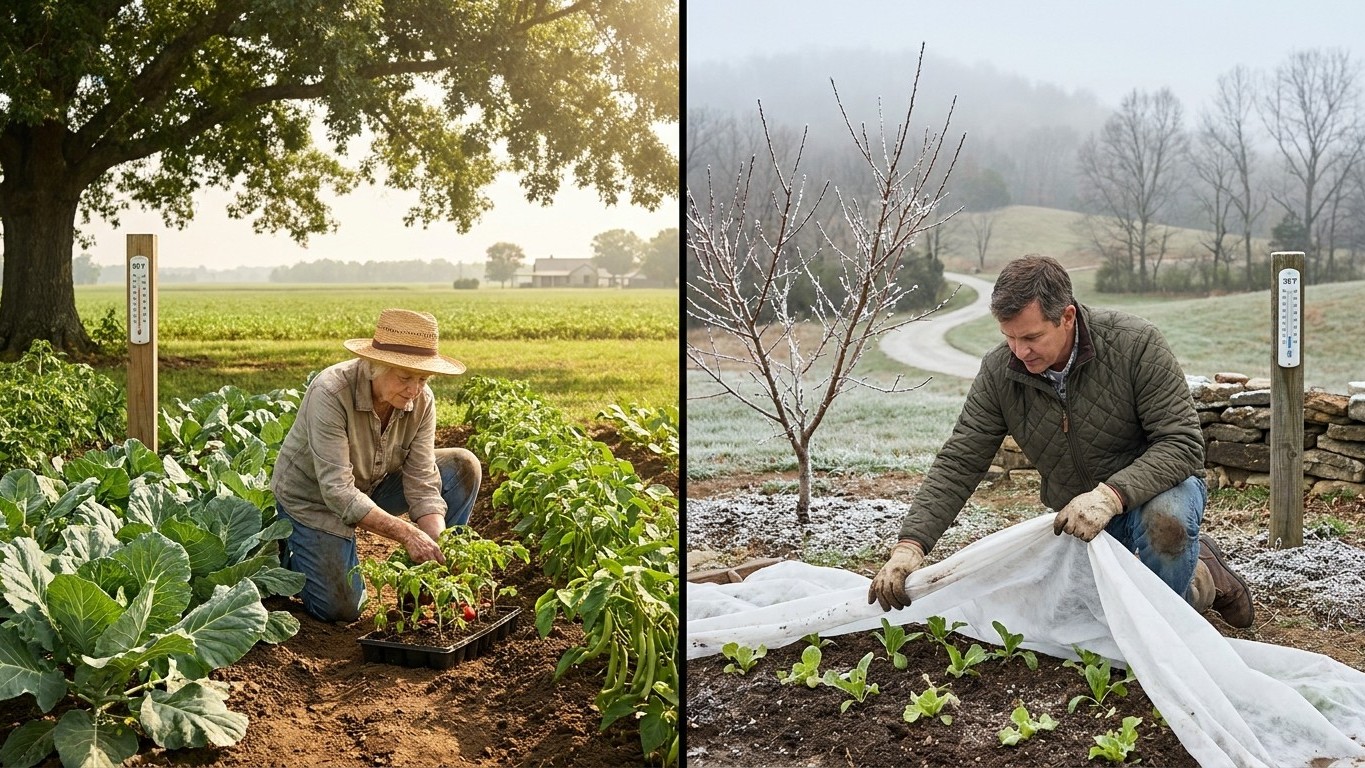

Arkansas gardeners work with a split personality of a state: humid subtropical summers that punish anything planted too early, and winters mild enough in the south to keep collards going through Christmas. The short answer is that your zip code within Arkansas matters almost as much as the season itself. A gardener in Bentonville plans around a last frost date that can land in mid-April, while someone in El Dorado might be transplanting tomatoes three weeks earlier. Knowing which part of the state you’re in changes nearly every decision that follows.
Arkansas’s Climate Zones and What They Actually Mean

The USDA Plant Hardiness Zone Map puts Arkansas mostly between zone 7a and 8a, with a sliver of zone 6b tucked into the highest elevations of the Ozark and Ouachita mountains in the northwest and west-central parts of the state. Zone 8a covers most of southern Arkansas, including the area around Texarkana and El Dorado. That’s not a small difference. A zone 6b winter can dip to -5°F in a hard freeze; zone 8a rarely sees anything below 10°F. Perennials, fruit trees, and even some marginal shrubs that sail through a Delta winter can get wiped out in the Ozarks.
You can check your exact zone using the USDA Plant Hardiness Zone Map, and it’s worth doing before buying anything perennial. A peach tree rated for zone 7 will likely struggle in a cold pocket near Mountain Home, even though the label says “hardy in Arkansas.” Microclimates inside the state are real: a south-facing slope in the Ozarks can behave like a full zone warmer than a low-lying frost pocket ten miles away.
Three Distinct Growing Regions
Arkansas breaks down into three practical growing regions rather than one uniform climate. The Ozark and Ouachita highlands in the north and west run cooler, with rockier, thinner soil and a shorter frost-free window, conditions that actually favor cool-season crops, making Growing Spinach in Arkansas a natural fit for gardeners in this region. The Arkansas River Valley, running through Little Rock and Fort Smith, sits in the middle in every sense: moderate winters, hot summers, decent soil, and its long, hot stretch of summer heat makes Growing Peppers in Arkansas particularly well-suited to that region, while the Delta’s rich bottomland soil and long warm season make Growing Pumpkins in Arkansas especially productive further east. The Delta region in the east, from Jonesboro down through Pine Bluff, has some of the richest alluvial soil in the country, flat land built by centuries of Mississippi River flooding, but it also traps heat and humidity like a greenhouse in July and August. That rich, loose alluvial soil happens to be ideal for root crops, which is why Growing Beets in Arkansas thrives there, and it’s also why Growing Potatoes in Arkansas tends to be especially productive in Delta gardens, and the same deep, friable ground makes Growing Carrots in Arkansas just as rewarding, since carrots push straight down through loose soil without hitting the rocky resistance common in the highlands. Growing Parsnips in Arkansas another rewarding option for gardeners in that region.
The Planting Calendar That Actually Works
Spring in Arkansas is a trap for impatient gardeners. Average last frost dates range from around April 15 in the northern Ozarks to early April in the southern Delta and Gulf Coastal Plain counties. But “average” hides a lot of variance. Arkansas has had frost as late as the first week of May in cooler pockets, and a warm February can trick gardeners into planting tomatoes six weeks too early, only to lose them to a cold snap in March. The University of Arkansas Cooperative Extension Service publishes county-specific frost data, and checking it before setting out warm-season crops saves more plants than any amount of enthusiasm.
Fall planting deserves more attention than it gets. Arkansas summers routinely push past 95°F for weeks at a time, and that heat stresses out spring-planted tomatoes, peppers, and squash right when they should be producing. Many experienced Arkansas gardeners treat their spring garden as the first act and their fall garden, planted in late July through September for cool-season crops like broccoli, kale, and lettuce, as the more reliable second act. First frost typically arrives in mid-to-late October in the north and early-to-mid November in the south, giving fall crops a solid six to eight week window before real cold sets in.
Winter isn’t dead time everywhere in the state. In zone 8a counties, cold-hardy greens, garlic, and some root vegetables can overwinter with minimal protection. Further north, that same approach requires row cover or a cold frame, and even then, a hard freeze can still take out anything not fully established.
Soil: The Part Nobody Warns You About
Arkansas soil varies more dramatically than its climate does. Delta soil, the alluvial deposits along the Mississippi and Arkansas Rivers, is often deep, fertile, and easy to work, which is exactly why the state’s row-crop agriculture concentrates there. Home gardeners in Jonesboro or West Memphis often get lucky with soil that needs little more than compost to perform well.
Central and western Arkansas tell a different story. Heavy clay is common, particularly in and around Little Rock and through much of the River Valley. Clay holds water like a bathtub after a summer downpour, then cracks and hardens during a dry August stretch. That swing between saturated and bone-dry stresses root systems and makes raised beds or heavy amendment with organic matter close to mandatory for anyone growing vegetables rather than just ornamental grasses. In the Ozark highlands, soil tends to be thinner and rockier, often sitting over limestone or shale bedrock, which limits root depth and drainage in different ways than clay does.
A basic soil test through the Cooperative Extension Service, available in every Arkansas county, costs far less than a season of guessing. It tells you pH (Arkansas soils often run acidic, which favors blueberries and azaleas but can frustrate anyone trying to grow asparagus or lavender without lime amendment) and flags nutrient deficiencies before they show up as yellowing leaves in July.
Humidity, Heat, and the Pests That Come With Them
Summer humidity is the defining challenge of gardening anywhere in Arkansas, and it’s not just about comfort while weeding. High humidity combined with heat creates ideal conditions for fungal disease: powdery mildew on squash and cucumbers, early blight on tomatoes, black spot on roses. Gardeners who space plants generously and water at the soil line instead of overhead cut disease pressure noticeably compared to those who don’t.
Japanese beetles have become a fixture across much of the state since establishing themselves broadly by the 2010s, and they show up reliably in June and July, skeletonizing rose leaves and stripping grape vines. Squash bugs and squash vine borers hit cucurbits hard enough in Arkansas’s climate that some gardeners plant a second, later round of squash specifically to outrun the first pest generation. None of this is unique to Arkansas, but the combination of long hot seasons and high humidity means pest and disease pressure runs higher and longer than in drier states.
Heat stress itself deserves a mention separate from pests. Tomatoes stop setting fruit reliably once nighttime temperatures stay above roughly 75°F, which happens across much of Arkansas for stretches of July and August. That’s why many Delta and River Valley gardeners see a heavy tomato harvest in June, a lull during peak summer heat, and then a second flush in September as nights cool back down. It’s not a plant problem or a gardener mistake; it’s just how tomato pollen behaves in that kind of heat.
Water: Feast, Then Drought
Arkansas gets a respectable 45 to 55 inches of rain annually depending on region, more than most states, but it rarely arrives on a convenient schedule. Spring often brings heavy rain and even flooding, particularly in the Delta, while July and August can turn into a dry stretch that leaves gardens dependent entirely on supplemental watering. Mulching with three to four inches of organic material (straw, shredded leaves, or wood chips) does more to even out that swing than any other single practice, holding moisture during dry spells and reducing soil splash that spreads fungal spores during wet ones.
Drip irrigation or soaker hoses make more sense in Arkansas than overhead sprinklers for exactly this reason. Wetting foliage in a humid climate is asking for disease; wetting the soil at the root zone isn’t.
None of these regional quirks show up on a seed packet, which is why the same tomato variety can perform completely differently in Fayetteville than it does in Pine Bluff, even planted the same week. Arkansas rewards gardeners who plant to their specific county rather than to a national average, and the Cooperative Extension office for each county remains the most reliable free resource for pinning down exact frost dates, soil test results, and pest timing for that particular patch of ground.
Where to check before you plant
A single set of frost dates can’t describe a state that runs from the Ozark highlands down to the Delta lowlands, crossing hardiness zones and shifting last-frost averages by weeks along the way. What holds true in the Boston Mountains often doesn’t hold in the Arkansas River Valley, let alone further south near the Louisiana line.
The University of Arkansas System Division of Agriculture’s Cooperative Extension Service uaex.uada.edu publishes planting calendars, variety trial results, and pest and disease alerts built specifically for Arkansas conditions, not a generic national average. Their agents track things like when local insect pressure typically starts and how soil temperatures are trending in a given region, information no seed packet can offer.
Even that statewide guidance benefits from a local check. Your county extension office keeps records tuned to your specific soil types, elevation, and microclimate, and can run a soil test that tells you what your ground actually needs rather than what a general guide assumes. Calling or visiting before you commit seed to soil costs nothing and often saves an entire season of guessing.
Where to Go Next, Crop by Crop
The calendar only gets you so far — the details change depending on what you’re growing. If you’re putting in a bulb crop this fall, it’s worth reading about growing garlic in Arkansas, since a bulb that misses its cold spell never divides into cloves at all — it just sits under the surface as one round lump, whether that’s from planting too late in the Delta or riding out a mild winter down there. If it’s the yard itself giving you trouble, the piece on Arkansas lawn care explains why thin grass in summer usually isn’t a watering problem — it’s Bermudagrass, Zoysiagrass, or St. Augustinegrass planted for a climate they’re not suited to, and what to feed and plant instead. And if tomatoes are what you’re after, the guide to growing tomatoes in Arkansas lays out the actual planting window, pinned to the National Weather Service’s light-frost date of April 3 near Little Rock, drawn from NOAA’s 1991-2020 climate normals. Start with whichever one matches what’s already in your ground.