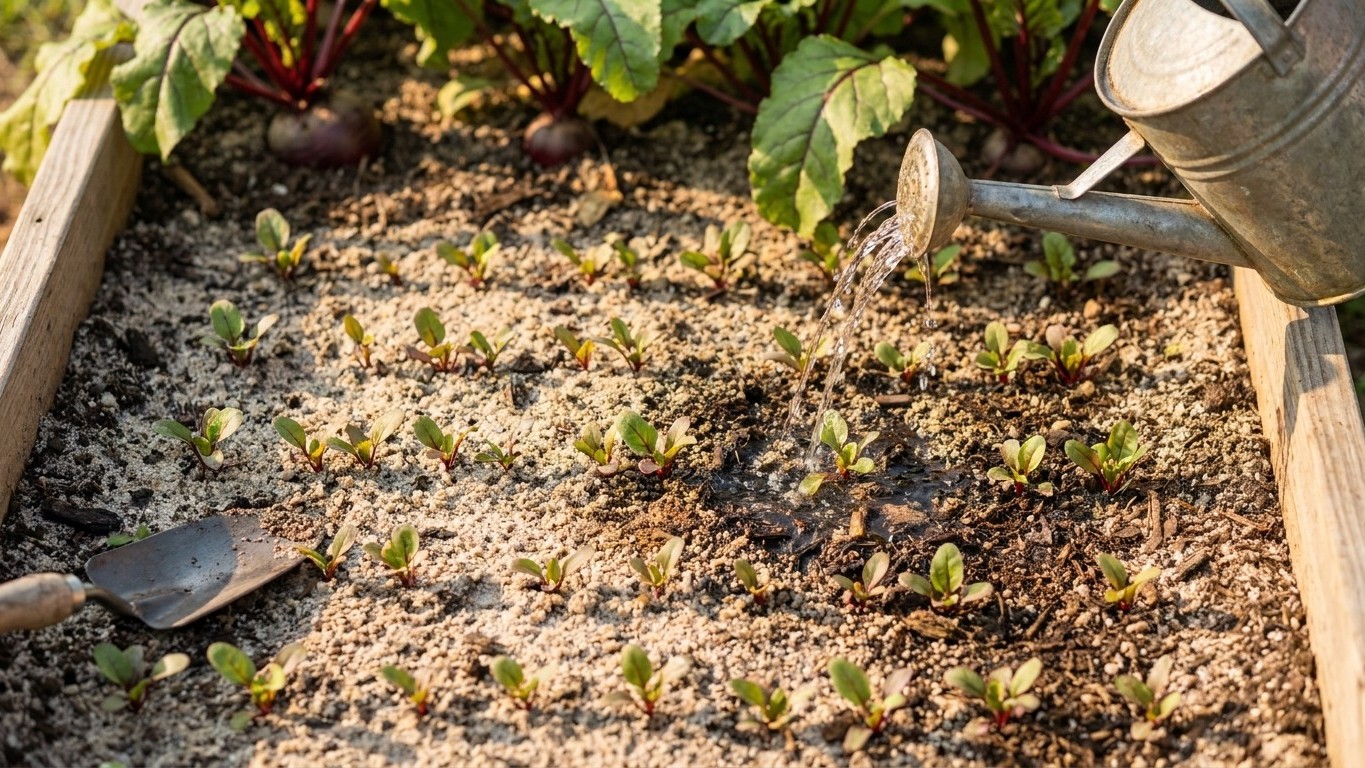

The Bama series, Alabama’s official state soil, is 67 percent sand and drains fast, which means beet roots planted in ground like it will feel dry spells within days, not weeks. That single fact reshapes everything about timing, watering and when a beet root turns woody instead of sweet.
The short answer
Alabama’s state soil, the Bama series, is a sandy Ultisol: 67 percent sand, 14 percent clay, 19 percent silt, with a surface pH around 5.3 and organic matter around 0.8 percent. It’s well drained, which sounds like a virtue until you’re growing a root vegetable that needs steady moisture for six straight weeks. Sandy ground like this sheds rainfall quickly, so the top few inches where beet seedlings root can go from damp to dust in a stretch of dry, sunny days. Add a pH of 5.3, which is strongly acid, and you’ve got soil that beets tolerate poorly without correction, since they prefer conditions closer to neutral.
Low organic matter compounds the problem. At 0.8 percent, this soil has little of the spongy material that holds water and slow-releases nutrients. Utah State University Extension recommends amending beet beds with organic matter, up to 1 inch of composted material per 100 square feet, precisely because sandy, lean soils like Bama can’t hold onto what a beet root needs on its own. For a closer look at these conditions, see Beet Soil in Alabama.
Where the heat comes in
The exact count of days Alabama spends above 90 F isn’t part of the sourced data used for this page, so no specific number is given here. But the state’s summers are well known for pushing well past the 85 F mark that Utah State University Extension identifies as the threshold where heat combined with water stress makes beet roots turn woody and fibrous. That combination, sandy soil that dries fast plus a climate that runs hot for a good part of the growing season, is the two-part risk any Alabama gardener is working against.
None of this describes every yard in the state. Alabama spans hundreds of mapped soil series, and a backyard bed, especially one in a river bottom, a hill-country plot, or ground a builder has graded and filled, can look nothing like the Bama profile. Treat these numbers as a starting point for what the region’s soil tends to do, not a stand-in for a test of your own dirt.
The six weeks that decide it here
Beets are sown directly in the ground, never transplanted, and the standard advice is to get seed in the soil 2 to 3 weeks before the last spring frost. At the reference weather station used for this page, USW00003856, NOAA’s 1991-2020 Climate Normals put the last spring freeze somewhere between March 19 and April 3. Working back from that window, a typical When to Sow Beets in Alabama lands in late February to mid-March, which means the first six weeks of root development, the window Utah State University Extension flags as the make-or-break period for bolting, plays out across March and into April.
That stretch of Alabama spring doesn’t behave one way. It swings. Some years bring cool, damp weeks that keep soil moisture steady without any help from the gardener. Other years bring dry snaps, sometimes right when seedlings are putting down their first real roots, and on sandy ground like the Bama series, a week without rain is enough to tip a young beet plant into drought stress. That stress is the trigger for premature flowering, or bolting, which sends the plant’s energy into a seed stalk instead of a root.
The risk here isn’t a single bad month. It’s the unpredictability. A gardener who sows in early March based on the frost window above still has to watch the ten days after germination closely, because whether that stretch turns dry or stays damp determines whether the crop bolts or bulks up normally. Bolting from that early thirst is a completely different failure from the woodiness that shows up later when a mature root sits in hot, dry soil. One happens in the first six weeks; the other happens as harvest approaches. Mixing them up leads to the wrong fix at the wrong time.
Gardens outside the immediate reference station, especially suburban and rural sites, often see their last frost a week or two later than the airport-station figure above, sometimes more at higher elevations. That pushes the safe sowing window later too, which is one more reason to treat March 19 to April 3 as a reference point rather than a rule.
What goes wrong here
- Bolting from early dry spells: Sandy, fast-draining soil like the Bama series loses surface moisture within days of a dry stretch, and if that happens during the first six weeks after sowing, beet plants respond by bolting instead of forming roots. The remedy is consistent watering through that window, checking soil moisture by hand rather than by the calendar, and a layer of mulch to slow evaporation from the surface.
- Poor germination and misshapen roots from acid soil: A surface pH near 5.3 is more acid than beets prefer. Left uncorrected, this shows up as spotty germination or roots that come up stunted and irregular. A soil test that specifies a lime application, based on the actual reading rather than a guess, is the standard fix, and it takes months to shift pH, so it has to happen well ahead of sowing.
- Nutrient and moisture loss from low organic matter: At around 0.8 percent organic matter, this soil holds neither water nor nutrients well, leaving beet roots exposed to swings in both. Utah State University Extension’s recommendation of up to 1 inch of composted organic matter per 100 square feet, worked in before sowing, addresses both problems at once without overloading the bed.
- Woody roots from late-season heat: Once a beet root is sizing up, heat above 85 F combined with any water stress turns the flesh fibrous and tough. This is not the same failure as early bolting; it happens later, closer to the 60- to 80-day maturity window counted from seeding, and the fix is steady watering through Alabama’s hot stretches plus timing the crop so it matures before the worst heat sets in.
Checking this against your own county
Everything above describes the state soil and a single reference weather station, not your particular yard. The only way to know your actual soil texture, pH and organic matter is a soil test, and the only way to know your actual last frost date is local record-keeping that accounts for your elevation and microclimate. The Alabama Cooperative Extension System, at aces.edu, runs county offices across the state that handle soil testing and can speak to frost timing and bolting risk specific to your area. That’s the next step before committing a bed to beets based on state-level averages alone.
Common questions
When should I sow beets in Alabama?
The general guidance is 2 to 3 weeks before the last spring frost. At the reference station used here, that frost falls between March 19 and April 3, which puts sowing in late February through mid-March for that location. Your own last frost date, checked with your county extension office, may run later.
Why did my beets bolt instead of forming roots?
Bolting is almost always tied to water stress in the first six weeks after sowing. On sandy, fast-draining soil like Alabama’s state soil, a dry stretch during that early window is the most common trigger, and it’s a different problem from the woodiness that shows up later in hot weather.
How can I fix acidic soil for beets?
Start with a soil test rather than a guess. A surface pH near 5.3, typical of the state’s sandiest soils, is more acid than beets tolerate well, and a lime application sized to your actual test result is the standard correction, applied well before sowing since pH shifts take time.
Are beets grown from transplants or seeds in Alabama?
Beets are sown directly in the garden bed as seed, not started as transplants. The 60- to 80-day maturity window runs from the sowing date, which is also why the first six weeks after seeding, not after any transplant date, are what determine bolting risk.