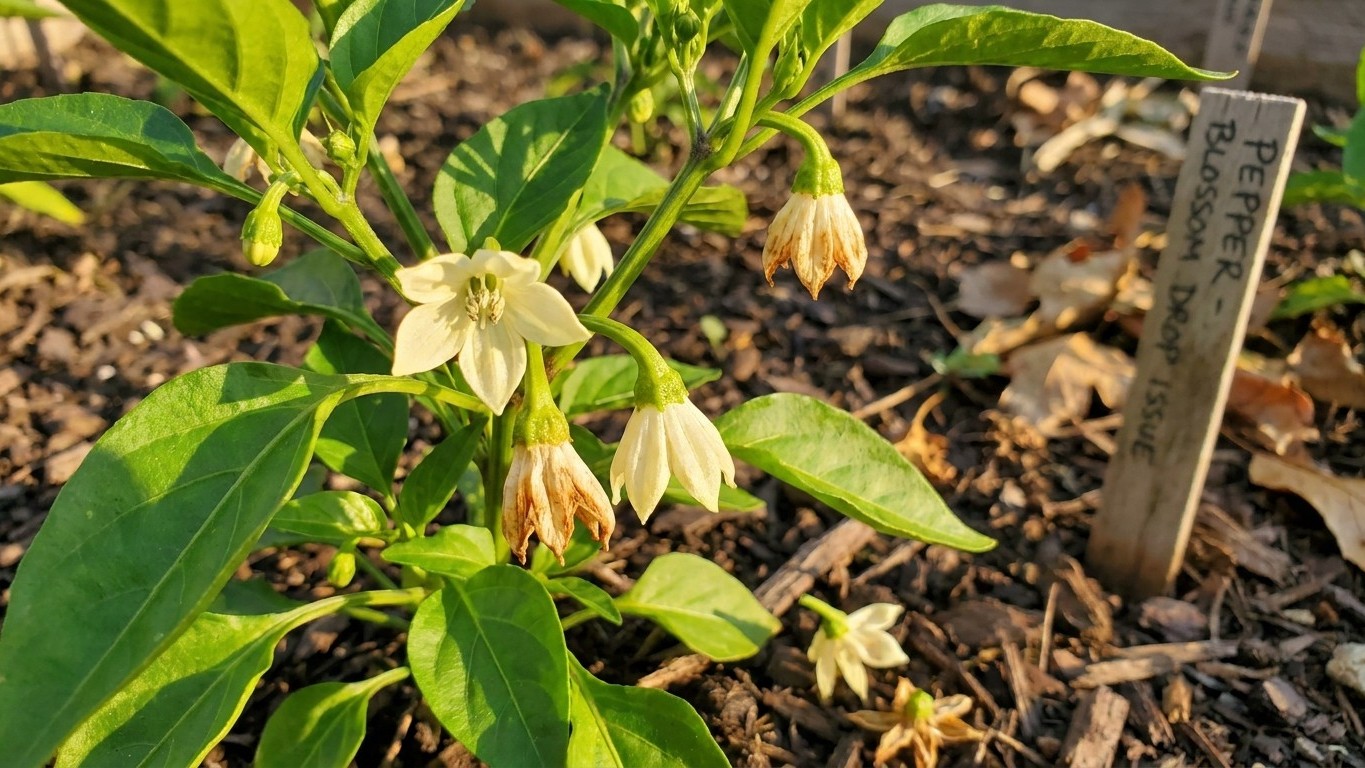

Blossoms falling off a pepper plant almost always trace back to temperature, not soil, water, or fertilizer. Utah State University Extension puts it plainly in its guide Peppers in the Garden: fruit set fails when nights drop below 55°F, or when daytime highs climb above 90°F. Two different failure points, two different fixes, and most gardeners only ever prepare for one of them.
The short answer
Pepper flowers need a narrow temperature window to actually turn into fruit. According to Utah State University Extension, that window closes at both ends: nights colder than 55°F and days hotter than 90°F both cause blossom drop. It’s not one threshold with some wiggle room. It’s two hard limits, and a plant sitting in a garden bed doesn’t get to pick which one it hits.
This matters because most advice a home gardener hears focuses on heat. Peppers are a warm-season crop, the thinking goes, so hotter is better, and any problem must be too much sun or not enough water. That’s only half true. A stretch of unusually cool nights in early summer, the kind that barely registers as a cold snap, can knock blossoms off just as effectively as a heat wave in August. The plant itself often looks fine: healthy leaves, steady growth, plenty of flowers opening. What’s missing is fruit behind those flowers, and that gap is the tell.
The practical takeaway is that blossom drop isn’t a single diagnosis. If you see flowers falling and you’ve had a run of nights that felt unusually cool for the season, even in the 50s, that’s a plausible cause on its own, independent of anything happening during the day. If instead you’ve had a run of days pushing past 90°F, that’s the other side of the same coin. Both produce the identical symptom: flowers open, then drop, with no pepper forming.
Utah State University Extension doesn’t publish a database of nighttime lows by region, so there’s no way to look up whether your particular yard is at risk on any given week. That has to be tracked locally, by paying attention to your own overnight temperatures rather than assuming a summer month is automatically warm enough. Daytime highs are easier to anticipate from regional climate data, but the two thresholds have to be watched separately. Fixing one doesn’t protect against the other.
What actually decides it
Blossom drop isn’t a vague stress response. It’s the plant failing at a specific physiological step, and that step fails differently depending on which end of the temperature range is the problem.
Cold nights below 55°F
Pepper flowers depend on pollen that stays viable and mobile at moderate temperatures. When nights fall below 55°F, pollen doesn’t perform the way it needs to, and fertilization doesn’t happen even though the flower opens normally. The bloom looks complete from the outside. Inside, nothing connects. A few days later the flower yellows at the base and drops, and there’s no pepper behind it because there was never a fertilized ovary to grow one. This is the failure mode gardeners in cooler climates, or in regions with a big day-to-night temperature swing, run into without expecting it. A daytime high in the 80s can mask a night that dipped into the low 50s, and the plant pays for that night three days later when the flower drops.
Hot days above 90°F
The heat-side failure works through a different mechanism. Above 90°F, pollen viability drops off, and the flower itself comes under enough heat stress that the plant treats it as expendable. A pepper plant under sustained heat is triaging: it will shed blossoms and even small developing fruit to protect its own survival rather than push resources into fruit that’s unlikely to mature successfully anyway. This is why blossom drop often clusters right after a multi-day heat spell rather than on the single hottest afternoon. The stress accumulates, and the flowers that were open during the worst of it are the ones that go.
Why the two causes get confused
Because both produce identical-looking symptoms, gardeners often diagnose the wrong one. Someone gardening through a heat wave assumes heat is always the answer, and someone gardening in a mild-summer climate assumes heat can’t be the issue at all, missing that a handful of unusually warm days did the damage. Utah State University Extension’s framing avoids that trap by naming both boundaries as equally valid explanations, without ranking one as more likely than the other.
How to do it
- Track your actual nighttime lows during flowering. Don’t estimate from the season or the region; use a simple outdoor thermometer or a weather station reading for your own yard, since this site does not publish summer night minima by territory.
- Track daytime highs against the 90°F line. Regional day-count data is more commonly available, so check whether your area is running a stretch of days above that threshold during the flowering period.
- Match the drop to the right window. If flowers fell within roughly a few days of a cool night below 55°F, treat that as the likely cause. If they fell after a run of days above 90°F, treat that as the likely cause instead. Don’t assume it’s whichever one is easier to fix.
- Adjust siting and timing for the cold side. If cool nights are the recurring issue, that points toward planting later in the season, choosing a warmer microclimate in the yard, or accepting that early flowers in a cool stretch may not set fruit and later flowers will.
- Adjust for the heat side separately. If hot days are the recurring issue, that points toward afternoon shade during the worst stretch, consistent soil moisture so the plant isn’t fighting heat and drought stress together, and timing plantings so peak flowering doesn’t land on the hottest weeks of the season.
- Reassess after each flush. Pepper plants keep producing new flowers through the season. A round of drop from one temperature extreme doesn’t mean the plant is done; the next flush can set fruit normally once conditions move back inside the 55°F to 90°F window.
What goes wrong
- Blaming heat when the real cause was a cool night. Gardeners see blossom drop in summer and assume it’s always the 90°F threshold, then respond by adding shade or more water, which does nothing if the actual cause was a night that dipped below 55°F. Track both temperature ends before deciding.
- Assuming a mild climate is immune to the heat threshold. A short heat spell, even in a region that’s usually cool, can push daytime highs above 90°F for a few days and cause drop that looks out of place for the local climate. The threshold applies regardless of the region’s usual pattern.
- Guessing nighttime lows instead of measuring them. Because summer night minima aren’t published by territory on this site, gardeners sometimes assume their nights are warm enough based on the daytime forecast. Daytime and nighttime temperatures can diverge sharply, especially in low-humidity regions, so the assumption fails exactly when it matters most.
- Treating one dropped flush as plant failure. A single bout of blossom drop from either temperature extreme doesn’t mean the plant won’t produce. Pulling a plant or drastically changing its care after one bad flush can waste a plant that would have set fruit normally once conditions moderated.
- Fixing the wrong end and then giving up. If a gardener adds shade cloth for heat but the real problem was cool nights, the drop continues, and the conclusion is often “nothing works” rather than “I fixed the wrong threshold.” Reassessing which boundary was actually crossed prevents that dead end.
Common questions
Can both thresholds happen in the same season?
Yes. A single growing season can include a cool stretch early on and a hot stretch later, and each can cause its own round of blossom drop independent of the other. There’s no immunity gained from surviving one extreme.
Does watering more help during a hot spell?
Consistent soil moisture reduces overall plant stress during heat, which matters, but Utah State University Extension’s threshold is about temperature itself, not soil moisture. Watering won’t lower the air temperature the flower is exposed to, so it addresses a related stress rather than the direct cause.
How do I know if a dropped flower was ever going to be a fruit?
There’s no visible marker at the moment of drop. The failure happens internally, either through pollen viability at the cold end or heat stress driving the plant to shed the bloom, and by the time the flower yellows and falls, that decision has already been made.
Should I bring plants indoors or cover them when nights turn cool?
This site doesn’t publish specific night-temperature protection thresholds beyond the 55°F fruit-set boundary from Utah State University Extension. Watching your own nighttime readings against that number is the reliable way to judge risk, rather than relying on general seasonal assumptions.