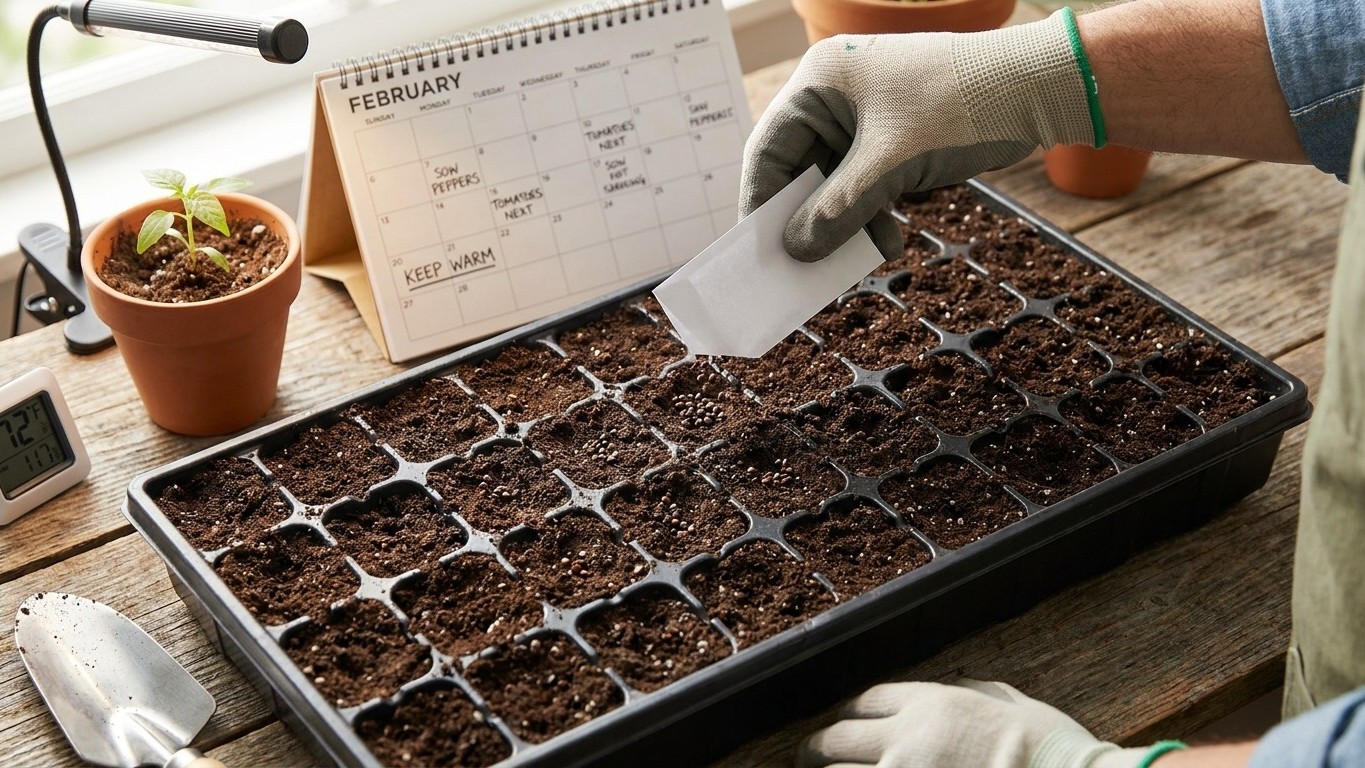

Eight to ten weeks. That’s the window Utah State University Extension gives for growing pepper transplants indoors, and it’s the number that should anchor every January seed-starting calendar. Count backward from your planned outdoor transplant date, land on a sowing date, and the rest of the schedule falls into place around two other markers: soil temperature and frost risk.
The short answer
Utah State University Extension states plainly: allow 8-10 weeks to grow transplants. That’s the figure, full stop, and it’s the one number in this whole process that isn’t up for interpretation. If your transplant date is set for a specific week outdoors, subtract 8 to 10 weeks and that’s when the seed goes into the tray.
Here’s how the math actually plays out. Say your outdoor transplant date lands in a given week of spring. Counting back 8 weeks puts your indoor sowing date about two months earlier. Counting back 10 weeks pushes it another two weeks before that. The spread matters because pepper seed germinates slowly and unevenly compared to something like a squash or a bean, so the extra two weeks in that range isn’t padding, it’s a buffer for seeds that take their time waking up.
The transplant date itself isn’t arbitrary either. Utah State University Extension ties it to two conditions that have to both be true at once: the soil needs to have warmed to 60 F, and the danger of frost needs to have passed. Neither condition alone is enough. A yard can be frost-free with soil still sitting in the low 50s, especially in spots with heavy clay or shade from a fence line, and peppers set into cold soil sulk for weeks even if the air temperature is perfectly pleasant.
There’s a second path worth naming, because not every gardener starts seed indoors at all. Utah State University Extension also covers direct sowing: seed goes into the ground about 2 weeks before the last frost date if you’re skipping transplants altogether. That’s a different calendar with a different logic, built around frost timing rather than a fixed growing window, and it generally produces a later harvest since the plant spends its early weeks outdoors instead of under controlled indoor conditions.
So the short answer has three parts: 8-10 weeks before transplant, transplant only once soil hits 60 F and frost is behind you, or 2 weeks before last frost if seeding straight into the garden. Everything else in growing peppers from seed hangs off these three numbers.
What actually decides it
The 8-10 week window isn’t one single decision point. It’s the sum of several separate mechanisms, each of which can shift your actual sowing date on its own.
Soil temperature, not calendar date
The 60 F threshold is a soil measurement, not an air temperature guess. Soil warms slower than air, sometimes by several weeks in spring, depending on how much sun a bed gets and whether it’s covered in old mulch or bare and dark. A gardener who transplants by the calendar instead of by a soil thermometer risks planting into ground that’s still too cold, even on a warm, sunny week.
Frost danger as a separate gate
Soil temperature and frost risk don’t always clear at the same time. It’s possible to have soil at 60 F while a late frost is still a real risk in a given week, particularly in regions with unpredictable spring swings. Utah State University Extension treats these as two conditions that both must be satisfied, not one substituting for the other.
Fruit set failing at both temperature extremes
Once plants are in the ground and growing, temperature keeps deciding outcomes, just in a different way. Pepper flowers can fail to set fruit when nights drop below 55 F, and they can just as easily fail when daytime highs climb above 90 F. Both ends of that range cause blossom drop, and neither is more forgiving than the other. This site tracks days above 90 F for individual territories, but it does not carry summer night minima, so if your area runs cool at night, that’s something you’ll need to watch yourself rather than assume from latitude or from how cold your winters get. A location with brutal winters can still have warm, stable summer nights, and the reverse is also true.
Mulch timing and soil warmth
Organic mulch is a separate decision with its own threshold. Utah State University Extension advises waiting until soil is above 75 F before laying it down. Mulch applied too soon acts like insulation on cold ground, locking in low soil temperatures right when the plant needs the opposite. This is a distinct mechanism from the 60 F transplant threshold. Soil can clear 60 F and still be well short of 75 F for weeks afterward.
How to do it
- Pick your outdoor transplant date based on when your local soil typically reaches 60 F and frost danger has passed in your area, not on a fixed spot on the calendar.
- Count back 8 to 10 weeks from that transplant date, per Utah State University Extension, to find your indoor sowing date.
- Sow pepper seed indoors on that date, in trays or cells with a seed-starting medium.
- Grow the seedlings indoors under consistent conditions, watching for slow, uneven germination since peppers are not fast starters compared to many other vegetable seeds.
- Hold seedlings indoors until both outdoor conditions are actually met: soil measured at 60 F or above, and frost risk cleared for your area.
- Harden off the seedlings gradually before the final move outdoors.
- Transplant into the garden once both threshold conditions are confirmed, not estimated.
- Wait until soil temperature climbs above 75 F before laying any organic mulch around the transplants.
- If you’re skipping indoor starts entirely, seed directly into the garden about 2 weeks before your last frost date instead of following the 8-10 week indoor schedule.
What goes wrong
- Sowing too early, leggy seedlings by transplant time. Counting back more than 10 weeks stretches seedlings past their prime indoors, leaving them tall and weak before the soil is even ready. Stick to the 8-10 week window and don’t pad it further.
- Transplanting on the calendar instead of by soil temperature. A seedling moved outdoors because “it’s late spring” rather than because the soil actually measured 60 F often stalls for weeks. Check soil temperature directly with a thermometer before moving anything outside.
- Moving plants out before frost danger has actually passed. Soil can be warm enough while a late frost is still possible in a given week. Wait for both conditions, soil at 60 F and frost risk cleared, before transplanting.
- Mulching before soil hits 75 F. Organic mulch laid on cool soil traps that coolness in place and slows the very warming the plant needs. Hold off until soil is confirmed above 75 F.
- Blossom drop from cold nights. Nights under 55 F stop fruit set even when the plants look healthy otherwise. Since summer night minima aren’t tracked by territory here, watch your own overnight lows rather than guessing from regional reputation.
- Blossom drop from excessive daytime heat. Days above 90 F cause the same fruit-set failure from the opposite direction. Check how many days above 90 F your specific area typically sees and plan for shade or timing adjustments accordingly.
- Direct-sowing too close to or too far from the last frost date. Seeding earlier than 2 weeks before last frost risks cold damage, while waiting much longer delays the harvest unnecessarily. Utah State University Extension’s 2-week mark is the reference point for direct sowing.
Common questions
Can I start pepper seeds earlier than 10 weeks before transplanting?
Utah State University Extension’s guidance caps the useful window at 8-10 weeks. Starting earlier tends to produce overgrown, leggy seedlings that struggle once they’re finally moved outdoors, rather than giving them a head start.
What if my soil still hasn’t reached 60 F on my planned transplant date?
Wait. Utah State University Extension ties transplanting to the soil actually reaching 60 F, not to a fixed date. Holding seedlings a bit longer indoors is far less risky than setting them into cold ground.
Can I skip starting seeds indoors and just direct-sow peppers?
Yes, Utah State University Extension covers this option too: seed directly about 2 weeks before your last frost date. It’s a different schedule from the 8-10 week indoor method and generally results in a later harvest.
Why did my pepper flowers drop even though I followed the transplant schedule?
Fruit set can fail at both temperature extremes, nights below 55 F and days above 90 F. The schedule gets your plants into the ground safely, but ongoing temperature swings during flowering are a separate factor you’ll need to monitor locally, since night minima aren’t published by territory here.