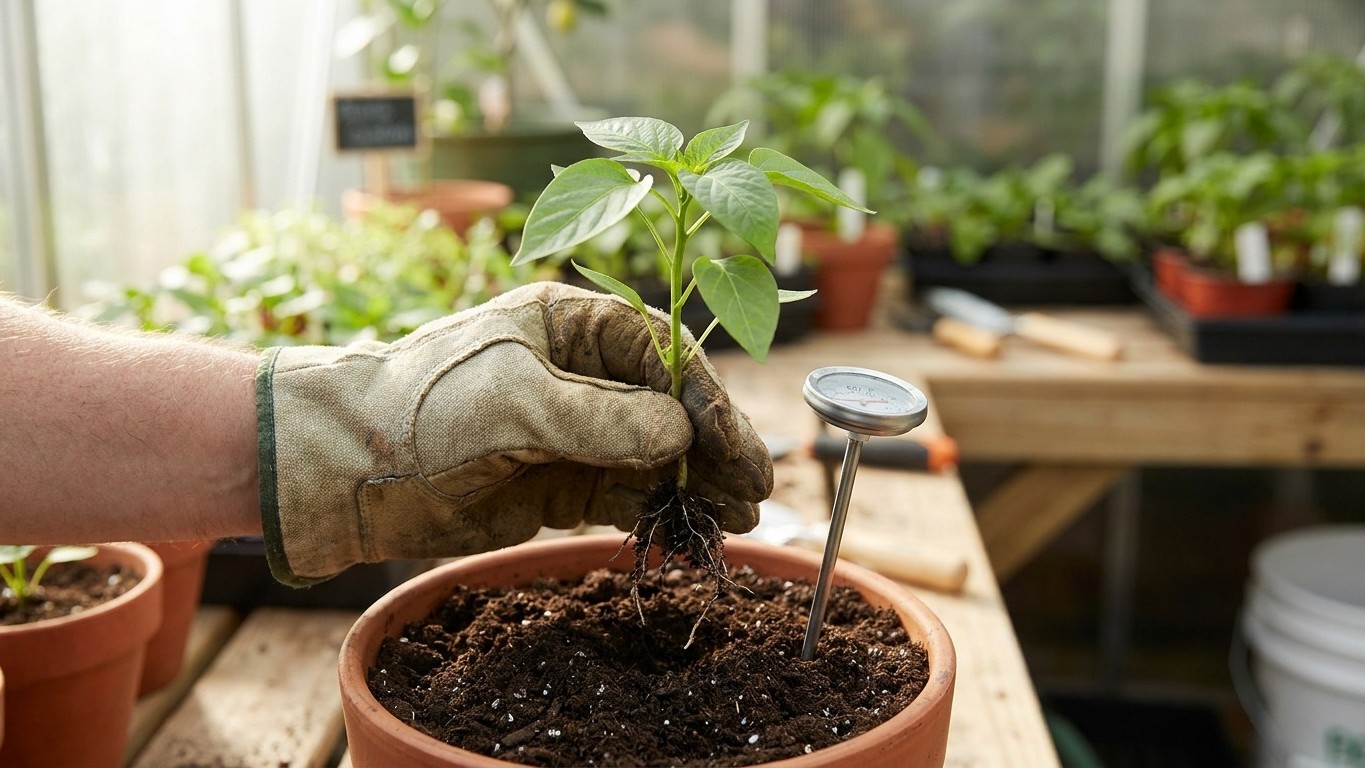

Wait until soil reaches 60 F before transplanting peppers, and only after all danger of frost has passed. That threshold comes from Utah State University Extension’s guide to growing peppers, and it isn’t a suggestion you can shave a week off. Peppers set into colder ground stall long before they show any visible damage.
The short answer
Sixty degrees Fahrenheit at root depth is the number Utah State University Extension gives for safe transplanting, and it comes paired with a second condition that gardeners sometimes skip past: frost danger has to be gone first. Soil temperature and air temperature don’t always move together in spring. A sunny afternoon can push topsoil past 60 F while a clear night still drops cold enough to kill a young transplant outright. Both boxes need to be checked, not just one.
Behind that transplant date sits another number that trips up a lot of gardeners every January: Utah State University Extension recommends allowing 8 to 10 weeks to grow transplants indoors. That means the indoor sowing date isn’t picked from a calendar habit, it’s counted backward from whenever your soil is realistically going to hit 60 F in your yard. Guess the transplant date wrong and the seedlings are either leggy and rootbound waiting for warm ground, or too small and fragile to handle the shock of the garden.
If you’d rather skip the indoor stage entirely, direct seeding is an option, but the timing rule flips. Utah State University Extension recommends seeding two weeks before the last frost date when sowing peppers directly in the ground, since the seed itself tolerates cooler soil better than a transplanted seedling does. That’s a narrower, riskier window, and it only works in areas where the growing season runs long enough to make up for the slower start.
One more soil-temperature threshold shows up later in the season and gets ignored constantly: mulch. Laying organic mulch too early insulates cold soil and keeps it cold. Utah State University Extension is specific that you should wait until soil is above 75 F before mulching peppers, well after the 60 F transplant threshold. The mulch is a summer tool, not a spring one.
What actually decides it
Root growth stalls in cold soil
Pepper roots are built for warmth. When soil sits below that 60 F line, root growth slows to the point where the plant can’t take up nutrients fast enough to support new leaf growth. The plant doesn’t necessarily die. It just sits there, sometimes for weeks, looking faintly purple or yellow and doing nothing while soil that’s still too cold keeps it in a holding pattern. Gardeners often blame this on transplant shock or a bad batch of seedlings, when the real cause is a soil thermometer reading nobody checked.
Frost is a separate threat from cold soil
Soil temperature and frost risk are two different clocks, and they don’t run at the same speed. Soil can warm to 60 F on a string of sunny days while the last frost of the season is still a week or two away, especially in low-lying spots where cold air pools overnight. Transplanting the moment the soil thermometer clears 60 F, without checking the frost outlook, is how a whole flat of seedlings gets wiped out in one clear, cold night.
Fruit set fails at both temperature extremes
Even after a pepper plant survives transplanting and starts flowering, temperature keeps deciding the outcome. Utah State University Extension is explicit that fruit set fails when nights drop lower than 55 F, and it fails just as reliably when days climb above 90 F. Growers tend to brace only for the heat, watching for scorching afternoons, and get caught off guard by a stretch of unusually cool nights that drops blossoms just as thoroughly as a heat wave would. This site tracks the count of days above 90 F for individual territories, but summer night minimums aren’t part of that dataset. Where cool nights are the likelier problem in your area, that’s something you have to watch on your own thermometer. Don’t guess at it from your latitude or from how cold your winters run. Winter cold and summer night lows aren’t the same measurement, and one doesn’t predict the other.
How to do it
- Count backward from your expected transplant date. Using the 8 to 10 week window Utah State University Extension gives for growing transplants, work out the indoor sowing date based on when your soil realistically reaches 60 F, not on a fixed calendar date.
- Sow indoors and grow under consistent warmth and light. The 8 to 10 week period is meant to produce a sturdy, compact transplant, not an oversized one waiting on cold ground.
- Track soil temperature directly, at root depth, in the bed you’re planting into. Air temperature and forecasts are not a substitute for a soil thermometer reading.
- Confirm frost danger has passed before moving plants outside. A single reading above 60 F on a warm afternoon isn’t enough if a frost is still forecast.
- Transplant once both conditions are met: soil at or above 60 F, and no more frost risk. This is the point where the plant’s roots can actually use the warmth instead of sitting stalled in it.
- If direct seeding instead, sow two weeks before your last frost date. This is the one step in the sequence that runs on a different clock than the transplant method.
- Hold off on organic mulch until soil is above 75 F. Mulching earlier locks in cold soil right when the plant needs it warming up.
What goes wrong
- Transplanting into soil still under 60 F. The plant survives but stalls, showing pale or purplish leaves and no new growth for weeks. Fix it by checking soil temperature directly before planting, not the air forecast, and holding off until the reading clears 60 F.
- Trusting a warm day and ignoring the frost forecast. Soil can hit 60 F while a frost is still likely overnight, especially in low spots. Fix it by confirming frost danger has fully passed, using both the soil reading and the frost outlook before moving plants outside.
- Mulching before soil reaches 75 F. Organic mulch applied too early traps cold in ground that hasn’t finished warming, slowing the plant down for the rest of the season. Fix it by waiting for a soil reading above 75 F before laying mulch, well after the transplant stage.
- Blaming blossom drop only on heat. Growers watch for days above 90 F and assume that’s the only threat, but nights below 55 F drop blossoms just as reliably. Fix it by tracking your own overnight lows through the flowering period, since summer night minimums aren’t something you can infer from your area’s winter cold or its latitude.
- Direct seeding too close to the last frost, or too far from it. Sowing right up against the frost date risks losing seedlings to a late cold snap; waiting too long past the two-week window shortens the whole growing season. Fix it by seeding two weeks before your last frost date, as Utah State University Extension recommends, and not adjusting that window based on a warm spell.
Common questions
Can I use air temperature instead of checking soil temperature?
No. Air and soil warm at different rates, and Utah State University Extension’s 60 F threshold is a soil measurement taken at root depth. A warm afternoon reading on a thermometer left in the sun tells you nothing useful about the ground your transplants will actually sit in.
How far apart are the indoor sowing date and the transplant date?
Utah State University Extension allows 8 to 10 weeks to grow transplants indoors before they go in the ground. Count backward from the date your soil typically reaches 60 F and frost danger has passed in your area to land on the right sowing date.
Why did my peppers stop setting fruit in the middle of summer?
Fruit set fails at both temperature extremes. Utah State University Extension notes it happens with nights below 55 F and with days above 90 F. Check your local overnight lows as well as daytime highs before assuming heat is the only culprit.
Is direct seeding a realistic alternative to starting seeds indoors?
It can work, but the timing is different and less forgiving. Utah State University Extension recommends seeding two weeks before the last frost date for direct sowing, a narrower window than the indoor-transplant method allows, and it demands a longer overall growing season to make up the slower start.