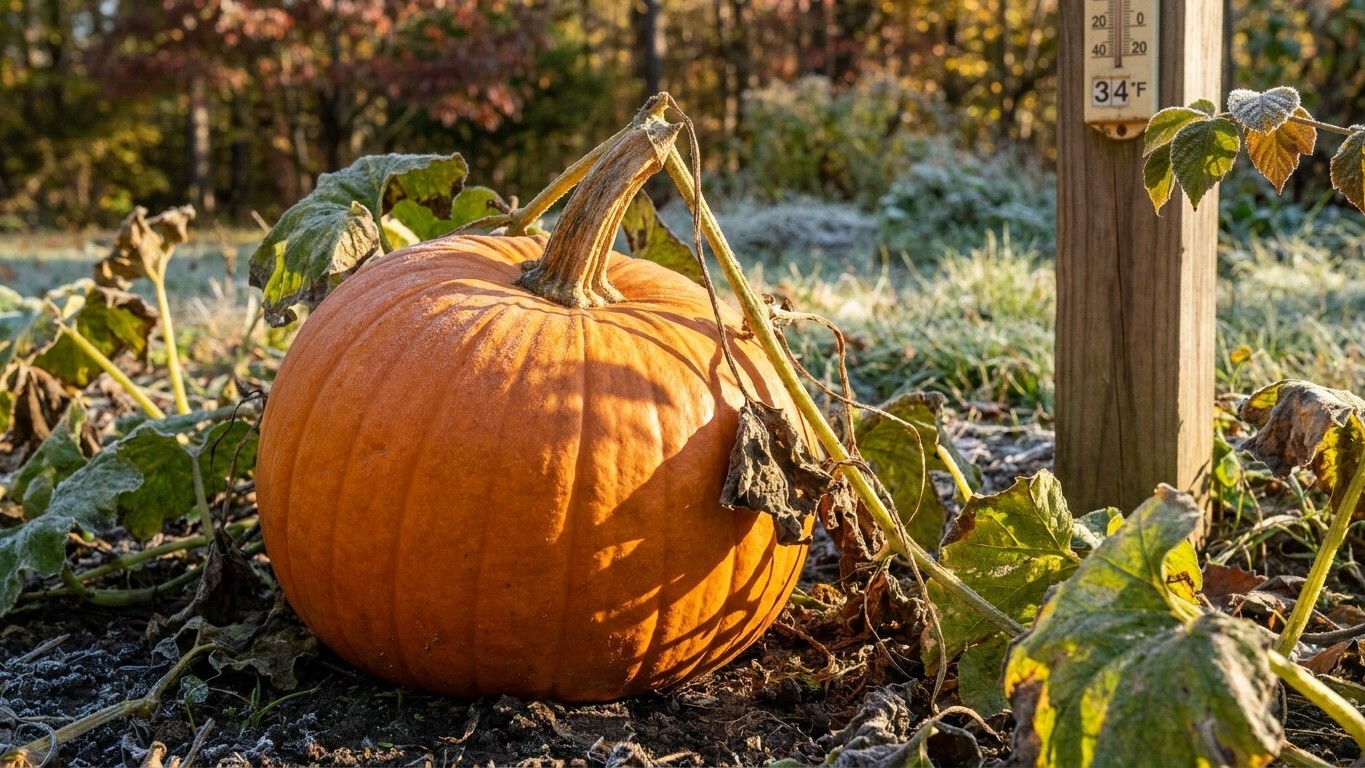

Yes, in most years, but only if the flowers open on schedule, not just the seeds. Will Pumpkins Ripen Before Frost in Georgia? Georgia’s first fall frost typically lands between November 13 and December 1, and a pumpkin flower needs 45 to 55 days after it opens to become a hard, ripe fruit. Line those two facts up and a real planting calendar appears, built on dates rather than hope, which is exactly why knowing When to Sow Pumpkins in Georgia matters so much. Miss the window at either end and the result is a green pumpkin sitting on a collapsed vine. Here’s how the math actually plays out, county by county.
The short answer
Georgia’s first fall frost doesn’t arrive on a single day. NOAA’s 1991-2020 climate data puts the window between November 13 and December 1, based on the 30 to 70 percent probability band for a 32 F freeze at the Atlanta-area station. That’s nearly three weeks of uncertainty before frost even becomes likely, and it’s the number every pumpkin grower in the state has to work backward from.
A pumpkin flower needs 45 to 55 days after it opens, not after the seed goes into the ground, to turn into a fruit with a hardened, colored rind. That distinction trips up a lot of first-time growers who count from the planting date instead of the bloom date. A vine can sit in the ground for weeks putting out leaves and male flowers before a single female flower, the one with the tiny fruit already swelling at its base, opens and gets pollinated. The clock that matters starts there, not at the seed packet.
Run the subtraction against the earliest possible frost date, November 13, and a female flower needs to open by around September 19 to guarantee the full 55 days. Run it against the latest possible frost date, December 1, and a flower opening as late as October 17 could still squeak by on the faster 45-day timeline. That’s the real window: somewhere between September 19 and October 17 is the last safe date for a flower to open and still finish before frost, depending on how the season unfolds and where in the state the garden sits.
The safer bet is the earlier end of that range. North Georgia and the mountains freeze several weeks ahead of the state average, so a grower in Rabun or Union County shouldn’t count on that December 1 cushion. The coastal plain runs milder and can push the real frost date later than the state window suggests, which gives growers around Valdosta or Waycross more room to let a late flower ride. Atlanta’s own frost date is skewed by the urban heat island of the airport station used to measure it, so treating that number as a stand-in for a rural county nearby overstates how much time is actually available.
None of this promises a ripe pumpkin. It sets the boundaries a grower has to plant inside of. A flower that opens outside that window, on either end, is a flower that either never gets pollinated in time or gives a fruit that frost catches before the shell hardens.
When to sow here
Sowing date isn’t set by the calendar square marked “last frost.” It’s set by the soil, and the soil takes its own time catching up to the air.
- Georgia’s last spring frost falls between March 11 and March 29 in most of the state, based on the same NOAA freeze-probability data used for the fall window.
- Soil temperature doesn’t cross 65 F, the mark pumpkin seed needs for reliable germination, on the day frost clears. It lags the air by weeks, warming slowly as the sun angle climbs and cooling back down after every cold rain.
- Waiting for two full weeks of consistently warm days after the last frost date is a reasonable way to let that lag play out before pushing a thermometer into the bed.
- A soil thermometer read 3 inches deep, checked in the morning before the surface heats up, gives a truer number than guessing off the forecast air temperature.
- Row covers can buy roughly two extra weeks, trapping ground heat and letting a grower set seed a little earlier than bare soil would otherwise allow.
- Whatever date the soil actually hits 65 F becomes the real start of the season, the point every later calculation about flowering and frost should be measured from, not the frost date itself.
Treat the two dates, last frost and 65 F soil, as separate lines on the calendar rather than one. In the mountains, where cool nights linger longest, that 65 F mark can arrive noticeably later than in the coastal plain, where sandy soils warm fast under the same spring sun. That gap runs in the same direction as the fall frost data: a Piedmont or mountain grower ends up with both a later safe sowing date and a tighter fall window, which shortens the growing season twice over instead of once.
What goes wrong here
- A late flower that never colors. A vine that keeps blooming into September or October, past the safe cutoff worked out above, sets fruit that simply runs out of days. The rind may size up but never hardens or turns from green to orange before frost ends the season. The fix is to stop new flowers from setting once the calendar passes the local cutoff, pinching off blooms so the vine’s energy goes into fruit already on it instead of starting fruit that has no chance of finishing.
- A fruit caught by frost before it hardens. Even a fruit that started on time can run into an early frost, since the fall window spans nearly three weeks of uncertainty. Utah State University Extension’s guidance is to harvest with the stem attached and move fruit to a spot where it will not freeze, rather than leaving it on the vine gambling on a late frost. A fruit that’s already fully colored and firm-shelled when frost threatens is worth cutting early rather than risking it.
- A vine that dies back before the skin hardens. Pest pressure, particularly from squash bugs and cucumber beetles, can collapse a vine weeks before the fruit is ready, cutting off the leaf area a plant needs to finish hardening the rind. Both pests already have their own Georgia-specific pages on this site covering identification and control; a vine showing wilting runners or shot-holed leaves in August is often a pest problem, not a season-length problem, and worth checking against those pages directly.
Checking this against your own county
Everything above is a statewide range built from a single weather station’s climate normals, and Georgia is a big state, stretching from mountain valleys in the north to sandy coastal plain in the southeast. The frost windows and soil-warming pace described here shift by weeks depending on where a garden actually sits, and no single date works for both Blairsville and Brunswick.
The University of Georgia Cooperative Extension keeps county-level frost data and planting guidance through its local offices, and a call or visit to the office serving a specific county is the most reliable way to pin down an actual local frost date rather than relying on a statewide average. Extension agents also track local pest pressure and soil conditions that a national data set can’t capture.
Anyone gardening near a river bottom, on a ridge, or right along the coast should treat the numbers in this article as a starting point for that conversation, not the final word for a particular plot.
Common questions
What happens if a pumpkin flower opens after the safe cutoff?
The fruit will likely still form and size up, but it runs out of days before the rind fully hardens and colors. Frost typically ends the process before it finishes, leaving a green or pale fruit that won’t store or carve the way a properly ripened one would.
Does Atlanta’s frost date apply to the whole state?
No. The November 13 to December 1 window comes from an Atlanta-area station affected by the urban heat island of the airport itself. North Georgia and the mountains typically freeze several weeks earlier in the fall, while the coastal plain tends to stay frost-free later than that window suggests.
Does starting seeds indoors get around the soil temperature rule?
Not entirely. A transplant still goes into outdoor soil that needs to be near 65 F for the roots to establish without stalling, so an indoor head start shifts the timeline slightly but doesn’t remove the wait for warm ground.
How should ripe pumpkins be stored after harvest?
Utah State University Extension’s guidance doesn’t specify a storage temperature or keeping time, only that fruit should be kept somewhere it won’t freeze. Harvest with the stem attached and move fruit indoors or to a sheltered spot once a hard freeze is forecast.