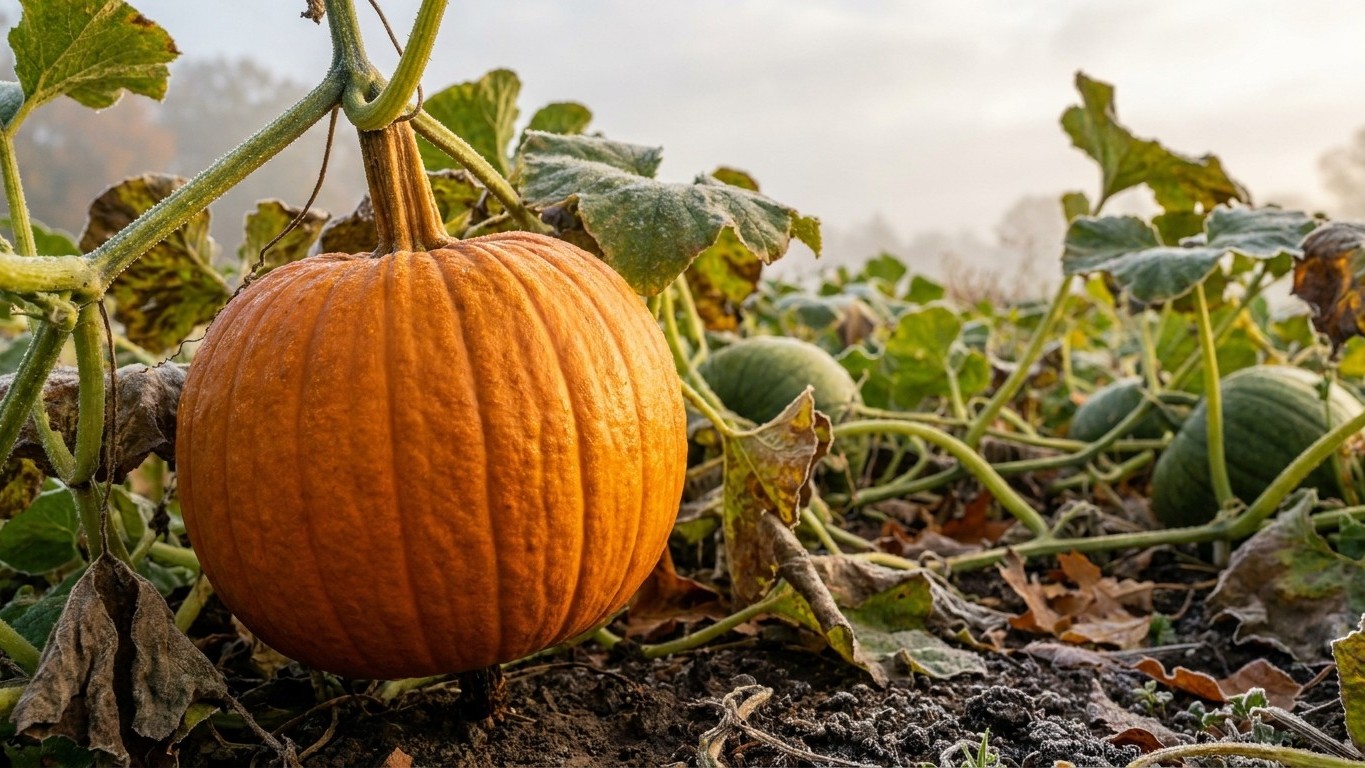

Will Pumpkins Ripen Before Frost in Ohio? Yes, but only if the vine’s flowers open before the third week of August. Ohio’s zone 6a growing season closes with the first fall frost, expected between October 5 and October 15 according to Ohio State University Extension. Pumpkins need 45 to 55 days from bloom to ripen, per Utah State University Extension. Miss that flowering window and the fruit stays green on the vine no matter how big or healthy the plant looks.
The short answer
Ohio’s first fall frost in zone 6a falls somewhere between October 5 and October 15, according to Ohio State University Extension’s Ohio Gardening Calendar. That range is the wall every pumpkin vine in the state is racing toward. Utah State University Extension puts pumpkin maturity at 45 to 55 days after flowering, not after seeding and not after the vine sets its first true leaf. Count backward from the earlier end of that frost window, October 5, and the math gets tight fast.
A flower that opens by August 11 has the full 55 days to work with even if frost arrives on the early side. A flower opening around August 21 only has 45 days before that same October 5 date, which means only the quicker fruit on the vine will color up in time. Anything still tracking toward the full 55 days is betting on frost holding off until the later end of the window, October 15. Push flowering past August 21 and there’s no more room to negotiate: the outcome depends entirely on which end of that ten-day frost window shows up in a given year, and the Extension range doesn’t say which one to expect.
This is why growers fixate on when the vine flowers, not when it was planted and not even when the fruit first sets. A pumpkin can look enormous and green in early September and still be weeks from having any color, because the clock that matters started at bloom.
Utah State University Extension’s pumpkin guide names several varieties gardeners commonly grow, including Jack O’Lantern, Connecticut Field, Big Max, Atlantic Giant, Sugar Pie, Baby Boo, Casper, Lumina, and Jack Be Little. The source doesn’t publish days-to-maturity, fruit size, or color figures for any of them individually, so there’s no way to say from that guide alone whether a given variety leans toward the 45-day end or the 55-day end. Whatever is planted, the same rule applies: the flowering date matters more than the name on the seed packet.
The practical takeaway for Ohio growers is to work backward from the flowering deadline, not forward from hope. If the goal is a pumpkin with real orange skin by Halloween, the vine needs its first productive flowers open no later than the third week of August, and everything upstream of that, including When to Sow Pumpkins in Ohio, soil temperature, transplant timing, has to be scheduled with that deadline already in mind.
When to sow here
Working out a sowing date in Ohio means ignoring the frost calendar for a minute and looking at the ground itself.
- Start from the last spring frost window. Ohio State University Extension’s Ohio Gardening Calendar puts it at May 5 to May 15 in zone 6a. That date matters for tender transplants in general, but pumpkin seed doesn’t respond to air temperature at all.
- Wait for the soil, not the calendar, to hit 65 F. Utah State University Extension is specific here: pumpkin seed goes in once soil temperature reaches 65 F, a threshold measured in the ground, not in the air above it. Treating the last frost date as the sowing date is a mistake that costs real time later in the season.
- Expect that 65 F reading well after frost has passed. Bare soil in Ohio in early May is still cold from winter even once the air stops threatening a freeze, so the gap between frost clearing and soil actually reaching 65 F commonly runs into the following weeks, not days.
- Use row covers to close part of that gap. Row covers warm the soil underneath faster than bare ground is exposed to open air, buying roughly two weeks compared with an uncovered bed.
- Run the arithmetic against the flowering deadline. If soil reaches 65 F in very late May without covers, or roughly two weeks earlier with them, count forward to the date the vine is likely to flower, then check that date against the August 11 to August 21 window described above. That comparison, not the planting date by itself, is the only test that tells a grower whether the season is long enough.
Two weeks sounds small on paper. Against a 45-to-55-day flower-to-ripe clock squeezed between a soil that warms slowly and a frost that can arrive as early as October 5, it’s often the difference between a pumpkin with color and one that isn’t.
What goes wrong here
Ohio’s frost-bound season produces the same handful of failures year after year, and each one traces back to timing rather than bad luck.
- A late flower that never colors. Vines that flower after August 21 push fruit-set into September, and the pumpkin spends its final weeks racing a shrinking clock instead of ripening. The remedy is to pinch off new flowers once the calendar makes it clear they can’t finish, redirecting the plant’s energy into the fruit that already has a chance.
- A fruit caught by frost while still green. Even a well-timed flower can lose the race if frost arrives at the early end of the October 5 to October 15 window. Utah State University Extension’s guidance is to harvest with the stem attached before frost hits, rather than leaving a fruit on the vine hoping for a few more days of coloring.
- A vine that dies back before the skin hardens. A stripped or collapsed vine stops feeding the fruit long before the rind has toughened enough for storage. Keeping the foliage healthy through the back half of the season, watching for stress and disease pressure rather than assuming the plant will hold on, gives the rind the time it needs to finish hardening.
Insect pressure compounds all three failures by weakening the vine earlier than the season already threatens to. Squash bugs and cucumber beetles are common on Ohio pumpkin vines, and both already have their own dedicated pages on this site covering identification and control, so there’s no need to repeat that ground here.
Checking this against your own county
Zone 6a covers a wide stretch of Ohio, but frost doesn’t arrive on the same day in a river valley near Cincinnati and on a ridge near Cleveland. The October 5 to October 15 range from Ohio State University Extension is a statewide window, not a county-by-county forecast, and the same is true of the May 5 to May 15 spring range.
The most reliable next step is checking those dates against local records through Ohio State University Extension, which maintains county offices across the state with data specific to local microclimates. A grower on a valley floor with cold air pooling overnight should plan around the earlier end of the frost window; one on higher, better-drained ground can often push the later end with more confidence. Either way, the 45-to-55-day flowering rule doesn’t change. Only the date it gets measured against does.
Common questions
Can a pumpkin ripen after it’s cut from the vine?
Utah State University Extension’s guidance centers on harvesting with the stem attached before frost, not on curing green fruit indoors afterward. The source doesn’t publish a process for ripening cut pumpkins, so there’s nothing sourced here to recommend on that front.
Does a warm September make up for a late flower?
No. The 45-to-55-day window is tied to flowering date and frost arrival, not to how warm the weeks in between happen to be. A late-August flower still needs the same 45 to 55 days regardless of temperature swings during that stretch.
Where should a harvested pumpkin be stored?
Utah State University Extension’s guidance only says to keep harvested pumpkins where they will not freeze. No storage temperature, humidity level, or keeping time is published in that source, so any more specific figure would not be coming from this guidance.
Should soil temperature or air temperature drive the sowing decision?
Soil temperature. The 65 F threshold from Utah State University Extension is measured in the ground, and soil warms weeks behind the air around it. Sowing by the last frost date alone risks putting seed into soil that hasn’t caught up yet.