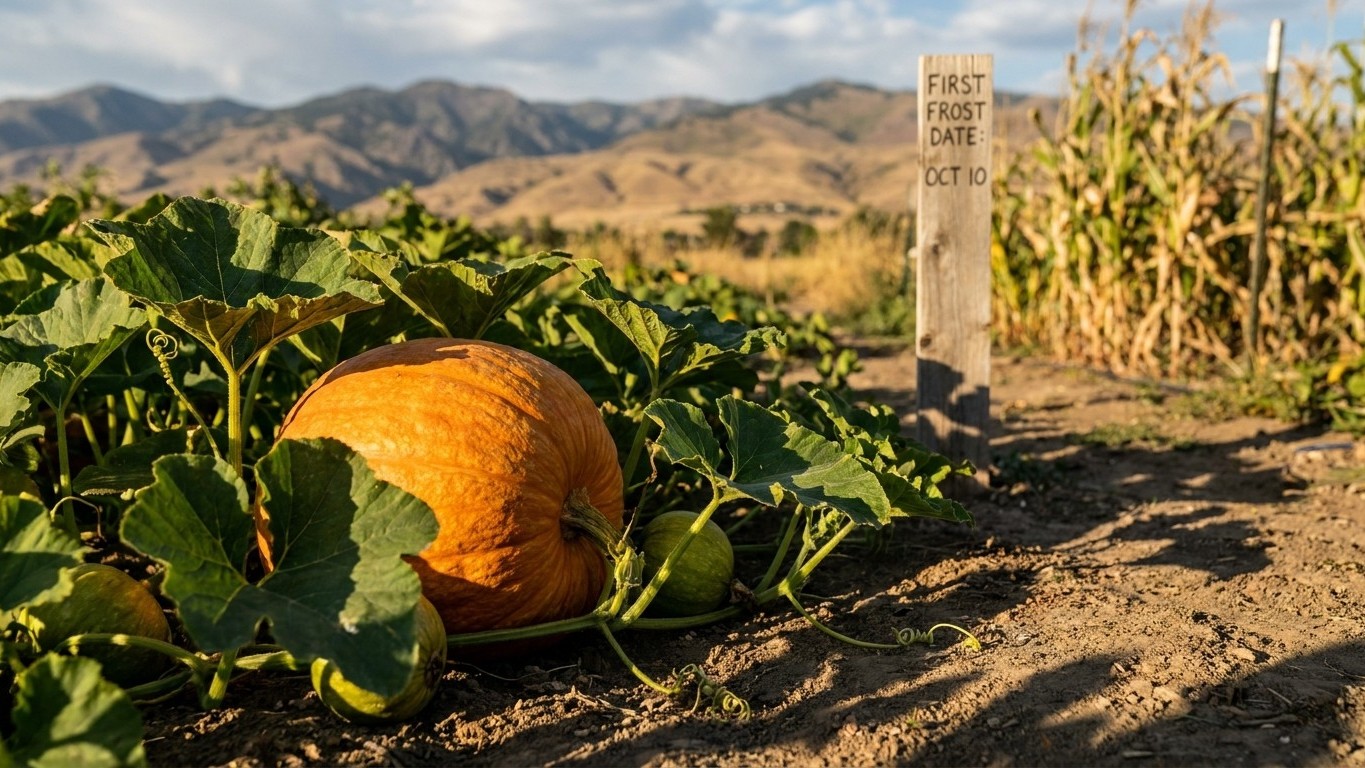

Idaho’s answer depends entirely on where you’re standing. In the Boise valley, a pumpkin sown and tended with care can ripen before the ground freezes, but only if its flower opens by early September at the latest. Climb into higher, colder pockets of the state, and that same math turns unforgiving fast. This isn’t a season you can eyeball. It’s a season you calculate backward from frost, starting with the bloom, not the seed packet, which is the whole question behind Will Pumpkins Ripen Before Frost in Idaho?
The short answer
Around Boise, the first fall frost typically lands somewhere between October 7 and October 21, according to NOAA’s 1991-2020 Climate Normals for that station. That’s not a single date. It’s a two-week band, and which end of it you get in any given year is partly luck. Pumpkins need 45 to 55 days from the moment a female flower opens to reach a fully colored, hardened fruit, per Utah State University Extension. Count backward from frost, not forward from planting, and the picture gets specific.
If your local frost tends toward the early edge of that window, October 7, the last flower with any real shot at ripening needs to open between roughly August 13 and August 23. Miss that, and you’re gambling. If your area sits on the later edge, October 21, you get more breathing room: a flower opening as late as August 27 to September 6 can still finish in time. That’s nearly two extra weeks of flowering window, just from where you happen to garden within the same broad frost range.
Here’s the catch that trips up a lot of backyard growers: Boise sits in a low valley, which means it’s about as forgiving as Idaho gets. Most of the state sits higher and colder, with growing seasons that close weeks earlier than the capital’s. A grower in a mountain valley or on the eastern high plains isn’t working with the October 7-21 window at all. Their first frost likely arrives sooner, sometimes considerably sooner, which pushes the last-safe-flower date backward too. There’s no single number for the whole state, and any answer that pretends otherwise is guessing.
What this means practically: track when your vines actually start setting female flowers (the ones with a small swelling at the base), not just when the plant starts blooming male flowers, which show up first and don’t count. Once you see a female flower open, start a 45-to-55-day countdown against your local frost history. If the math doesn’t clear, that fruit is likely headed for the compost pile green.
When to sow here
- Wait past the last spring frost window, which for the Boise area runs April 23 to May 7. Planting before this range risks a young seedling getting killed outright. For a full breakdown of When to Sow Pumpkins in Idaho, timing depends heavily on your specific region’s frost dates.
- Don’t stop at the frost date. Soil needs to reach 65 F before pumpkin seed will germinate reliably, according to Utah State University Extension, and soil warms far slower than the air above it. A yard can sit weeks past its last frost and still have cold, sluggish soil a few inches down, especially in shaded or heavy clay ground.
- Check soil temperature directly with a probe thermometer rather than guessing from the calendar. This is the single most common mistake: growers see a frost-free forecast and plant, only to have seed rot in soil that’s still too cold to sprout it.
- If you want to sow earlier without losing seed to cold soil, use row covers or clear plastic mulch. Warming the soil this way can buy roughly two weeks over bare ground, which matters when your growing window is already tight.
- Pick a variety suited to shorter seasons rather than assuming they’re interchangeable. Common names growers in shorter-season regions turn to include Connecticut Field, Jack O’Lantern, Sugar Pie, Baby Boo, Casper, Cinderella, Big Max, Howden, and Autumn Gold. No days-to-maturity or size figures are published here for these, so check the seed packet itself rather than relying on the name alone.
Put together, the arithmetic looks like this: last frost clears by early May at the latest, but soil temperature might not hit 65 F until well into May or even early June depending on your specific yard. Row covers can pull that sowing date forward by about two weeks. Every day gained at the front end is a day of slack at the back end, when frost is bearing down on an unripe fruit.
What goes wrong here
- A late flower that never colors. The vine keeps blooming into late summer, a fruit sets, and then frost arrives before it’s had its 45 to 55 days. The fruit stays pale green and hard-shelled but never develops full color. Remedy: once you’re within 55 days of your area’s expected first frost, pinch off new female flowers so the plant’s energy goes into fruit already set instead of doomed latecomers.
- A fruit caught by frost before the skin hardens. A soft rind won’t store and won’t finish ripening properly once picked. Remedy: watch the extended forecast closely as your frost window approaches, and if a hard freeze is coming early within the October 7-21 range, cover vines overnight with sheets or row cover fabric to buy a few more days.
- A vine that dies back before the fruit is ready. Powdery mildew and other late-season vine diseases can shut a plant down weeks before frost actually arrives, cutting the ripening clock short even in a year with a favorable frost date. Remedy: keep foliage as dry as possible with morning watering at the soil line rather than overhead, and remove badly infected leaves promptly rather than letting disease spread across the whole vine.
- Pest pressure weakening plants right when they need to finish strong. Vines stressed by feeding damage put less energy into fruit development. For identification and treatment specific to this state, see this site’s pages on squash bugs in Idaho and cucumber beetles in Idaho rather than guessing at what’s chewing your leaves.
Once frost does hit or a hard freeze is unavoidable, harvest with the stem attached and move fruit somewhere it won’t freeze, per Utah State University Extension. That source doesn’t publish a specific storage temperature or keeping time beyond that guidance, so don’t assume a number that isn’t there.
Checking this against your own county
Boise’s frost window is a starting point, not a statewide answer. Elevation changes fast in Idaho, and a difference of a thousand feet can shift your first frost by weeks. Before you commit to a sowing date, contact University of Idaho Extension for your county. Extension offices track local frost data and can tell you whether your specific area runs closer to, or well outside of, the Boise valley’s timing. That single conversation can save an entire season of guessing.
Common questions
Can I start pumpkin seeds indoors in Idaho to get a head start?
Starting seed indoors and transplanting after soil has warmed can shave time off the season, since the plant doesn’t have to sit waiting in cold ground. Just harden seedlings off before moving them outside, and still wait until soil conditions outdoors are suitable.
Which pumpkin variety matures fastest for a short Idaho season?
No days-to-maturity figures are given here for any specific variety, so check the seed packet for that number directly rather than relying on a name alone. Growers in shorter-season areas often favor smaller varieties over large ones, but confirm the maturity window before you buy.
How do I know when a pumpkin is actually ripe?
Utah State University Extension recommends harvesting with the stem attached, and doing so before frost hits. A hardened rind that resists a fingernail press and full color for the variety are the practical signs to watch for.
Will a green pumpkin ripen after I pick it?
This isn’t addressed with specific data in the source used for this page. What is published is that fruit should be harvested before frost and kept somewhere it won’t freeze. Don’t assume a green pumpkin will fully color up once separated from the vine.