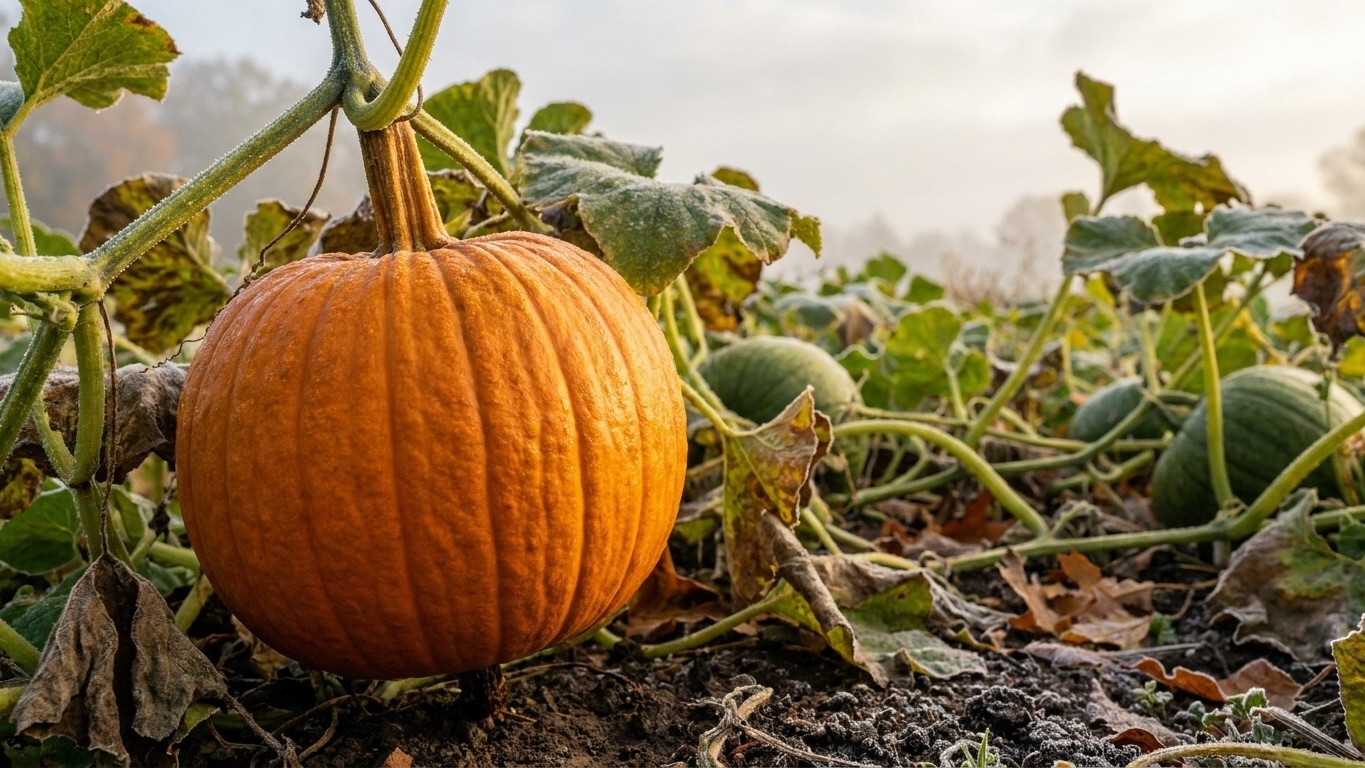

Yes, pumpkins can ripen in most of Ontario, but only if the flowers open early enough. Working back from the province’s average first fall frost of October 16, the last safe window for a pumpkin blossom to open sits somewhere in late August. Miss that window and you’re left with green pumpkins on a dying vine when the cold arrives.
The short answer
Start from the frost, not the calendar page you’d expect. Environment and Climate Change Canada’s 1981-2010 normals put the average first fall frost at Toronto Pearson on October 16. That’s a mean, not a guarantee: in roughly half the years on record, frost arrives later than that, and in the other half it arrives earlier. Treat October 16 as the midpoint of a window, not a date you can circle in pen.
Utah State University Extension’s guidance on pumpkins puts the maturation period at 45 to 55 days after flowering, not after seeding, not after transplanting, but from the day the flower opens. That distinction changes the whole calculation. A vine that’s been in the ground for two months but hasn’t flowered yet has contributed nothing to the ripening clock.
Run the subtraction against October 16. Fifty-five days back lands you at August 22. Forty-five days back lands you at September 1. That gives a flowering window of roughly the last ten days of August, stretching to the very start of September, as the latest point a bloom can open and still have a realistic shot at a ripe, hardened pumpkin before frost.
Anything that flowers after the first days of September is racing a clock that may already be too short. And because October 16 is only an average, gardeners in cooler pockets, or in a year when frost simply shows up early, should treat even that late-August window as optimistic rather than safe. If you’re wondering, Will Pumpkins Ripen Before Frost in Ontario?, the answer depends heavily on your local microclimate. The further north or the more inland the growing site sits relative to the Toronto Pearson station used for this normal, the more that window deserves to shrink in your own planning, not stretch.
None of this says pumpkins can’t be grown here. It says the flowering date, not the planting date, is the number that actually decides whether a fruit colours up or stays green on the vine.
When to sow here
Soil temperature, not the last frost date, is what actually triggers safe germination for pumpkins. Environment and Climate Change Canada’s normals put the average last spring frost at Toronto Pearson at April 30, but pumpkin seed sown the day after that frost date will likely just sit in cold soil and rot rather than sprout. Soil takes weeks longer than air to warm, and the two numbers should never be treated as the same milestone. For a full breakdown of the ideal timing, see When to Sow Pumpkins in Ontario.
- Let the air frost risk pass first. April 30 is the average last spring frost for this region, and because it’s an average, treat it as a floor, not a finish line. A late frost well into May isn’t unusual.
- Wait for the soil, not the calendar, to hit 65°F. Utah State University Extension names 65°F soil as the threshold for sowing pumpkin seed. That figure comes from soil temperature readings, which lag several weeks behind the date the air stops freezing. A cheap soil thermometer, pushed a few inches into the bed, is a more honest guide than counting days off the last frost.
- Consider row covers if you want a head start. Clear or lightweight row covers trap solar heat and can warm the soil beneath them by roughly two weeks compared to bare ground left exposed to the spring air. That’s not a substitute for checking soil temperature directly, but it’s a real way to move the sowing date earlier without gambling on a warm spell that doesn’t hold.
- Sow once 65°F is confirmed, not estimated. Guessing costs you nothing when it’s wrong; a rotted seed just means a reseed. But every week spent waiting on cold soil to eventually warm on its own is a week subtracted from the already narrow flowering window calculated above.
The arithmetic, in plain words: the frost clears by around the end of April, the soil doesn’t catch up to seed-friendly warmth until some weeks after that, and a row cover can pull part of that lag back in. Stack those delays against the narrow late-August flowering deadline, and it becomes clear why pumpkins grown from very late sowings in this region are the ones most likely to run out of season.
What goes wrong here
- A flower opens too late and the fruit never colours. This is the single most common failure tied directly to the 45-to-55-day flowering clock. A bloom that opens in mid-September, well past the late-August deadline calculated above, simply doesn’t have enough warm days left before October 16 rolls around. The remedy is upstream: sow as soon as soil hits 65°F, and consider pinching back vines in late summer to push the plant’s energy into fruit that has already set rather than into new blossoms that have no chance of maturing anyway.
- A nearly ripe fruit gets caught by an early frost. Because October 16 is only a mean date, frost sometimes arrives before that, catching orange, nearly finished pumpkins still on the vine. Utah State University Extension advises harvesting with the stem attached before frost hits, so watching the forecast in early October and cutting fruit a few days ahead of a predicted cold snap beats leaving it exposed and hoping the average holds.
- The vine dies back before the skin has hardened. A pumpkin can look orange while its rind is still soft enough to dent with a fingernail, meaning it hasn’t finished the process that lets it store. If the vine collapses from disease, drought stress, or an early cold snap before that hardening finishes, the fruit is left half-ripe. Keeping the vine healthy into September, through consistent watering and by watching for stress, gives the fruit its best shot at finishing properly before the plant gives out.
Checking this against your own county
Toronto Pearson’s frost normals are a useful benchmark, but a province this size isn’t one climate. Growing along the Niagara peninsula behaves differently than growing near Sudbury or up toward Thunder Bay, and local frost timing can shift by weeks in either direction from the figures used above. Before locking in a sowing date based on this page alone, check with Ontario’s Ministry of Agriculture, Food and Rural Affairs, which tracks regional growing conditions across the province in more local detail than a single airport weather station can offer.
That local check matters most for gardeners in cooler microclimates or higher elevations, where the real first frost может arrive noticeably earlier than the provincial normal used here, shrinking the already narrow late-August flowering window even further.
Common questions
Can I still get a ripe pumpkin if my flower opens in September?
It depends on how early in September and how kind that particular year’s frost timing turns out to be. A bloom opening in the first day or two of September is right at the edge of the 45-day minimum against the October 16 average frost date. Anything later than that is working against the odds, though a mild fall could still pull it through.
Does starting seeds indoors help beat this timeline?
Utah State University Extension’s guidance centers on the flowering clock, not on transplant timing, and pumpkins generally resent having their roots disturbed. Starting indoors can shave a little time off the front end, but it doesn’t change the 45-to-55-day countdown that only begins once a flower actually opens outdoors.
How do I know a pumpkin has actually finished ripening, not just turned orange?
Colour alone isn’t the full test. Press a fingernail into the rind; if it dents easily, the skin hasn’t hardened yet. Utah State University Extension recommends harvesting with the stem intact once fruit is mature and before frost threatens, rather than waiting on colour as the only signal.
Where should I store pumpkins after harvest?
Utah State University Extension’s published guidance is limited on this point, stating only that pumpkins should be kept somewhere they will not freeze. No specific storage temperature or keeping time is given in that source, so beyond avoiding frost exposure, exact storage conditions aren’t spelled out here.