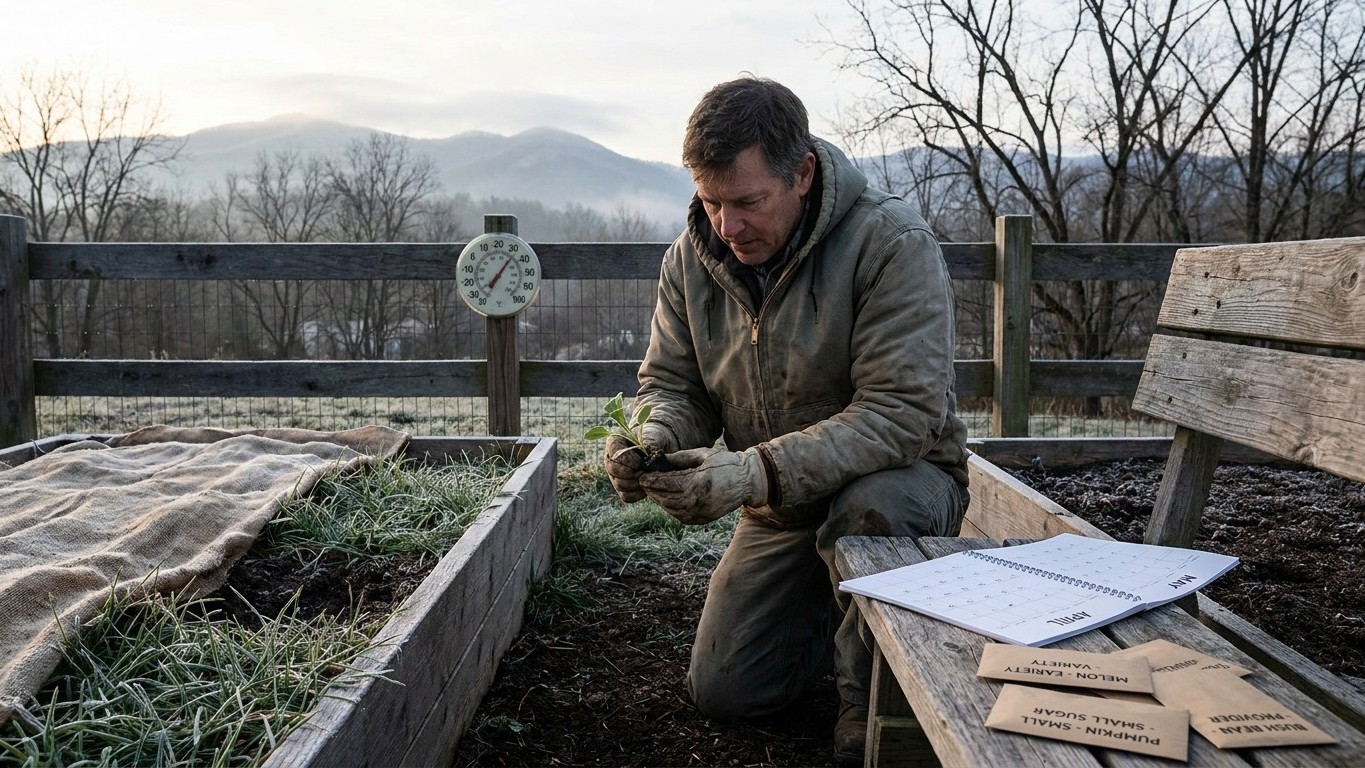

Boise sits in USDA zone 6b-7a territory, but Idaho as a whole spans zones 3b through 7b. The average last spring frost falls between April 23 and May 7, the first fall frost between October 7 and October 21. Those three numbers, taken together, decide almost everything a gardener in this state can realistically grow.
How long your season really is

Subtract one date from the other and you get the frost-free window: roughly 150 to 160 days at the reference station in Boise, a low valley that sits on the warm end of the state’s climate spread. That’s the number that matters more than any zone map. It tells you how many days a plant has, from the moment it can safely go in the ground to the moment cold ends the growing year, to sprout, grow, flower, and produce something worth harvesting.
A 150-day window sounds generous until you start counting backward from a harvest date. Long-season crops, the ones that need 90, 100, sometimes 120 days from transplant to maturity, eat most of that window and leave almost no margin for a late spring or an early fall. Melons, many pumpkin varieties, and some slow dry beans fall into this category. They’re not impossible here, but they’re a gamble stacked against the calendar: Growing Pumpkins in Idaho takes careful timing, and knowing When to Carve a Pumpkin in Idaho starts with getting that planting timeline right. A first-time gardener is usually better served starting with a more forgiving crop: Growing Peppers in Idaho, Growing Potatoes in Idaho, or even Growing Carrots in Idaho are far more realistic plans to build a season around, and Growing Sweet Corn in Idaho fits comfortably within that same frost-free window.
The hardiness zone range itself, 3b to 7b under the USDA Plant Hardiness Zone Map, built on average annual extreme minimum temperature, tells a different part of the story: it’s about whether a perennial or a fruit tree survives winter at all, not how long the growing season runs. A gardener at 3b in the higher country works with a frost-free window that can be a month shorter than Boise’s, sometimes more, even though both locations sit inside the same state. This is also where long-lived perennials come into play, since Growing Asparagus in Idaho depends far more on winter hardiness than on the length of the frost-free season. For that shorter window, cold-hardy root crops and leafy greens tend to be the safer bet, and Growing Beets in Idaho is a good example of a plan built around fewer frost-free days, much like Growing Parsnips in Idaho, another crop that tolerates a short, cool season well, or Growing Spinach in Idaho, which thrives in the cool edges of a short season.
Here’s the part that trips people up every year: frost dates are averages, not guarantees. NOAA’s 30-70% probability band for a 32F freeze means that in roughly half of all years, frost arrives later in spring or earlier in fall than the stated date. Planting tender crops on the average last-frost date isn’t playing it safe. It’s playing the odds, and losing that bet means replanting in June with a shorter season ahead of you than you started with.
What the summer does to a garden here
Boise averages 47.5 days a year at 90F or above. That’s not background heat, it’s a working constraint. Once temperatures push past roughly 90F, tomato blossoms stop setting fruit, even on healthy, well-watered plants. Lettuce, spinach, and other cool-season greens bolt, turning bitter and shooting up a seed stalk instead of staying tender. Peas quit producing. The plants aren’t dying, they’re just done for the season, and no amount of fertilizer brings the flowers back.
Winter works the opposite constraint. The coldest month’s average daily minimum in Boise sits at 25.4F, a figure that decides which perennials, shrubs, and fruit trees can survive here at all, independent of how hot the summers get. A plant rated for a milder zone can look fine every summer and still die back to the ground, or die outright, the first hard winter that hits its actual limit.
Put those two numbers together and the shape of the gardening year in much of Idaho isn’t one long, steady summer bell curve. It’s closer to two shoulder seasons bookending a hot, unproductive middle. Cool-season crops go in early, finish before the heat arrives, and a second round goes in for fall once the worst of the 90F stretch has passed. Heat-loving crops like tomatoes and peppers occupy the middle stretch, but even they stall out during the hottest days rather than accelerating. Planning a garden around a single spring planting and a single fall harvest misses how much this climate actually splits the season in two.
What tends to go wrong in Idaho
University of Idaho Extension’s home garden guidance points to a recurring cast of pests rather than a random assortment, and a handful of them account for most of the calls and complaints extension offices field each year. The Colorado potato beetle shows up early, feeding on potato, tomato, and eggplant foliage and stripping leaves fast enough to stunt young plants before they’ve established. Cutworms work at the very start of the season too, cutting seedlings off at the soil line overnight, often before a gardener has even confirmed what germinated.
Aphids, whether green peach, cabbage, or pea aphids, build up through the cooler parts of the season on a wide range of crops, curling leaves and spreading viruses along the way. Later in summer, as heat sets in, the tomato hornworm becomes the visible problem: a large caterpillar that can strip a tomato plant of foliage in a matter of days once it’s established.
Squash bugs and grasshoppers tend to build through mid to late summer, the former targeting squash and pumpkin vines, the latter chewing broadly across whatever’s still green when populations peak. Onion thrips and onion maggot, wireworms in root crops, and carrot rust fly round out the list the extension service flags most often for home vegetable gardens. None of this means every garden in the state meets all of them, and it’s not a complete inventory of every insect present here. It’s the short list worth knowing, with identification and any treatment decision best confirmed through the county extension office rather than guessed at from a photo online.
Where to check before you plant
Everything above describes Idaho at the state level, anchored to a reference station in a low valley. That’s useful for framing what’s possible here, but it isn’t a substitute for local numbers. A state that runs from zone 3b to zone 7b, from river-valley floors to mountain benches, doesn’t have one planting calendar. It has dozens, and the gap between them can run three weeks or more on either side of the frost dates cited here.
The University of Idaho Extension is the land-grant service for the state, and its county offices carry local data: county-specific frost records, current pest pressure reports, and planting calendars built for actual elevation and microclimate rather than a statewide average. Before committing seed money and a season’s worth of effort to a planting date pulled from a general guide, a call or visit to the county office is the step that turns a state-level estimate into a number a garden can actually be planned around.
What to Plant Next, Now That You Know the Numbers
Once the freeze dates and heat totals make sense, the question turns practical: what actually goes in the ground, and when. If you’re thinking about fall planting, growing garlic in Idaho walks through why the state’s hard freezes are exactly what cloves need to split properly, using the same Boise-area freeze data to pin down a planting window. For the lawn itself, Idaho lawn care tackles the awkward middle ground Boise sits in — too many 90°F days for a pure cool-season lawn, too cold in winter for a pure warm-season one — and what that means for seed choice and feeding schedule. And if tomatoes are the goal, growing tomatoes in Idaho lays out the spring frost window from the same NOAA station, plus the varieties and pests that actually show up once the plants are in. Each of these pulls from the same climate normals used above, just pointed at a different crop or patch of ground, so the dates and thresholds will already feel familiar.