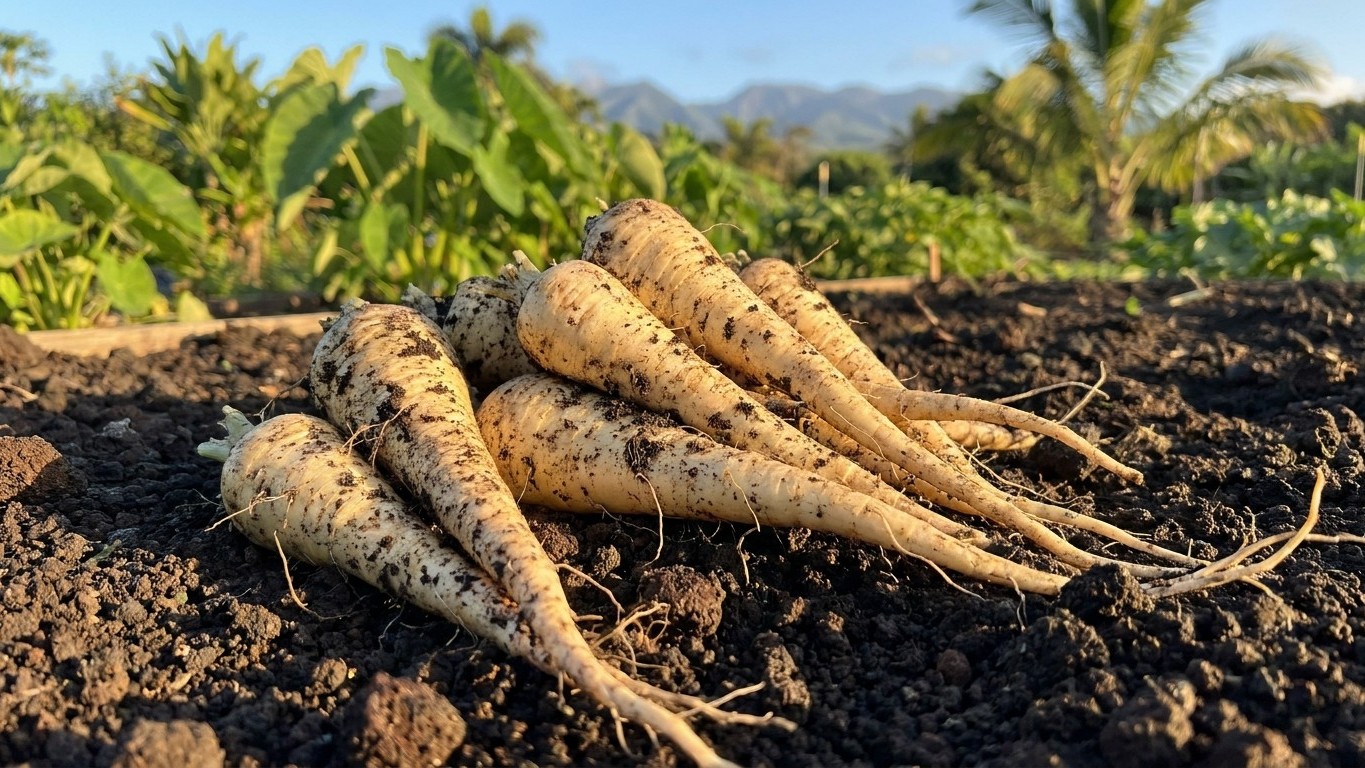

The mean minimum temperature during Hawaii’s coldest month sits at 66.8°F, and no measurable freeze has ever been recorded in the state’s inhabited lowlands. That single fact settles the question before you plant a single seed: a parsnip grown in Hawaii will grow, size up, and reach harvest, but it will never sweeten the way the same root does in a cold-winter garden. The starch-to-sugar conversion that makes parsnips famous simply has no trigger here.
The short answer
Does this territory deliver several frosty weeks in a row? No. Not one. NOAA NCEI’s 1991-2020 Climate Normals, using Honolulu as the reference station, list a mean daily minimum of 66.8°F for the coldest month of the year. That’s not a chilly night here and there. That’s the average low across the coldest stretch of the calendar, and it sits nearly 35 degrees above freezing. For comparison, a parsnip needs actual frost, repeated exposure to temperatures at or below 32°F, to trigger the enzymatic process that breaks down stored starch into sugar. Hawaii’s lowlands never come close.
This is the point where a lot of garden advice goes wrong, because it’s tempting to look at Hawaii’s warm hardiness zone and assume that’s the relevant number. It isn’t. Hardiness zones describe how cold a place gets in absolute terms, useful for predicting whether a perennial survives winter. Sweetening in parsnips is a different mechanism entirely. It’s triggered by the plant’s own stress response to cold exposure, not by the zone rating on a seed packet. A territory can sit in a mild zone and still deliver a handful of frosty mornings each winter, enough to sweeten a parsnip crop. Hawaii’s lowlands don’t have that; there’s no freeze event in the record at all, not a rare one, not an occasional one. NOAA’s own data flags the freeze percentile calculations for the reference station as not computable, because zero days per year fall at or below 32°F.
So the honest answer for a home gardener is this: you can absolutely grow parsnips in Hawaii. The root will form, the shape will be recognizable, the flavor will be mild and starchy rather than the deep, sweet, almost nutty taste that cold-climate growers rave about. If your goal is a parsnip for the table that tastes like the ones described in gardening books and seed catalogs, that particular flavor profile depends on weather Hawaii’s lowlands don’t produce. If your goal is simply to grow the vegetable, harvest it, and cook with it, there’s no reason it won’t work. The distinction matters because a lot of first-time growers plant with the sweetening promise in mind, wait patiently through the growing season, and end up disappointed by a root that tastes fine but not remarkable. Knowing that going in changes expectations, not effort.
Does the season fit?
Parsnips need 100 to 120 days from the day they’re seeded to reach a harvestable root, according to Utah State University Extension. In a mainland garden, the standard advice is to sow 2 to 3 weeks before the last expected spring frost, then count forward. In Hawaii’s lowlands, that reference point doesn’t exist. NOAA’s climate data for the region shows no freeze event at all in the historical record, so there’s no last spring frost date and no first fall frost date to build a calendar around. Here’s how the arithmetic actually plays out on the ground:
- Start with germination. Parsnip seed is slow, typically taking 14 to 21 days to sprout. That’s before the 100 to 120 day root-maturity clock even starts counting toward harvest.
- Add the 100 to 120 days from seeding to maturity. That’s roughly three and a half to four months of continuous growing time the plant needs in the ground, regardless of season.
- Compare that to Hawaii’s frost calendar, which is blank. There’s no cold snap coming to cut the season short, no risk of the crop freezing before it matures. In terms of pure time available, the growing window in lowland Hawaii is effectively open year-round.
- Because there’s no frost-based planting cue, the practical scheduling question shifts entirely to rainfall, elevation, and windward versus leeward exposure rather than a calendar date. A gardener on a wetter windward slope faces different timing pressures than one on a dry leeward coast, even though both skip the frost question entirely.
- Even when the 100 to 120 days are satisfied comfortably, and they generally are, the season length was never the limiting factor for sweetness. That comes back to the missing frost, not the calendar.
So the season fits, in the sense that nothing here forces a rushed harvest. The days-to-maturity math works fine in a climate with no cold cutoff. What doesn’t fit is the sweetening step, and no amount of careful timing changes that.
What goes wrong here
- Forked roots from heavy or stony ground. Parsnips send down a single taproot, and anything that blocks its path, compacted clay, rocks, hardpan, splits it into two or three forked legs instead of one straight root. Utah State University Extension recommends deep, sandy soil for this reason, and says heavy soil should be double dug before sowing to loosen it well below the depth the root will reach.
- Forked roots from overwatering. This is a separate cause from soil texture, not the same problem in disguise. Too much water, especially inconsistent watering that swings between soaked and dry, encourages the root to branch rather than grow straight down. Even in loose, sandy soil, a parsnip bed that gets flooded on a heavy-rain week and then left dry will fork.
- A calendar that drifts without a frost to anchor it. Mainland gardeners plant off a last-frost date. In Hawaii’s lowlands, that date doesn’t exist, so it’s easy to sow at the wrong point in the rainy season or at an elevation with weather patterns that don’t suit a 100 to 120 day root crop, and lose track of the window entirely. Anchoring the calendar to rainfall and elevation instead of frost avoids this.
- A winter too mild to sweeten. With a mean coldest-month minimum of 66.8°F and no recorded freeze in inhabited areas, the plant never receives the cold exposure that converts starch to sugar. There’s no remedy for this one within the garden. It’s a fixed feature of the climate, and a grower here should plan to harvest and cook the root for its texture and mild flavor rather than expect the deep sweetness cold-climate parsnips are known for.
Before pulling parsnips out of the ground, or even cutting back the foliage, there’s a safety detail almost no garden page mentions. According to the North Carolina Extension Gardener Plant Toolbox, “All parts of this plant contain furocoumarins which can make skin sensitive to light causing burns so be sure to wear gloves, long sleeves and long pants when dealing with it.” That’s the root, the leaves, the stems, every part of the plant, not just the foliage.
The mechanism is what makes this risk easy to miss. Furocoumarins don’t burn skin on contact alone. The reaction needs sap on the skin AND exposure to sunlight afterward. That combination is exactly what happens on a bright afternoon of harvesting or trimming tops in an open garden bed, plenty of sun, bare forearms, sap transferred from stem to skin while pulling roots. The burn doesn’t show up immediately either. It typically appears hours after the exposure, once the skin has had time in the sun, which means a gardener can finish a morning of work feeling fine and only notice redness or blistering later that day. That delay is also why washing hands after the fact doesn’t undo the exposure. The protection has to happen before contact: gloves, long sleeves, long pants, the same way you’d dress for any task involving a plant that reacts with sunlight rather than one that simply irritates on touch.
Checking this against your own county
Climate figures for a whole territory smooth over a lot of local variation, and Hawaii is a particularly extreme example of that. A garden on the windward side of an island gets vastly different rainfall than one just a few miles away on the leeward side, and elevation changes conditions again within short distances. The 66.8°F coldest-month figure comes from a single reference station and won’t match every microclimate across the islands exactly.
Before planning a parsnip bed, it’s worth checking with the University of Hawaii’s College of Tropical Agriculture and Human Resources (CTAHR) Extension, which maintains local guidance tailored to island and elevation conditions rather than a single statewide average. Their extension directory is available at ctahr.hawaii.edu. A county-level office can speak to rainfall patterns, soil conditions, and elevation-specific timing in a way that a territory-wide climate normal can’t.
Common questions
Can parsnips grow in Hawaii at all?
Yes. They’ll germinate, form roots, and reach harvest size within the standard 100 to 120 day window. What they won’t do is sweeten, since that process depends on frost exposure that doesn’t occur in the state’s lowland areas.
Is there any way to force parsnips to sweeten without frost?
No method for artificially replicating frost-triggered sweetening is documented in the sources behind this page. The conversion is tied to actual cold exposure in the ground, and the mean coldest-month minimum in Hawaii’s lowlands, 66.8°F, never approaches the range required.
Why do my parsnips keep forking instead of growing one straight root?
Two separate causes produce this, and they call for different fixes. Heavy, stony, or compacted soil blocks the taproot and should be corrected with deep, sandy soil or double digging. Inconsistent or excessive watering is a separate cause and calls for steadier, moderate irrigation instead.
Do I need to wear protective clothing just to trim the tops, or only when digging the root?
All parts of the plant contain the furocoumarins that cause the reaction, not just the root or just the foliage. Gloves, long sleeves, and long pants are warranted for any handling, trimming, digging, or pulling, especially on a sunny day.