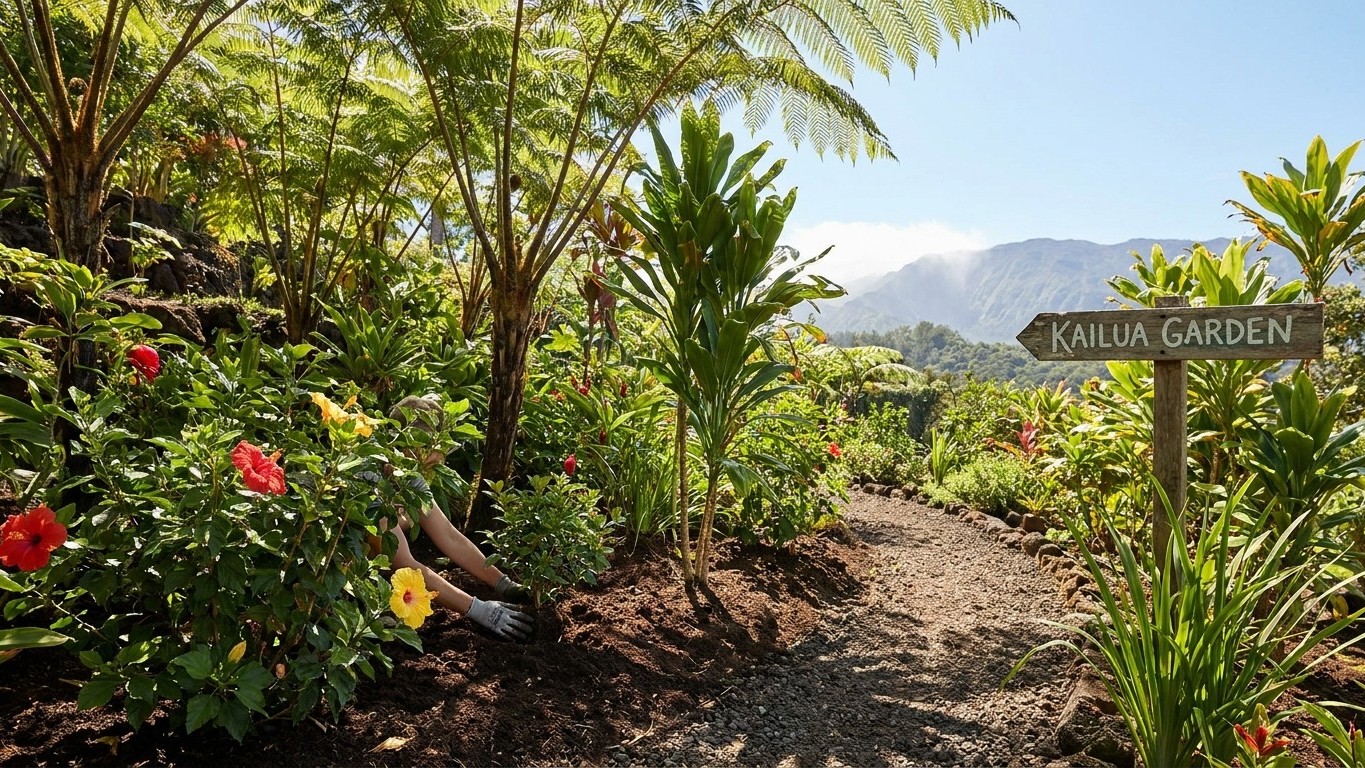

There’s no frost season to plan around in lowland Hawaii, and that changes everything about how a garden year works here. USDA zones run from 9a up to 13a depending on elevation, days above 90F stay relatively rare even at sea level, and winter nights never get cold enough to threaten a plant. What actually decides a Hawaii garden is rainfall, elevation, and which side of the mountain you’re on.
How long your season really is

Start with the numbers that matter here, because they don’t behave like they do almost anywhere else in the country. The USDA Plant Hardiness Zone Map places Hawaii between zone 9a and zone 13a, a range built on one variable only: the average coldest temperature a given spot sees in a year. NOAA’s climate normals for the reference station near Honolulu don’t even record a computable frost date, spring or fall, because no freeze occurs in inhabited areas. Zero days a year at or below 32F.
Put those together and the frost-free window that shapes gardening in most of the country simply doesn’t exist as a limiting factor here. There’s no last spring frost to wait out and no first fall frost to race against before winter shuts things down. That’s the opposite problem from what gardeners in cold-winter states deal with, where half of all years run colder than the average frost date by definition and a long-season crop like Growing Sweet Corn in Hawaii is a genuine gamble. In lowland Hawaii, the calendar question isn’t “will it freeze” but “is it wet enough, and is it too hot.”
Frost is not entirely absent from the state, it’s just not where anyone is gardening. Mauna Kea, Mauna Loa, and Haleakala get real winter cold on their upper slopes, sometimes snow. None of that touches a backyard plot in Hilo, Kona, or the leeward side of Oahu. The 9a-to-13a spread on the map reflects elevation and exposure more than latitude, since the islands don’t span much distance north to south. A garden at sea level and one a few thousand feet up the same mountain can sit in different zones entirely, which is why a single statewide planting date is close to meaningless without knowing where on the elevation gradient a garden actually sits, and even a seasonal question like When to Carve a Pumpkin in Hawaii depends more on that elevation than on any calendar date.
That reshuffles the whole planning question. Instead of asking how many frost-free days you get, the useful questions in Hawaii are how much rain a site receives, whether it sits windward or leeward, and how far up the slope it is. Those three variables do the work that frost dates do everywhere, and they explain why a crop like Growing Asparagus in Hawaii depends far more on elevation and drainage than on any planting calendar else, and they’re exactly why elevation-conscious and moisture-sensitive crops like Growing Potatoes in Hawaii, Growing Parsnips in Hawaii, Growing Beets in Hawaii, or Growing Spinach in Hawaii can thrive on a cooler upland slope even when a nearby lowland garden would struggle with the heat, while a sprawling vine crop covered in Growing Pumpkins in Hawaii depends far more on rainfall timing than on any frost date, and a root crop covered in Growing Carrots in Hawaii handles the lowland conditions differently, and other heat-loving crops covered in Growing Peppers in Hawaii often do better lower down where the warmth doesn’t let up.
What the summer does to a garden here
Honolulu’s climate normals put the average at 18.7 days a year above 90F, and the coldest month’s average nightly low sits at 66.8F. Neither number looks extreme next to a mainland desert or even a humid Southeast summer. But heat load isn’t only about how hot it gets, it’s about how often a plant crosses the threshold where it stops functioning normally, and 90F is close to that line for a lot of common vegetables.
Tomatoes drop their flowers and stop setting fruit once daytime heat gets into that range for stretches at a time, especially when nights stay warm too. Lettuce and other cool-season greens bolt and turn bitter under the same conditions. With almost 19 days a year crossing 90F, plus warm humid air keeping nights from offering much relief, a garden here doesn’t get the clean break between a hot growing season and a cold dormant one that shapes gardening elsewhere.
The practical result is closer to one long, warm growing period with a narrower window for cool-season crops than a two-season, frost-bookended year. A winter low that rarely drops below 66.8F means nothing truly goes dormant, but it also means lettuce, spinach, and other cool-weather vegetables have a shorter comfortable stretch, usually the cooler, often wetter months, rather than a defined “winter garden” season the way it works in milder mainland climates. Heat-loving crops, on the other hand, get something close to a year-round runway, provided rainfall and soil moisture cooperate.
What tends to go wrong in Hawaii
The University of Hawaii’s CTAHR extension service tracks a specific set of pests that home gardeners run into again and again, and a handful account for most of the damage. Tephritid fruit flies (oriental fruit fly, melon fly, Mediterranean fruit fly, and solanaceous fruit fly) attack a wide range of fruiting crops, laying eggs inside developing fruit so damage often isn’t visible until the fruit is cut open or drops early. They’re active essentially year-round given the lack of a hard winter to interrupt their life cycle.
The Chinese rose beetle is a nighttime feeder, chewing ragged holes in the leaves of roses, grapes, beans, eggplant, corn, cucumber, and ginger. Gardeners often notice the damage in the morning without ever seeing the culprit, since it feeds after dark and hides during the day.
Diamondback moth and related caterpillars, including imported cabbageworm, cabbage webworm, beet armyworm, and corn earworm, target brassicas and corn throughout the growing period, chewing foliage and boring into developing ears and heads. And slugs, snails, including the giant African snail, cause steady damage to seedlings and low-growing greens, thriving in the same rainfall and humidity that make the islands good for growing in the first place.
That’s not the full list CTAHR publishes, aphids, thrips, whiteflies, leafminers, bean fly, and little fire ant all show up in their home garden guidance too. But these four are the ones most gardeners here will genuinely meet, and identification matters more than guessing at a treatment.
Where to check before you plant
Everything above is a state-level average, and Hawaii covers more ecological variety per square mile than almost anywhere else in the country. A single planting calendar written for one elevation or one side of an island can be badly wrong a few miles away, at a different elevation, or on the opposite side of the same mountain. The 9a-to-13a zone range on the USDA map is a clue, not a substitute for knowing where a specific garden sits within it.
The land-grant extension service for the state, the University of Hawaii’s College of Tropical Agriculture and Human Resources (CTAHR), publishes home garden pest identification guides and connects gardeners to county-level offices that know local rainfall patterns, soil types, and pest pressure specific to that district. That local layer matters more here than in most states, since windward and leeward sides of the same island can differ by feet of annual rainfall.
Before committing to a planting date or a crop list based on statewide figures, a quick call or visit to the county extension office covering the actual garden site is worth more than any general guide, including this one. They can confirm which zone applies at that elevation, what pest pressure looks like that season, and whether recent rainfall changes the timing worth using this year.
Putting the Season to Work in Your Garden
Once you’ve got a handle on what Hawaii’s climate will and won’t do, the next question is what to actually put in the ground. If you’re set on growing a full head of garlic cloves, you’ll want to know why most of the state’s elevations can’t deliver the cold snap that crop depends on after planting — NOAA’s own climate normals explain the gap. Thinking about the yard instead of the vegetable bed? A guide to feeding and planting lawn grass lays out why the hottest, wettest stretch of the year is the real test for turf, and why cool-season grass never makes it through even one lowland summer here. And if tomatoes are the goal, a rundown of tomato planting dates, varieties and pests starts from a simple fact: a typical Honolulu-area year sees zero days at or below freezing, so the mainland’s spring-to-fall countdown doesn’t apply, and geography — not a calendar — decides when you plant. Each of these gets into the specifics your particular crop or lawn needs once you accept that Hawaii just doesn’t run on the seasons you might be used to.