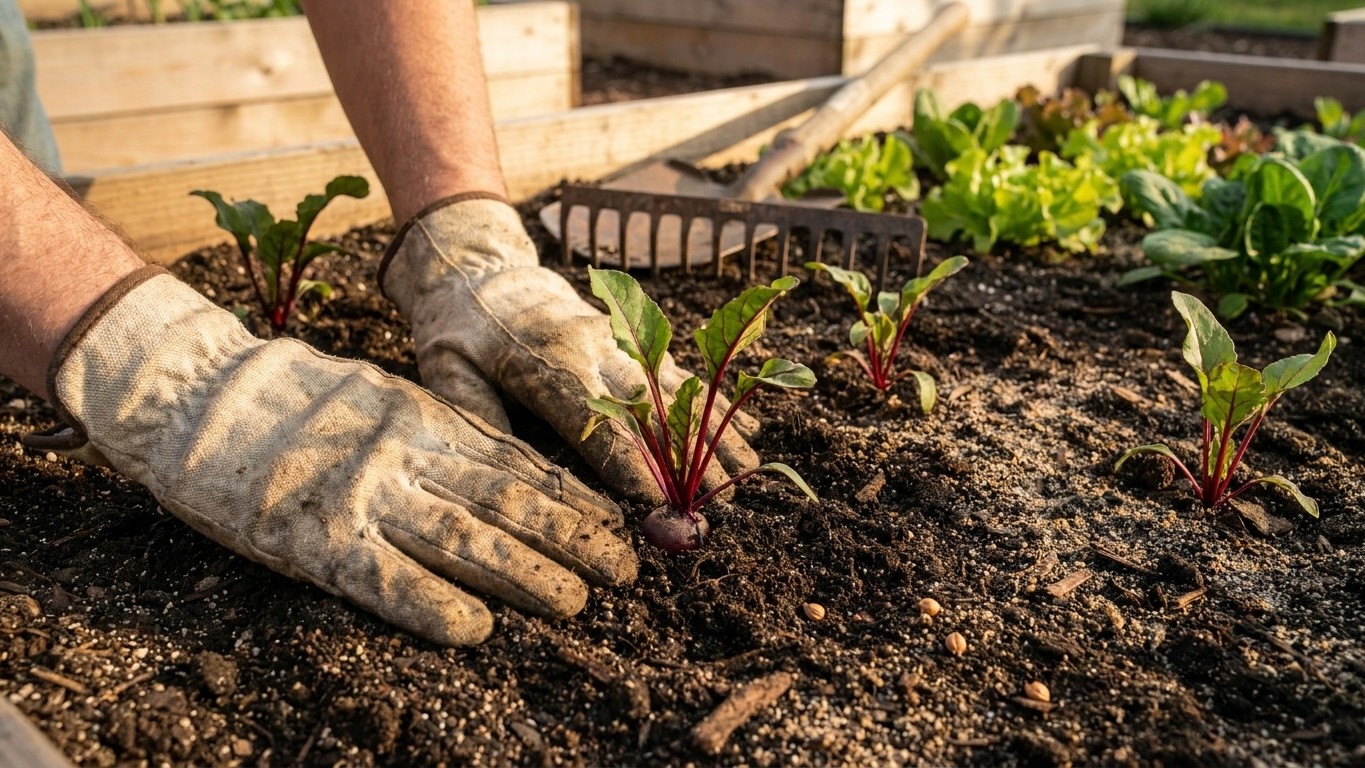

In Massachusetts, beets do best sown directly into deep, well-drained, sandy soil with organic matter worked in, about two to three weeks before the last spring frost, which falls between April 1 and April 8 in the Boston area. For a detailed breakdown by region, see When to Sow Beets in Massachusetts. The state’s representative soil is naturally well drained and slightly acid, a reasonable match, but it is only a starting point. Two separate risks follow from there: bolting from early dryness, and woody roots from later heat.
The short answer
Massachusetts has an official state soil, the Paxton series, and it tells you something useful even if it isn’t the dirt under your own boots. Paxton is an Inceptisol, a young soil that hasn’t had time to develop strong layered horizons. Its surface reads about 61 percent sand, 7 percent clay and 32 percent silt, with organic matter around 5.5 percent and a surface pH near 5.5, slightly acid. It’s classified well drained, and it was named the state soil by Massachusetts law in 1990 under the USDA NRCS State Soils programme. For a deeper look at what this means specifically for root crops, see Beet Soil in Massachusetts.
For a beet, that texture profile leans favorable. Beets want deep, sandy, well-drained ground rich in organic matter, according to Utah State University Extension, and a soil that’s 61 percent sand and well drained checks that box on paper. The catch with sandy, well-drained ground is that it also drains water away fast. It won’t hold a soaking the way a clay-heavy soil would, which means the six weeks after seeding demand more attention to watering, not less, even though the texture itself is a good match.
The organic matter figure, about 5.5 percent at the surface, is worth a second look too. That’s a natural, mapped value, not a measurement of a worked garden bed, and it sits well below the level that would signal a peat or muck surface. It also lines up with the Utah State guidance to cap compost or other organic amendments at 1 inch per 100 square feet: Massachusetts ground doesn’t start out starved for organic matter the way some coarser Western soils do, so heavy annual amending isn’t automatically the answer.
On heat, a specific count of how many days a year the Boston area passes 90 F isn’t published on this page. What matters for beets is a threshold, not a tally: Utah State Extension notes that heat above 85 F combined with water stress is what turns a root woody, so the relevant question for a Massachusetts gardener isn’t how many scorching days the year brings, but whether the soil is dry when a hot stretch hits.
None of this substitutes for knowing your own plot. Massachusetts spans hundreds of distinct soil series, and river-bottom ground, hill-country ground, and anything a builder has graded or filled will differ from Paxton in ways that matter more than any statewide average.
The six weeks that decide it here
Seed beets two to three weeks ahead of the last frost date, and in eastern Massachusetts that puts the sowing window in the first days of April, with the critical first six weeks of root development running through April and into May. That’s the stretch Utah State Extension flags as the one where water stress triggers premature flowering, better known as bolting, so it’s worth knowing what that window in Massachusetts tends to look like.
New England spring doesn’t hold a steady pattern. It swings: a raw, saturated week can be followed by a stretch of drying wind and full sun that pulls moisture out of the top few inches of soil fast, especially in ground as sandy and well drained as the state’s representative series. A gardener who assumes April rain will carry a bed through can be caught off guard by exactly the kind of short dry snap that does the damage, because bolting doesn’t require a drought. It only requires a few stressed weeks at the wrong point in the root’s early growth.
That’s the mechanism to plan around, and it’s a different problem from the one that shows up later in the season. Bolting is an early-season, water-driven failure tied to the first six weeks after seeding. Woodiness, by contrast, is a summer failure tied to heat above 85 F layered on top of dry soil once the root is already sizing up. Treating both as the same issue and defaulting to “just keep it watered” misses the timing that actually matters: consistent, unbroken moisture from the day the seed goes in through roughly the sixth week, and then renewed attention to moisture whenever a hot spell arrives later, from June onward.
Because the first six weeks in Massachusetts fall in a season that can flip between soaked and dry within days, checking soil moisture by hand two or three times a week during that window is a more reliable habit than watering on a fixed schedule.
What goes wrong here
- Bolting from an April or May dry snap. Sandy, well-drained soil like the state’s Paxton series sheds moisture quickly, and a week of drying wind during the first six weeks after seeding is enough to trigger premature flowering. Water on a schedule that assumes New England spring is reliably wet, and check soil moisture by hand instead of trusting the forecast.
- Woody roots from a summer heat spell. Once temperatures push past 85 F, any accompanying dry soil turns the root fibrous and tough, a separate problem from bolting that shows up later in the season. Deep, even watering through hot stretches, rather than light daily sprinkling, keeps the root from stressing.
- Acidic surface soil left untested. The state’s representative soil reads about pH 5.5 at the surface, slightly acid, and plenty of Massachusetts gardens run acid as well. Rather than guessing, a soil test through the local extension office will show the actual number and whether lime is worth applying.
- Over-amending with compost. Utah State Extension caps organic matter addition at 1 inch per 100 square feet; piling on more than that, especially in soil that already carries a natural 5.5 percent organic matter reading, can push roots toward forking or excess leaf growth instead of a clean, even root.
- Nutrients and moisture leaching through fast-draining ground. A soil built on 61 percent sand won’t hold fertilizer or water the way a heavier loam does. Mulching the bed and working in organic matter within that 1-inch limit helps the root zone retain both between waterings.
Checking this against your own county
Everything above starts from one representative soil series and one coastal weather station. Your own yard, whether it’s in the Berkshires, the Connecticut River Valley, or a subdivision on filled ground outside Worcester, can differ from both in ways that change the advice. Inland and higher-elevation parts of the state also frost later in spring and earlier in fall than the Boston-area dates given here.
The most useful next step is a call or visit to the University of Massachusetts Extension, ag.umass.edu, which can point you toward a soil test for your specific property and toward planting guidance calibrated to your county rather than to a statewide average. A soil test in particular will tell you your actual pH and texture, numbers no state-level series can substitute for.
Common questions
How long do beets take to mature in Massachusetts?
Beets are direct-seeded, not transplanted, and the maturity clock starts the day the seed goes into the ground rather than from any later transplant date. Plan your harvest window from your actual seeding date, not from when seedlings first appear.
What beet varieties should I grow in Massachusetts?
Utah State University Extension lists several beet varieties without rating any of them for season length, color, or best use, so there’s no single variety this source recommends for Massachusetts conditions specifically. Trialing a couple of varieties side by side in your own bed is a reasonable way to find what performs on your soil.
Is Massachusetts soil acidic enough to affect beets?
The state’s representative Paxton soil reads a surface pH near 5.5, slightly acid, and acidic ground is common across the state. Since this figure describes one mapped series and not your specific bed, a soil test through UMass Extension is the only way to know your actual pH and whether lime is needed.
When exactly should I sow beets in Massachusetts?
Aim for two to three weeks before your local last frost date. In the Boston area, NOAA’s 1991-2020 climate normals put that date between April 1 and April 8, but that station sits in the mildest, waterfront part of the state. Inland suburbs and higher elevations should expect a later last frost and should shift sowing accordingly.