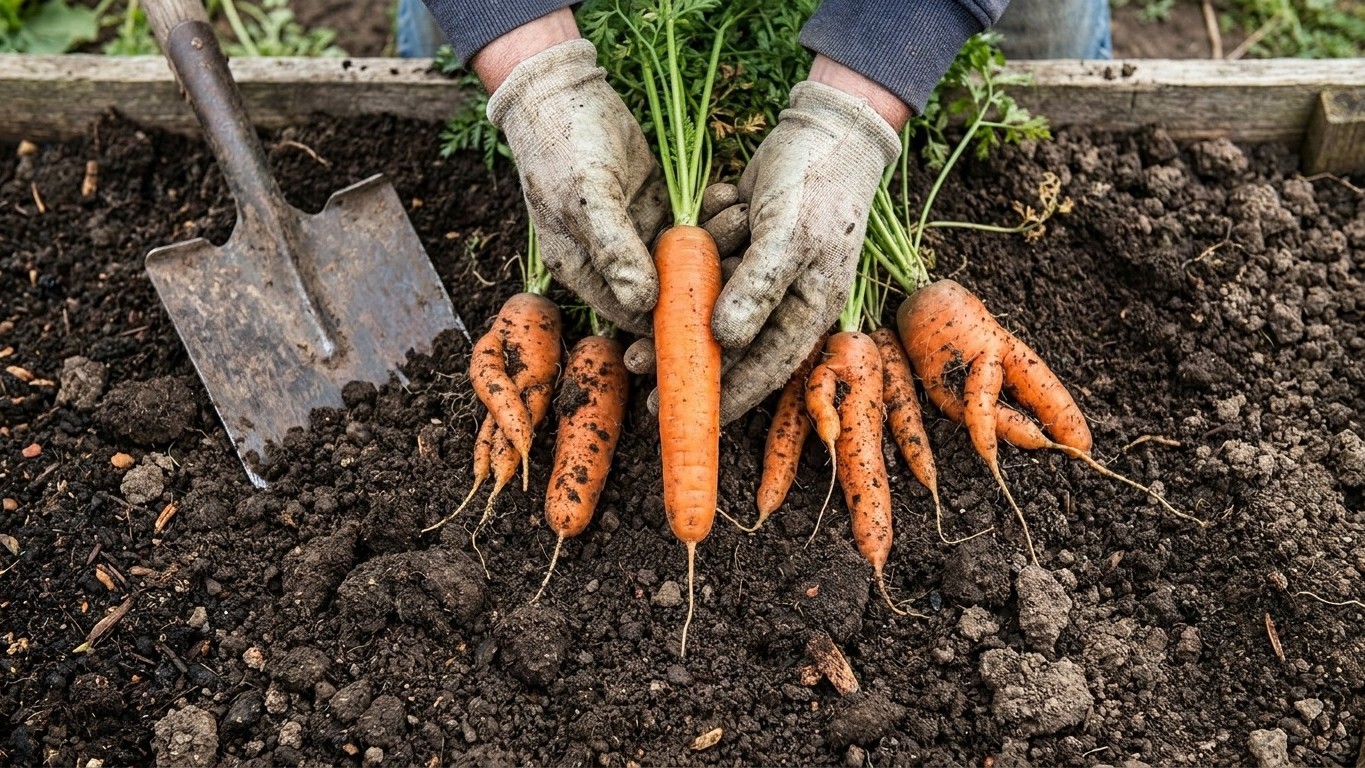

Minnesota’s benchmark soil, the Lester series, runs 39 percent sand, 24 percent clay and 37 percent silt with a near-neutral pH near 6.6. That mix sits close to the loam carrots want, but the clay share is enough to bend a root if the bed goes untouched, which raises the real question: Will Carrots Fork in Minnesota Soil? Compost, deep loosening or a raised bed settle the question before you ever drop a seed.
The short answer
The soil that carries Minnesota’s name, the Lester series, was set as the official state soil by Minnesota law. It’s an Alfisol, a forest-derived soil of moderate fertility that holds onto nutrients better than a sandy soil would. The surface horizon runs 39 percent sand, 24 percent clay and 37 percent silt, which lands it in loam to silt loam territory, with organic matter around 3.0 percent and a surface pH near 6.6, close enough to neutral that most vegetables tolerate it without amendment. Drainage is classed as well drained, which matters more for carrots than almost any other single trait.
Put that texture next to what Utah State University Extension says carrots actually need: deep, sandy, well-drained soil rich in organic matter. Heavy or rocky soil, their guidance is blunt about this, makes the root fork. A quarter clay isn’t rocky, and it isn’t heavy clay either, but it’s enough weight in the ground to resist a taproot pushing straight down, especially if that clay compacts into a crust below the surface few inches. The fix Utah State lays out for heavy ground is plain: work in plenty of compost and double dig the bed, loosening and amending well past the top few inches so the root has no reason to fork or twist around a hard layer.
If your bed sits in ground with more clay than that, or drains slower than “well drained,” a raised bed sidesteps the problem entirely by giving carrots a full profile of loosened, amended soil with nothing underneath to deflect a root. That’s often the simpler fix than fighting native clay bed after bed.
None of this is a diagnosis of your yard. The Lester series is what USDA maps as representative for Minnesota as a whole, and a state this size carries hundreds of distinct soil series, from river-bottom silt to glacial till to sandy outwash plains. A garden a few miles from where the Lester series is mapped, or one where a previous owner brought in fill dirt, can be built entirely differently. Treat these numbers as a starting point for what the region’s ground tends to do, not as a stand-in for a test of your own bed, and pair that test with When to Sow Carrots in Minnesota so the timing matches your soil’s readiness.
The test that settles it in your own garden
State-level soil data tells you what’s common in the region. It doesn’t tell you what’s twelve inches down in your own carrot bed. That takes a shovel, not a lookup.
- Dig a hole at least a foot deep where you plan to sow. Carrots need that much clear depth to grow straight, so this is the first thing to check, before texture or pH ever come into it.
- Look at what’s in the hole. Note any stones, buried construction debris, or a hard, lighter-colored layer that resists the shovel. Any of these will deflect or fork a taproot regardless of what the surface looks like.
- Feel the texture. Take a handful of moist soil from a few inches down and squeeze it. Soil that forms a hard, sticky ball is clay-heavy; soil that falls apart with no cohesion at all is sandy; soil that holds a loose shape and crumbles under light pressure is closer to the loam carrots prefer.
- Watch how water drains. Pour a bucket of water into the hole and time how long it takes to disappear. Water that lingers for hours points to compacted or clay-heavy ground underneath, the kind of ground where a raised bed or heavy compost amendment pays off. Water that vanishes almost immediately suggests sandy, fast-draining soil that will need more frequent watering to avoid the stress that splits carrots.
None of these steps replaces a lab soil test for pH and nutrient levels, but they answer the one question that actually determines whether your carrots fork: is there anything in the top foot of soil that a taproot has to fight its way around.
When to sow here
Carrots go into the ground as seed, directly where they’ll grow. There’s no transplanting step to count from, and no seedling stage indoors to shift the calendar. Every date here runs from the day seed goes into soil.
- Wait for the soil, not just the calendar. Carrot seed needs soil temperature of at least 40 F to germinate at all, and germination is strongest between 55 and 65 F. A calendar date means nothing if the ground underneath is still cold and wet.
- Count back from your last frost. Across the Twin Cities area, NOAA’s 1991-2020 climate normals put the last spring frost date somewhere between April 17 and April 30. Sow carrots 2 to 3 weeks ahead of that date, which for most of the metro puts seeding somewhere in the first half of April, moving later toward the tail end of that window depending on exactly where the local frost date falls.
- Adjust hard for the north. That April 17-30 window describes the milder southern part of the state. Northern Minnesota runs two to three weeks tighter at both ends of the season, which pushes the last frost date later into spring and moves the whole sowing window later to match. A gardener near the Iron Range or the Arrowhead region should expect to sow later than a gardener in the Twin Cities, not on the same schedule.
- Let soil temperature override the date if they disagree. If the calendar says it’s time but a soil thermometer reads below 40 F, wait. Seed sown into soil that cold will sit and rot rather than germinate, and a week’s delay costs far less than a failed stand that has to be reseeded.
No published figures here set an exact days-to-maturity count for the region, so lean on the seed packet for that number once the crop is in the ground, and count from the seeding date, not from any later date.
What goes wrong here
- Forking in heavy ground. Where clay content runs high or a compacted layer sits under the topsoil, roots split or twist around the obstruction instead of growing straight. Utah State University Extension’s remedy is direct: work in generous compost and double dig the bed well past the surface, or move to a raised bed built with loosened, amended soil from the start.
- Poor germination during a hot spell. Carrot seed germinates best between 55 and 65 F. A stretch of unusually warm weather right after sowing can push soil temperature well above that range, and germination rates drop as a result. Watering to keep the seedbed cool and consistently moist during a heat spell helps more than any other single fix.
- Splitting from uneven watering. Carrots that dry out and then get soaked, whether from an irregular watering schedule or a heavy rain after a dry stretch, tend to split as the root absorbs water faster than the outer layer can stretch. A steady, even watering routine through the growing season prevents the swings that cause it.
- Slow, weak stands in unamended clay. Even without visible forking, dense clay-heavy soil restricts root growth and can leave carrots stunted or misshapen. The same compost-and-double-dig approach that prevents forking also gives roots the loose profile they need to size up properly.
Checking this against your own county
State averages and even county soil surveys can only go so far. For a reading specific to your address, contact University of Minnesota Extension. They can point you to soil testing services, help interpret the results against what carrots and other root vegetables actually need, and flag anything particular to your county, from unusually sandy outwash soils to poorly drained lowland pockets that behave nothing like the statewide average.
Reach them at extension.umn.edu before committing a full bed to carrots, especially if your dig test turned up clay, stones, or slow drainage. A short conversation or a soil sample submitted early costs far less time than a season of forked or stunted roots discovered at harvest.
Common questions
Does Minnesota’s state soil mean my garden will have the same texture?
Not necessarily. The Lester series represents the state’s soil for the purposes of a soil-classification law, but Minnesota contains hundreds of distinct soil series. Your garden could sit on sandy outwash, river-bottom silt or heavily compacted fill, all of which behave very differently from the Lester series average.
Can I still grow carrots if my soil tests high in clay?
Yes, but the root will likely fork unless you address it first. Utah State University Extension recommends working in plenty of compost and double digging the bed, or building a raised bed filled with loosened, amended soil so the taproot never meets resistance.
How early can I sow carrot seed in spring?
Sow once soil temperature reaches at least 40 F, ideally 2 to 3 weeks before your local last frost date. In the Twin Cities area, where the last frost typically falls between April 17 and April 30, that puts sowing in early to mid-April. Northern parts of the state run two to three weeks later on both ends.
Why did my carrots split after a heavy rain?
Splitting usually comes from uneven watering, a dry stretch followed by a sudden soaking. The root absorbs water faster than its outer layer can expand and cracks under the pressure. Keeping the bed evenly moist throughout the season, rather than letting it dry out between waterings, prevents most splitting.