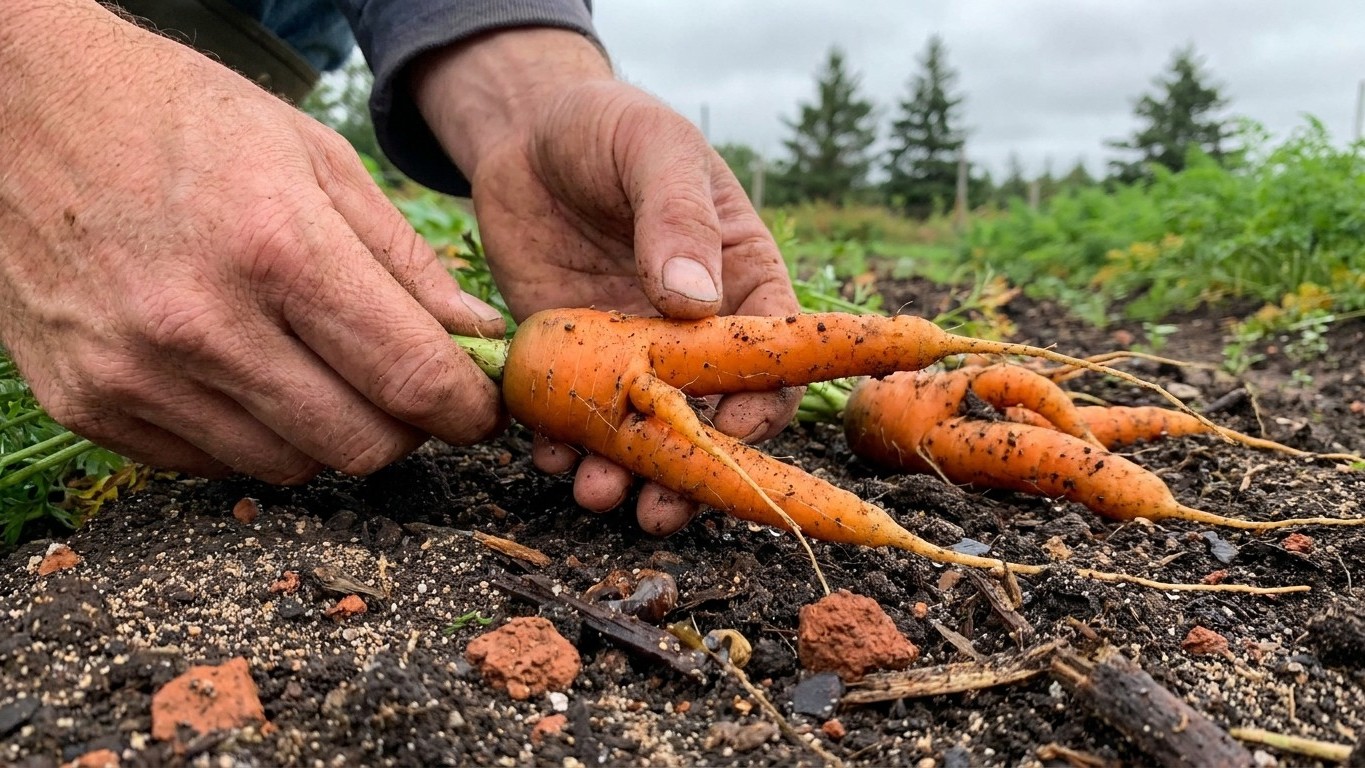

Nova Scotia’s ground runs acid and sandy-loam over a layer that drains slowly, which is a mixed bag for carrots. The sand fraction helps roots push down straight; the imperfect drainage and the clay underneath can still catch a root and split it in two. The fix isn’t a different vegetable. It’s knowing which half of that equation your own bed falls on, and building the soil to match.
The short answer
Across the mapped agricultural soils of Nova Scotia, the single most common soil order is Podzol, the acid, leached soil type that forms under conifer cover, where rainfall has washed the minerals and bases out of the topsoil and carried them lower down the profile. It shows up on 53 percent of the mapped surface, with Gleysolic soils, the wetter, poorly aerated type, coming in second. The median surface pH across those soils sits at about 5.2, which counts as strongly acid. Texture-wise, the typical mix runs 52 percent sand, 10 percent clay and 38 percent silt, landing in loam-to-silt territory, and organic matter averages around 2.1 percent. Drainage is classed as imperfect, meaning water moves through slower than a carrot really wants.
None of that is a life sentence for the crop, but it tells you where to start. Utah State University Extension, which studies root vegetables in garden soils generally, is direct on this point: carrots want deep, sandy, well-drained ground rich in organic matter, and heavy or rocky soil is what makes the root fork, split, or grow stubby instead of long and straight. Nova Scotia’s sand content is workable, on the higher side even. The trouble is the clay fraction combined with imperfect drainage, which together can leave a root sitting in wetter, denser ground than it likes, especially lower in the row where compaction tends to collect, raising the real question of Will Carrots Fork in Nova Scotia Soil?
The remedy Utah State lays out is straightforward: work in plenty of compost, and double dig the bed, turning and loosening the soil to a depth well beyond what a shovel usually reaches in one pass, so the root has no hard layer to deflect off of. If your ground runs heavier than that, or if you’ve hit a rocky subsoil at shovel depth, a raised bed filled with a loose, sand-heavy mix sidesteps the problem instead of fighting it. Getting the timing right matters just as much as the soil prep, which is why it’s worth checking When to Sow Carrots in Nova Scotia before you plant.
Here’s the catch with all of this: that 53 percent, that pH of 5.2, that 52-10-38 split, describes the province’s mapped agricultural soils taken together, not any one garden. Nova Scotia holds hundreds of distinct soil series, and river bottoms, old bogland, and anything a builder has graded or filled in can sit nowhere near that median. Treat these numbers as a starting point, a way to guess what your region’s ground tends to do, not a diagnosis of the dirt under your own boots.
The test that settles it in your own garden
The state figures describe a tendency. Your garden is one data point, and the only way to know it is to go dig.
- Dig a hole at least a foot deep where you plan to sow. Note where the soil changes color or gets noticeably harder. That’s the depth a carrot root will have to push through, and if it hits something dense or stony well before a foot down, that’s the layer that will cause forking.
- Look for stones and hard lumps as you dig. Even small ones, an inch or two across, sitting in the root zone are enough to split a growing tip in different directions.
- Feel the texture between your fingers. Rub a moist handful of soil. Gritty means sandy; slick and sticky means clay; a smooth, silky feel that holds a shape without being sticky is silt. Most gardens are some blend, and what you feel tells you more about your own bed than any provincial average can.
- Watch how water drains. After a rain, or after you water the bed yourself, check back in a few hours. Water that’s still sitting on the surface, or a hole that stays muddy well after the rest of the yard has dried, points to the same imperfect drainage the provincial soils tend toward, and it’s the strongest single signal that a raised bed or heavy compost amendment will pay off.
Run through those four checks before you commit to a planting method. A bed that dries fast and crumbles loosely between your fingers can probably take carrots straight in the ground with just a season of compost worked in. A bed that stays wet, packs hard, or hides stones a few inches down is telling you plainly to build up rather than dig down.
When to sow here
Carrots go into the ground as seed. There’s no transplanting step to count from, no seedling tray to hold them back a few weeks. The 70 to 100 days a carrot needs to mature run from the day the seed goes into the soil, which puts all the weight on getting that sowing date right.
- Start from the frost record. Environment and Climate Change Canada’s climate normals for the Halifax Stanfield International Airport station put the average last spring frost at May 7. That’s a mean date built from three decades of records, not a guarantee, and in roughly half of those years frost arrived later than that, not earlier. Treat it as the middle of a window, not a green light.
- Count backward two to three weeks. Carrot seed tolerates cool soil better than most garden vegetables, and the standard guidance is to sow it two to three weeks before the expected last frost. Counting back from May 7 lands sowing somewhere in the second half of April, ahead of the frost date rather than after it.
- Check the soil, not the calendar. Carrot seed needs the ground to have warmed to at least 40 degrees Fahrenheit before it will sprout at all. In a spring that runs cold, that threshold might not arrive until after your two-to-three-week window from frost has already passed, so hold off sowing until a soil thermometer actually reads 40 degrees or above, whichever date that turns out to be.
- Aim for the germination sweet spot. Seeds sprout fastest and most evenly when soil temperatures sit between 55 and 65 degrees Fahrenheit. Sowing right at the 40-degree minimum will work, but germination drags out and gaps in the row are more likely; waiting until the soil has climbed closer to that 55-to-65 range gives more even, quicker sprouting.
Because Nova Scotia is not one climate, that May 7 figure comes specifically from the Halifax area station. Inland and upland districts, along with anywhere farther from the coast’s moderating effect, tend to warm up slower in spring, which can push both the safe frost window and the 40-degree soil threshold back by a couple of weeks compared to what the Halifax record shows.
What goes wrong here
- Forked roots in heavy or compacted ground. Where the province’s clay fraction and imperfect drainage show up strongest, roots hit resistance and split into two or more prongs instead of growing straight down. The fix Utah State University Extension points to is working in generous compost and double digging the bed well past the depth a single shovel pass reaches, or moving to a raised bed filled with a loose, sandy mix if the native soil won’t cooperate.
- Poor or patchy germination during a warm spell. If a stretch of unseasonably hot weather pushes soil temperatures well above the 55-to-65 degree sweet spot right after sowing, germination can slow or turn spotty, leaving bare gaps in the row. Watering to keep the top inch of soil consistently moist through that stretch helps keep temperatures more even at seed depth.
- Split or cracked roots from uneven watering. A dry stretch followed by a heavy soak, common enough in a coastal climate that swings between fog and downpour, makes roots swell suddenly after growing slowly, and the skin splits under the pressure. Watering on a steady schedule rather than letting the bed dry out completely between soakings keeps growth even and the roots intact.
- Stunted or misshapen roots from stones and hard subsoil. Even where the general texture runs sandy enough, a stony patch or a hardpan layer a few inches down can deflect a taproot sideways or stop it short. Sifting the top foot of the bed to pull out stones before sowing, or again building a raised bed over the problem layer, sidesteps it entirely.
Checking this against your own county
The provincial figures here are useful for a general sense of what Nova Scotia’s ground tends to do, but they’re built from mapped agricultural soils across the whole province, and your own county, your own field, can differ from that median by a wide margin. Nova Scotia’s own agriculture department, reachable at novascotia.ca/agri/, is the right next step for anything more specific to your district, from local soil test services to guidance tuned to your particular growing conditions rather than a province-wide average. A soil test through that kind of service will give you an actual pH and nutrient reading for your bed, rather than the estimated median described above.
Common questions
Does Nova Scotia’s acid soil need lime before planting carrots?
The median surface pH across the province’s mapped agricultural soils runs around 5.2, strongly acid, but that figure isn’t published here as your garden’s number. A soil test through your local extension contact will tell you whether lime is worth adding to your specific bed.
Can I sow carrots directly after the last frost instead of before it?
You can, but you’re giving up time carrots don’t need to lose. Carrot seed handles cool soil well, which is why the standard practice is sowing two to three weeks ahead of the last frost rather than waiting for it to pass, as long as the soil has already warmed past 40 degrees Fahrenheit.
What’s the fastest fix for consistently forked carrots?
Rather than switching planting spots year after year, build a raised bed filled with a loose, compost-rich, sandy mix. It sidesteps the clay and drainage issues in the native ground entirely instead of trying to amend around them.
Is 2.1 percent organic matter enough for carrots?
It’s on the low side for a crop that grows best in rich, loose soil. Working in additional compost before sowing, on top of whatever double digging the bed needs, addresses both the organic matter level and the compaction at once.