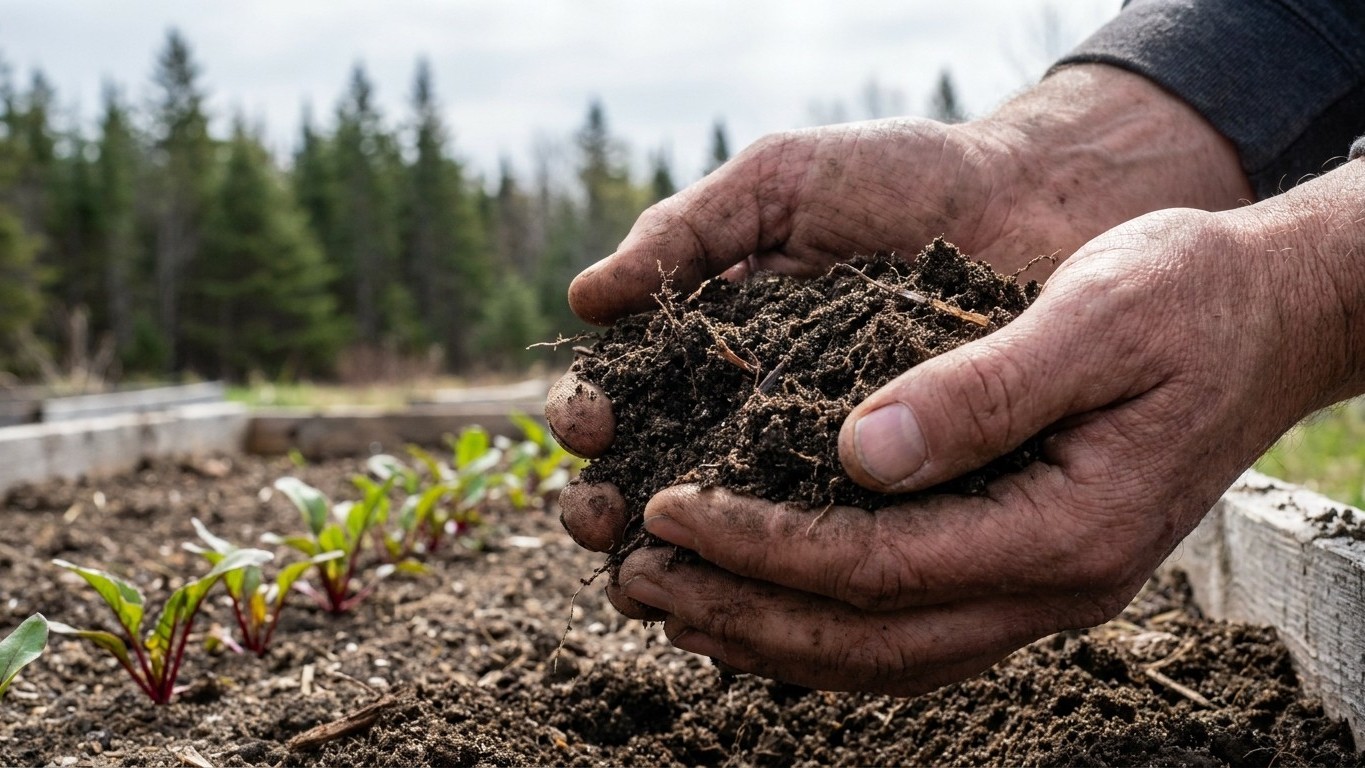

New Brunswick’s ground runs acid and its spring frost date is only an average, which means the two biggest beet failures here (bolting and woodiness) trace back to the same six weeks and the same soil profile, not to bad luck. Get the timing and the bed right and both risks drop sharply.
The short answer
Across the mapped agricultural soils of New Brunswick, the most common profile is a Podzol: an acid, leached soil that forms under conifer cover, where rain over time has washed the base minerals out of the topsoil. The median surface pH sits around 4.7, which counts as strongly acid. Texture runs to a sandy loam, roughly 47 percent sand, 37 percent silt and 16 percent clay, with organic matter near 3.4 percent, and drainage is classed as well drained. For a closer look at what this means specifically for root crops, see this breakdown of Beet Soil in New Brunswick. That comes from Agriculture and Agri-Food Canada’s Canadian Soil Information Service, drawn from 418 mapped soil components across the province.
A province the size of New Brunswick holds hundreds of distinct soil series, so this Podzol profile is a starting point, not a verdict on any one backyard. River flats, old bog ground, and anything a builder has scraped or filled will read completely differently. Treat the number as a description of what the region’s ground tends to do, then confirm your own plot with a soil test before you plant.
Set against what a beet actually wants, that profile is a mixed bag. Utah State University Extension describes the ideal beet bed as deep, sandy, and well-drained, with organic matter worked in at no more than 1 inch of composted material per 100 square feet. The province’s sandy loam and well-drained rating line up reasonably well with that description. The acidity is the sticking point: a median pH of 4.7 is well outside the comfortable range for most root vegetables, and ground that acid commonly needs lime before it will grow a straight, unblemished root. That is a soil-test question for your own bed, not something this provincial figure can settle for you.
On heat, the count of days New Brunswick spends above 90 F in a typical year isn’t published here, so no number is given. What the sourced data does support is the mechanism: Utah State University Extension links woodiness in the root to heat above 85 F arriving on top of water stress. A maritime province with a well-drained sandy loam base can still produce that combination on a dry, sunny stretch in a fast-draining bed, even without long runs of 90-degree heat. The trigger isn’t the thermometer alone; it’s heat plus a dry root zone.
The six weeks that decide it here
Beets are direct-sown, not transplanted, and the standard advice is to get seed in the ground 2 to 3 weeks before the last spring frost. For the specific dates that rule applies to here, see When to Sow Beets in New Brunswick. In New Brunswick, Environment and Climate Change Canada’s 1981-2010 climate normals put the average last spring frost at the Moncton station at May 23. That places a typical sowing window in the first half of May, and it puts the seedling’s first six weeks, the stretch that decides whether the plant bolts, right in the heart of the provincial spring.
The May 23 figure is a mean, not a guarantee. In roughly one year out of every two, the actual last frost at that station falls later than the average date. Sow by the calendar alone and you can walk young beet seedlings straight into a cold snap the “average” date said wouldn’t happen. Cold exposure at the seedling stage is one of the two levers behind premature flowering in beets, so a sowing date built only around the mean, with no buffer or row cover on hand, is already stacking risk before the soil even enters the picture.
The other lever is water. No province-wide figure for how wet or dry a New Brunswick spring runs is given here, so this isn’t a claim about typical rainfall. What the sourced soil data does support is texture: a sandy loam over a well-drained Podzol moves water through quickly. That is good news against waterlogging and root rot, but it means the bed can dry out between rain events faster than a heavier clay soil would, even in a province that gets its share of spring rain. For a young beet seedling, a week of that kind of drying, layered onto a cool snap, is exactly the water-stress-plus-cold combination Utah State University Extension points to as the trigger for early bolting.
Put together, the six weeks after a mid-May sowing carry two separate threats that happen to share a calendar: a real chance of frost later than the average date, and a fast-draining bed that can dry out between waterings. Neither one alone is unusual for the region. Stacked, they’re the reason bolted beets show up in New Brunswick gardens that otherwise look well tended.
What goes wrong here
- Bolting from a cold snap after the average frost date. Because May 23 is a mean and not a safe date, seedlings sown on schedule can still meet frost. Remedy: hold row cover or a cold frame ready through the first six weeks and use it whenever a forecast dips near freezing, rather than assuming the average date has already passed.
- Bolting from early water stress in a fast-draining bed. The sandy loam texture typical of this Podzol profile sheds water quickly, so a dry stretch in the first six weeks can stress seedlings even where spring rain is otherwise adequate overall. Remedy: check soil moisture at the seedling stage directly, by hand, rather than relying on rainfall alone, and water before the top few inches dry out.
- Woody roots from heat landing on a thirsty bed later in the season. Utah State University Extension ties root woodiness to heat above 85 F combined with water stress, a different failure from early bolting and one that shows up closer to harvest. Remedy: keep watering consistent through any hot spell in mid to late season, independent of how the seedling stage went.
- Stunted or misshapen roots in strongly acid ground. A median surface pH near 4.7 is well below what most root vegetables prefer, and acid Podzol soil left untreated can limit root development. Remedy: soil-test the specific bed and lime according to that result before sowing, since the provincial figure only flags the tendency, not your plot’s actual pH.
- Forked or hairy roots from over-amending. With native organic matter already near 3.4 percent, it’s tempting to pile on more compost. Utah State University Extension caps composted organic matter at 1 inch per 100 square feet; going heavier can push roots to fork or grow excessive hair. Remedy: measure the compost layer rather than eyeballing it, and skip additional organic matter in beds that already test high.
Checking this against your own county
Everything above describes the province’s dominant mapped soil profile and one weather station’s average frost date, not your specific garden. New Brunswick’s own provincial agriculture site currently blocks automated verification, so the reliable federal contact point is Agriculture and Agri-Food Canada, which can direct you to soil testing resources and regional guidance for your part of the province.
A soil test run on your actual bed will tell you the pH and texture you’re working with, which matters given how far the provincial median can sit from any one plot, river-bottom soils, old peat ground, and fill sites included. Local frost timing is worth checking too. If you garden well inland or at higher elevation than Moncton, your own last frost is likely to run later than the May 23 average used here, which shifts your safe sowing window later as well.
Common questions
How many days from sowing to harvest for beets in New Brunswick?
Beets are direct-sown, and the days-to-harvest window runs from that seeding date, not from a transplant date, since beets aren’t started indoors and moved out. This page doesn’t carry a specific New Brunswick maturity figure; count from your actual sowing date and check root size directly rather than relying on the calendar alone.
Should I lime my soil before growing beets in New Brunswick?
The province’s dominant mapped soil runs strongly acid, with a median surface pH near 4.7, and ground that acid commonly limits root vegetables. Whether your own bed needs lime, and how much, is a question for a soil test on your specific plot rather than for the provincial average.
Is New Brunswick’s spring frost date reliable for sowing beets?
The May 23 last-frost figure from Environment and Climate Change Canada’s Moncton station is a mean date, not a guaranteed cutoff. In about half of all years the last frost actually falls later, so sowing 2 to 3 weeks ahead of that date still carries real frost risk for young seedlings.
Why do my beets bolt in New Brunswick but not go woody, or the reverse?
These are two separate mechanisms. Bolting comes from water stress or cold hitting the seedling in its first six weeks. Woodiness comes later, from heat above 85 F combined with water stress as the root matures. A garden can hit one trigger without the other, so consistent watering across the whole season, not just at sowing, addresses both.