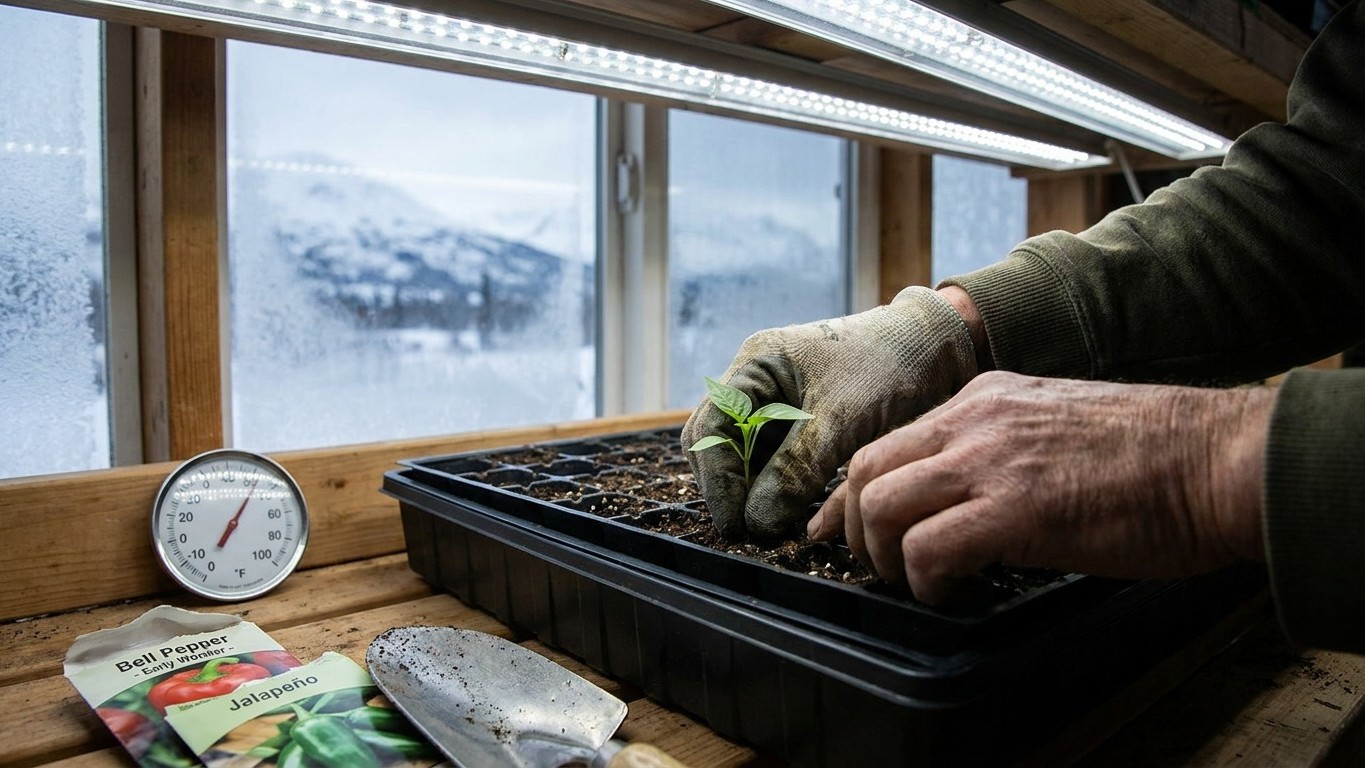

Peppers in the Anchorage area and most of Alaska’s populated growing regions should go into seed trays indoors in mid to late February through early March. Work back 8 to 10 weeks from a transplant date that falls after the last frost, May 3 to May 12, and only once soil has warmed to 60°F. Alaska’s near-total absence of extreme heat removes one failure point, but cool summer nights remain the wild card growers here have to track themselves.
The short answer
Start with the number that defines pepper growing at the reference station in Anchorage: 0.0 days a year at or above 90°F, per NOAA NCEI Climate Normals for 1991-2020. That is not a typo and not a rounding artifact. Anchorage, statistically, does not see 90°F weather. For a crop whose fruit set collapses under sustained heat above that threshold, this removes an entire failure mode that gardeners in Texas, Arizona or the Southeast have to manage every summer.
Why the heat threshold barely applies
Utah State University Extension notes that pepper fruit set fails when days climb past 90°F, because high heat disrupts pollen viability and the plant drops blossoms rather than push fruit it cannot support with available water. With zero days a year crossing that mark at the Anchorage reference station, outdoor pepper plants in this region essentially never face that particular stress. That is a real advantage over hotter states, and it means Alaska growers can spend their attention elsewhere instead of shading plants or drenching roots during a July heat spike.
Watch your own nights
The other end of that same failure range matters more here. Fruit set also fails when nights drop below 55°F, and this is where the math gets personal. This site does not carry summer night minimum data for Alaska, and there is no shortcut around that gap. Latitude will not tell you how cold your nights run in July, and neither will looking at January’s average low. Alaska’s long summer daylight can fool a gardener into thinking the season runs warmer than it does after sunset. If you garden in the Interior, along a river valley, or at any elevation above sea level, put an actual thermometer on the plants and read it at night. That single habit will tell you more about your pepper crop’s fate than any regional average ever could.
When to start seed here
The count-back method works the same everywhere, but the inputs change from county to county, and Alaska’s inputs vary more than almost anywhere else in the country. Here is how to run the math for your own address rather than borrow someone else’s date.
- Find your last spring frost window. For the Anchorage reference station, NOAA NCEI’s 1991-2020 normals put the 32°F freeze probability in the 30 to 70 percent band between May 3 and May 12. That is a window, not a guaranteed date, and it applies to one station only.
- Confirm soil temperature separately from frost date. Air can clear the frost line while soil is still cold. Pepper transplants need soil at 60°F before they go in the ground or an unheated tunnel, and in Alaska’s short season that soil warm-up can lag well behind the calendar. A simple soil thermometer pushed 2 to 4 inches down, checked over several mornings, beats guessing.
- Count back 8 to 10 weeks from that transplant date. If your soil reliably hits 60°F by the last week of May, seed indoors under lights sometime between mid-February and early March, depending on which end of the 8-to-10-week range your setup and variety need.
- Adjust for your own county, not for Anchorage. Anchorage is one of the mildest inhabited parts of Alaska, with roughly 143 frost-free days on average. The Interior and northern regions run a much shorter frost-free stretch, which pushes both the safe transplant date later and the indoor seeding date earlier relative to a compressed outdoor window. Long summer daylight helps offset some of that shortened season, but it does not replace soil warmth.
- Build in slack for a late frost. Since the frost window itself spans more than a week of probability, keep transplants ready to move indoors or under cover if a cold snap arrives inside that band.
Do the math for your county
Because Alaska’s growing regions differ so sharply from one another, a single statewide sowing date does not exist in any meaningful sense. A gardener near Anchorage working from the May 3 to May 12 frost window and a 60°F soil target will land on a different indoor seeding date than someone growing in a shorter-season interior valley, even though both are following the identical 8-to-10-week rule. Run the count-back with your own frost data and your own soil thermometer readings, not with a neighbor’s calendar from a different part of the state.
What goes wrong here
- Blossom drop from an unexpected hot spell. Outdoor days above 90°F are essentially absent at the Anchorage reference station, but an unventilated high tunnel or greenhouse can still spike past that mark on a bright, still day even when outside air stays mild. Vent structures aggressively on sunny afternoons and use shade cloth on the hottest stretches to keep the inside air from crossing the threshold that kills fruit set.
- Blossom drop from a cool night. This is the more common Alaska failure. Fruit set drops when nights fall below 55°F, and Alaska summer nights can dip there even during a warm-feeling day. Track your own nighttime lows with a thermometer at plant height. Where you see repeated cool nights, use row cover or cloches after sunset, and consider black plastic mulch to bank daytime heat into the soil and release it overnight.
- Sunscald where sun is strong. Alaska’s long summer daylight hours deliver intense, prolonged light exposure even when air temperatures stay moderate. Fruit and stems left without enough leaf cover can scald under that extended light. Avoid heavy pruning of foliage around developing fruit, and let the plant keep enough leaf canopy to shade its own peppers.
- Blossom-end rot from inconsistent watering. Short, intense growing seasons tempt gardeners to swing between drought stress and heavy watering as they chase a compressed timeline. That inconsistency interferes with calcium uptake and shows up as dark, sunken spots on fruit ends. Mulch to even out soil moisture and water on a steady schedule rather than reacting to whichever week feels driest.
Common questions
Can I Start Pepper Seed too early in Alaska?
Yes. Starting much earlier than 8 to 10 weeks before your soil-ready transplant date leaves plants rootbound and stressed indoors, waiting on a soil temperature that will not arrive any faster no matter how big the seedling gets. Stick to the count-back window rather than sowing at the first sign of late-winter cabin fever.
Does Alaska’s long daylight change the sowing schedule?
It changes growth rate and light exposure once plants are outdoors, not the indoor sowing math. The 8-to-10-week count-back from a frost-and-soil-confirmed transplant date still applies. Where long daylight matters most is later in the season, when it can intensify sunscald risk and speed up growth once soil finally warms.
What if my soil never reaches 60°F?
Some Alaska sites, particularly shaded, wet, or high-elevation ground, may struggle to hit that mark even in midsummer. Raised beds, black plastic mulch, or growing in containers that warm faster than ground soil are practical ways to push soil temperature up without waiting on the ground itself to comply.
Are peppers realistic to grow outdoors in the Interior or northern Alaska?
The frost-free window is far shorter there than the roughly 143 days typical of the Anchorage area, and that compresses the entire schedule. Many Interior and northern growers rely on unheated high tunnels or greenhouses to extend the effective season on both ends, since outdoor-only timelines can be too short for peppers to reach maturity from a spring transplant.