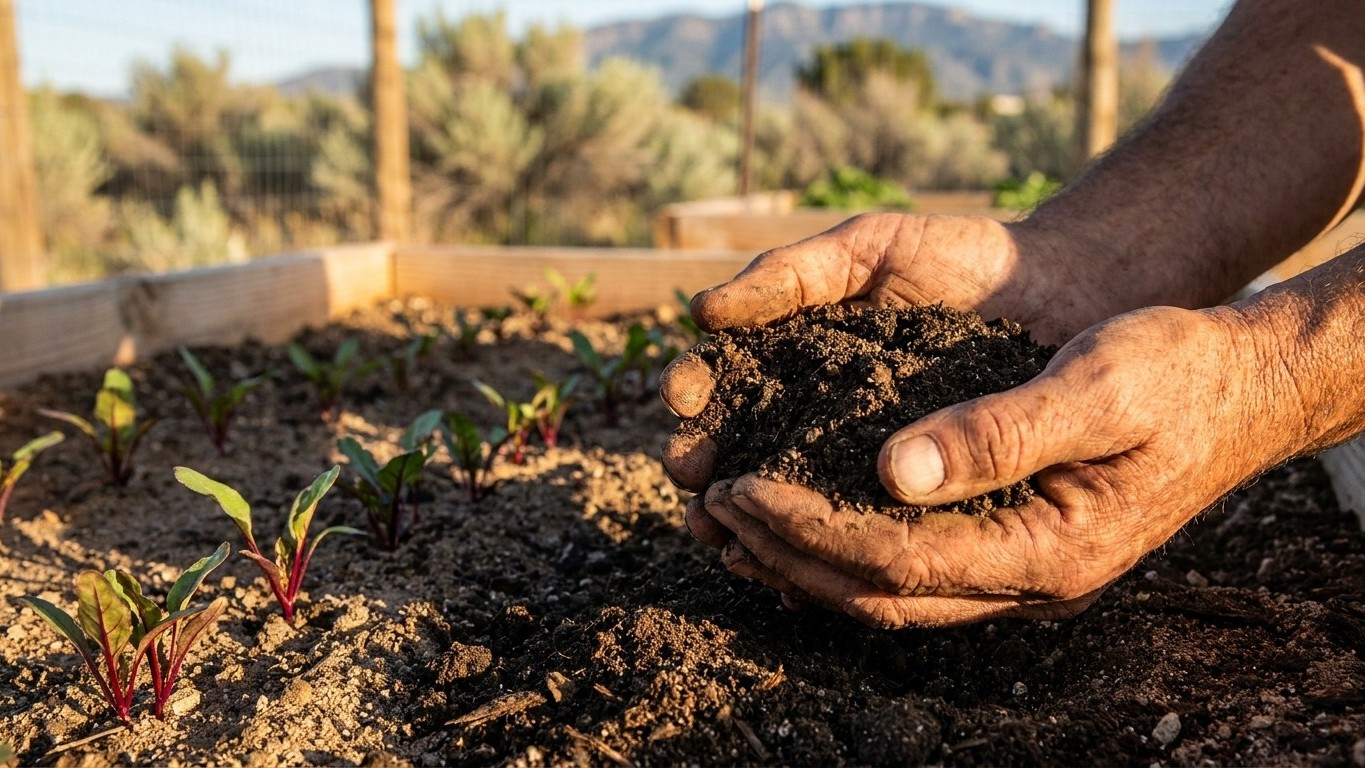

In New Mexico, Beet Soil in New Mexico does best when it’s deep, sandy, well-drained, and built up with organic matter, seeded directly into the ground two to three weeks before the last spring frost, and kept evenly moist through the first six weeks so they never bolt before the root even forms. Get the sowing window and the watering rhythm right, and the rest is mostly patience.
The short answer
The soil USDA lists as representative of New Mexico is the Penistaja series, an Aridisol, the kind of dry-climate ground that forms under low rainfall and tends to run alkaline and carry salts near the surface. The representative surface horizon comes in at 69 percent sand, 15 percent clay and 16 percent silt, with a pH around 7.5 and organic matter around 1.4 percent. It drains well. For a beet, that’s a mixed bag. Utah State University Extension is blunt about what the root wants: deep, sandy, well-drained soil rich in organic matter, amended with no more than 1 inch of composted organic matter per 100 sq ft. The Penistaja profile nails the sand and the drainage. It falls short on the organic matter, at roughly a tenth of what a well-built vegetable bed usually carries, which means a sandy New Mexico garden dries out fast between waterings unless that shortfall gets corrected with compost, not guessed at.
The pH sits at the alkaline end of what most root vegetables tolerate, and Aridisols in this class often carry salts that a gardener won’t see until germination struggles. Neither of those is disqualifying. Beets are one of the more alkaline-tolerant garden crops. But it means a New Mexico bed needs a soil test before anyone assumes the number on this page is their number.
The heat side of the equation matters just as much as the ground. Utah State University Extension’s threshold is specific: once temperatures push past 85 F while the plant is also short on water, the root turns woody. New Mexico’s low humidity and long, hot summer stretch mean that threshold gets crossed often and for extended runs, though the exact count of afternoons above 90 F for any single reference city isn’t part of the sourced figures used here. What matters for the gardener isn’t the tally of hot days, it’s making sure the beet finishes its growth and gets pulled before the heat and any dry spell overlap.
None of this is a verdict on any one backyard. New Mexico spans hundreds of mapped soil series, from river-bottom silt along the Rio Grande to rocky highland ground at elevation, and a lot of residential lots have been graded, filled or stripped of topsoil by a builder at some point. The Penistaja figures describe a natural, unworked surface horizon as mapped by USDA, not a cultivated bed. Treat them as a starting point for what the region’s ground tends to do, not a substitute for testing the dirt actually in the yard.
The six weeks that decide it here
Beet seed goes into the ground directly, never as a transplant, and the standard advice is to sow two to three weeks ahead of the last expected spring frost. For the reference city tracked by NOAA’s 1991-2020 climate normals, that last spring freeze falls somewhere between March 31 and April 12. Working back two to three weeks from that window puts a typical sowing date somewhere around mid to late March, roughly March 10 through March 29, depending on where in that freeze-date band a given season lands.
That timing matters because it sets the first six weeks of a beet’s life, the window Utah State University Extension identifies as the one where water stress causes premature flowering, on a specific stretch of the New Mexico calendar. Late March into early May in this state tends to run dry and windy, with soil moisture disappearing fast in that sandy, well-drained Penistaja-type ground. A gardener who sows on schedule and then waters on a normal weekly rhythm can still end up short, because wind and low humidity pull moisture out of sandy soil faster than a rain-fed schedule accounts for.
This is also the window where a late freeze can complicate things. NOAA’s frost-date figures come from a single airport weather station, and suburban and rural gardens elsewhere in the state typically see their own last frost land later, sometimes by one to two weeks or more at higher elevation. A gardener who sows by the reference-city date without checking their own county risks either a frost snap on tender seedlings or, more commonly in this dry climate, a false sense that the water-stress window has passed when it hasn’t even started.
The practical takeaway is narrow and specific: the six weeks right after sowing are the six weeks that decide whether the crop bolts, and in New Mexico those six weeks usually mean managing dry, moving air on sandy ground, not managing rainfall.
What goes wrong here
- Bolting from dry, windy early spring: the sandy Penistaja-type surface drains fast and holds little water to begin with, and New Mexico’s typically dry late-March-to-May stretch pulls what moisture there is out even faster. Utah State University Extension ties water stress in the first six weeks directly to premature flowering. The fix is even, scheduled watering from the day of sowing, checked by hand rather than by calendar, since wind alone can dry sandy topsoil between waterings that would be fine in heavier ground.
- Woody roots from summer heat: a beet that survives the bolting window can still turn fibrous later if it’s still in the ground once the season pushes past the 85 F threshold Utah State University Extension flags, especially if watering lapses at the same time. The remedy is timing the harvest to land before that overlap, not just watering harder once the root is already woody.
- Low organic matter limiting moisture retention: at roughly 1.4 percent organic matter, the representative surface horizon here has little buffer against the sandy texture’s fast drainage. Utah State University Extension’s guideline of up to 1 inch of composted organic matter per 100 sq ft addresses this directly, worked in ahead of sowing rather than added mid-season.
- Alkaline pH tying up micronutrients: a surface pH around 7.5 can restrict how well a plant takes up certain micronutrients, even when the raw nutrients are present in the soil. A soil test that reports pH alongside nutrient levels is the only way to know whether this is an issue in a specific bed, rather than guessing from the state average.
- Salts common in Aridisols slowing germination: soils in this classification often carry salts near the surface, which can show up as patchy or weak germination rather than an obvious symptom. A pre-planting soak or leach of the bed, followed by a soil test if germination is uneven, catches this before a whole row is written off as a bad batch of seed.
Checking this against your own county
Everything above describes what the Penistaja series and New Mexico’s spring pattern tend to do in general. Neither one is a measurement of any particular backyard. Before amending soil, adjusting a watering schedule, or picking a sowing date, get a soil test and a local frost-date estimate from New Mexico State University’s Cooperative Extension Service, the state’s land-grant extension office, at aces.nmsu.edu. County agents there can also speak to elevation effects on frost timing, which shift the NOAA reference-city dates used on this page earlier or later depending on where in the state a garden actually sits.
Common questions
How many days do beets take to mature in New Mexico?
Beets typically run 60 to 80 days from the day the seed goes into the ground, not from a transplant date, since beets are always direct-sown. Counting forward from a mid to late March sowing date puts most New Mexico beet harvests somewhere in late May through July, well ahead of the hottest stretch of summer if timed carefully.
Does the alkaline soil in New Mexico hurt beets?
Beets tolerate alkaline soil better than many root vegetables, so a surface pH around 7.5, the figure USDA records for the state’s representative Penistaja series, isn’t automatically a problem. It can still limit micronutrient uptake in some beds, which is why a local soil test matters more than the state average.
Should I plant beet varieties for New Mexico’s heat?
Common beet varieties gardeners in this region often mention include Detroit Dark Red, Early Wonder, Bull’s Blood, Chioggia and Golden. No verified data on this page ties any one of these to a specific season, color performance or heat tolerance, so choosing among them is better done through a local extension recommendation than a general claim.
Can I sow beets earlier than two to three weeks before the last frost?
Sowing earlier than the standard two-to-three-week window ahead of the last frost date raises the odds of frost damage to seedlings, and NOAA’s frost-date figures for the reference city already carry a range from March 31 to April 12. Since actual gardens away from that airport station tend to see their last frost even later, checking with the local extension office before pushing the sowing date earlier is the safer route.