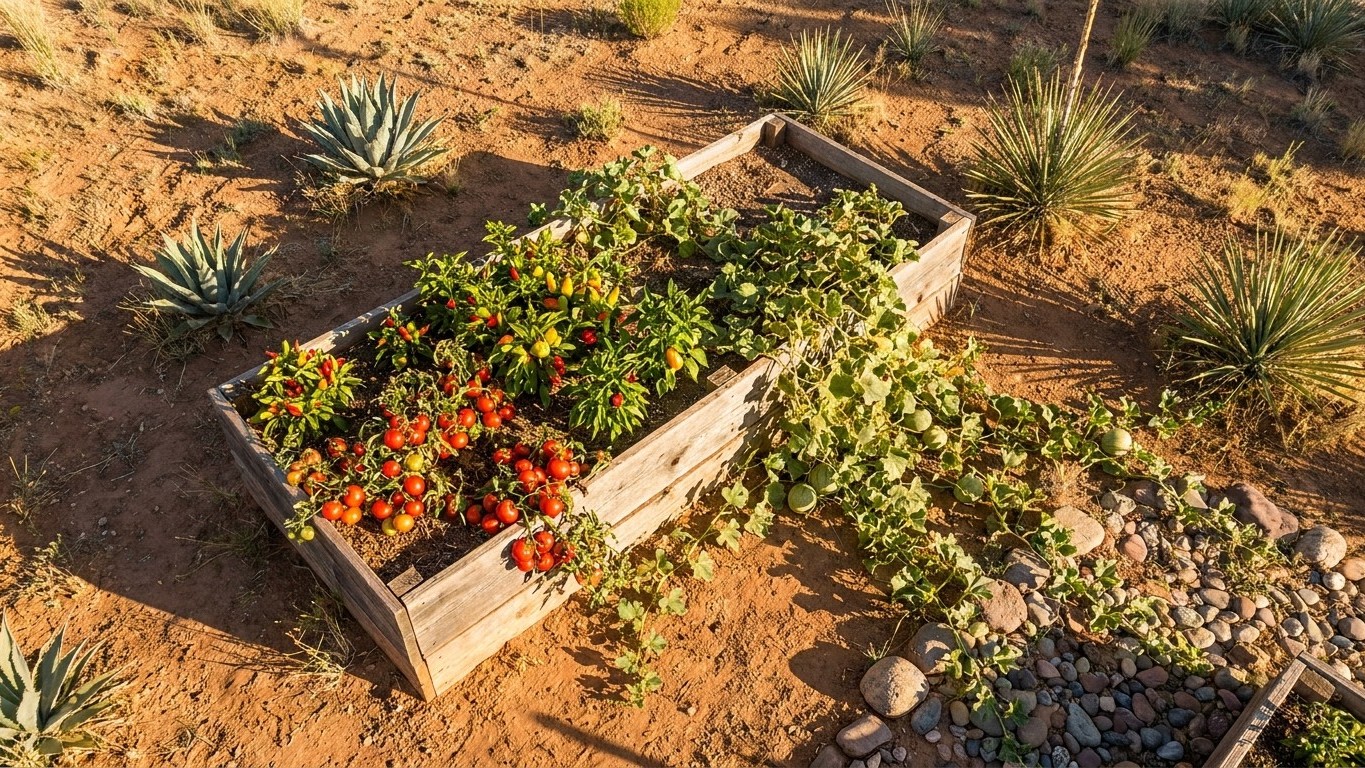

New Mexico gardening runs on a short, hot, unevenly timed calendar: a frost-free window of roughly six and a half months bookended by cold snaps, a summer heat load that shuts down cool-season crops for weeks at a time, and a hardiness range so wide the state figures barely apply to any one backyard. Here’s what that actually means for what you can grow, and when.
How long your season really is

Three numbers set the boundaries of what’s possible in a New Mexico garden, and none of them come from guesswork. The USDA Plant Hardiness Zone Map (2023, built on 1991-2020 normals) places the state across zones 4b to 9a. The average last spring frost at the reference station falls between March 31 and April 12. The average first fall frost lands between October 29 and November 9.
| Metric | Value |
|---|---|
| USDA Hardiness Zone (statewide range) | 4b to 9a |
| Average last spring frost | March 31 – April 12 |
| Average first fall frost | October 29 – November 9 |
Subtract one date from the other and you get the number that actually decides your garden: a frost-free window of somewhere around 200 to 220 days, depending on where in that range you land. That’s generous compared to a lot of the northern tier, and it’s why New Mexico gardeners can push tomatoes, peppers, melons, and even cool-season staples like potatoes (see this guide to Growing Potatoes in New Mexico for timing tips) and carrots (covered in Growing Carrots in New Mexico) further than they’d get in a shorter-season state, alongside guidance like this one on Growing Peppers in New Mexico for making the most of that window, and that same window is exactly what makes long-vining crops like pumpkins viable, as this guide to Growing Pumpkins in New Mexico lays out, and the same fall frost window shapes a question that comes up every October: When to Carve a Pumpkin in New Mexico. But it also rules things out. Anything that needs a truly long, mild season with no heat stress in the middle, think certain long-day onions bred for northern latitudes, or brassicas that expect cool weather straight through, doesn’t fit the pattern here without real intervention.
The harder point: these are averages, not promises. NOAA calculates them from a 30-70% freeze probability band, which means in roughly half of all years, frost shows up later in spring or earlier in fall than the dates above. Plant your tomatoes on April 1 because “that’s the average last frost” and you’re playing a coin flip, not following a rule. The dates are a planning anchor, not a safe date. And they come from a single airport weather station, not your yard. Suburban and rural gardens, especially anything with elevation gain, routinely see frost linger later into spring and arrive earlier in fall, often by one to two weeks. If you garden outside the reference city, treat these dates as a starting estimate and adjust conservatively toward a shorter season, not a longer one.
What the summer does to a garden here
Albuquerque averages 42.5 days a year at or above 90F. That’s not a description of “hot summers,” it’s a specific stress threshold. Once temperatures push past roughly 90F, tomato blossoms stop setting fruit, no matter how healthy the plant looks. Lettuce and spinach bolt and turn bitter. Broccoli and other cool-season brassicas simply quit performing well. Forty-two and a half days isn’t a heat wave, it’s six weeks scattered through the hottest stretch of summer where a chunk of the vegetable garden effectively goes on pause.
That reshapes the whole gardening year here into something closer to two seasons with a dead middle than one long, uninterrupted growing run. Cool-season crops, lettuce, spinach, peas, most brassicas, do their real work in the spring shoulder and again in early fall, not in July. Warm-season crops like tomatoes, squash, and peppers get planted after the last frost, produce through the milder stretch of early summer, often stall or drop blossoms during the hottest weeks, then can pick back up as temperatures ease in late summer if the plants are still alive and the first fall frost hasn’t arrived yet.
Winter brings its own ceiling. The average daily minimum for the coldest month sits at 26.4F at the reference station, which is the number that actually decides whether a perennial, shrub, or fruit tree survives winter here at all. That’s meaningfully colder than a simple “mild winter” label would suggest, and it’s a big part of why the hardiness zone range spans from 4b to 9a depending on elevation and location within the state. A gardener at the warmer end of that range can leave far more in the ground over winter than one at the colder end, and the difference isn’t marginal.
What tends to go wrong in New Mexico
New Mexico State University Extension flags a specific set of insects that home gardeners here actually run into, based on Guide H-176. A handful of these account for most of the damage reported to county offices:
- Bagrada bug — shows up early in spring, targeting young cole crops like cabbage, broccoli, and kale just as seedlings are getting established.
- Beet leafhopper — active through the warmer months, moving between crops and spreading curly top virus as it feeds.
- Squash bug — appears as squash and pumpkin vines mature in summer, feeding on stems and leaves until plants wilt and collapse.
- Aphids — build up through spring and into early summer on tender new growth across nearly every vegetable crop.
- Thrips — most active in the hot, dry stretch of summer, scarring leaves and flowers and stunting growth.
- Corn earworm — arrives as corn silks emerge in summer, tunneling into ears from the tip down.
- Spotted and striped cucumber beetles — active from late spring through summer on cucumbers, melons, and squash, feeding on leaves and transmitting bacterial wilt.
- Grasshoppers — build in number through summer, especially in dry years, and can strip a garden fast once populations spike.
- Lygus bugs — feed on buds and developing fruit through summer, causing distorted growth and dropped blossoms.
This isn’t every insect a New Mexico gardener could ever meet, and pressure shifts depending on where in the state you garden. It’s the short list the extension service itself calls out as recurring problems for home vegetable growers. If something’s chewing on your plants and it’s not on this list, your county extension office can identify it accurately, which matters more than guessing.
Where to check before you plant
Everything above is a state-level starting point, and New Mexico is too large and too varied in elevation for a single planting calendar to fit every yard. A hardiness range running from 4b to 9a means a garden near the Colorado border and a garden near the Texas border aren’t playing by the same rules, and a date that works for the reference city can be off by weeks at either edge of the state.
New Mexico State University’s Cooperative Extension Service, the land-grant extension for the state, is the resource built for exactly this gap. Their site is at aces.nmsu.edu, and from there your own county office can give you frost dates, soil guidance, and pest pressure specific to your actual location, not a statewide average. That’s a meaningfully different, and more useful, starting point than any figure in this article. A three-week error on either end of the season is the difference between a tomato crop that sets fruit and one that never gets the chance, so it’s worth the extra step before you commit seed to soil.