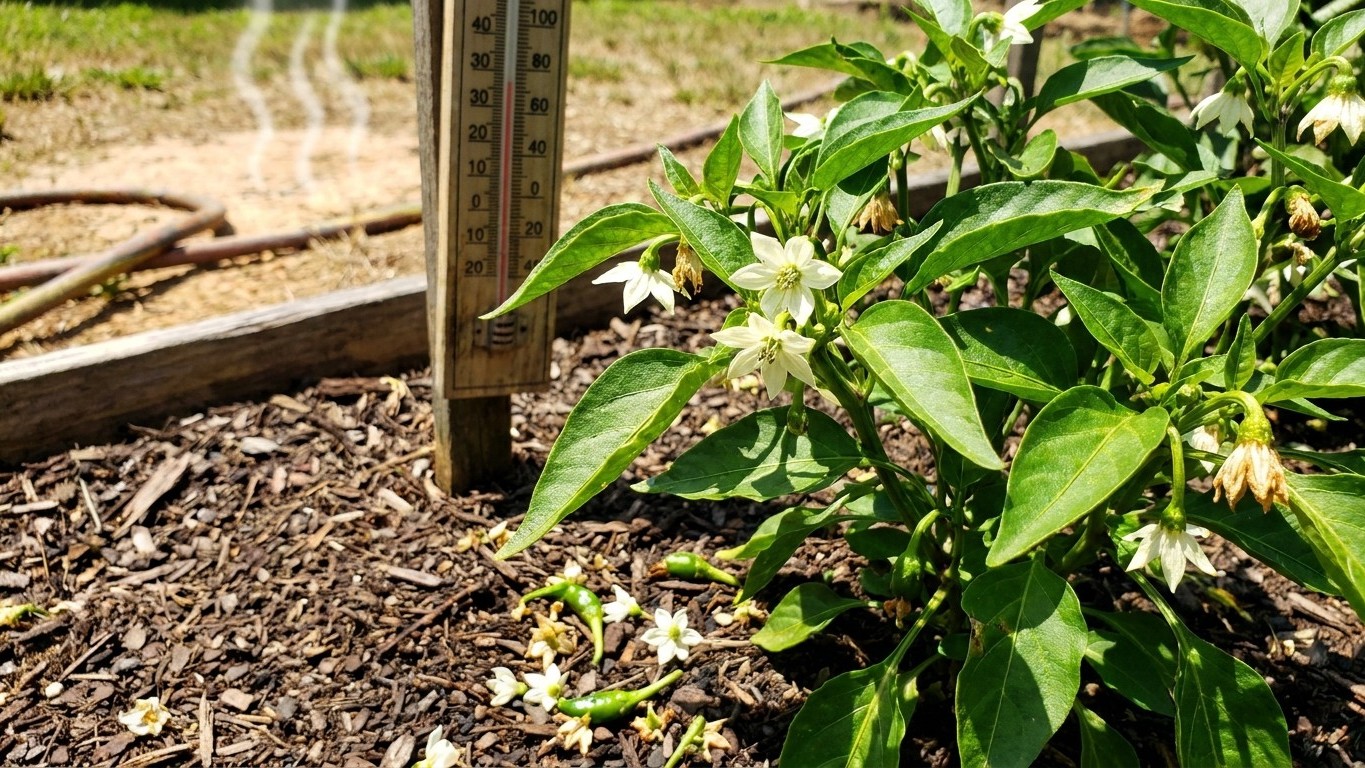

Peppers stop setting fruit in Georgia for two opposite reasons: the pollen becomes unviable once afternoons push past 90°F for stretches during bloom, and it can also fail when nights drop below 55°F in early spring or late fall. Georgia’s reference station logs 35.8 days a year at or above 90°F, which is the real obstacle most home gardeners run into here. Timing the transplant window matters more than the variety chosen.
The short answer
Start with the number: 35.8 days a year at or above 90°F at the Atlanta reference station, per NOAA NCEI Climate Normals for 1991-2020. That’s not a single scorching afternoon, it’s more than a month’s worth of days scattered across a Georgia summer, and a good chunk of them land in July and August when a spring-planted pepper crop is still flowering and trying to set its main harvest. Pepper flowers don’t need a heat wave to fail. A run of 90°F-plus days during bloom is enough to make pollen sterile or keep it from shedding properly, and the plant responds by dropping blossoms rather than wasting energy on fruit that won’t finish. Gardeners often blame disease or a bad transplant when the real cause was simply a hot week at the wrong stage of the plant’s cycle.
The other failure point sits at the opposite end of the thermometer, and it matters just as much even though it gets less attention. Nights below 55°F interfere with pollen release the same way extreme heat does, just through a different mechanism, and peppers set in Georgia can hit this wall twice: once in early spring right after transplant, and again in fall if a crop is pushed late trying to dodge summer heat. This site tracks daytime heat loads by county, but it does not carry summer overnight low temperatures, so there’s no substitute here for watching your own nighttime forecast during the weeks your plants are flowering. Don’t estimate cool nights from your county’s latitude or from how cold your winters run. A north Georgia mountain valley and a coastal plain field at a similar latitude can have very different overnight patterns in the shoulder seasons, and the only reliable read is a thermometer on your own property during bloom.
Put together, the practical takeaway is that pepper fruit set in Georgia depends less on soil, fertilizer, or even variety, and more on hitting a window where nights stay above 55°F and days stay mostly under 90°F during flowering. That window exists here, but it’s narrower in the hottest stretch of summer than gardeners in cooler states typically expect.
When to start seed here
Working backward from Georgia’s frost data gives a seed-starting date you can adjust to your own county. Here’s the arithmetic laid out step by step:
- Locate your last spring frost window. The reference station used for Georgia frost probabilities shows a 30-70% freeze-risk band running from March 11 to March 29, based on NOAA NCEI’s 1991-2020 climate normals for that station. That reference site sits at an urban airport that runs warmer than its surroundings, so treat this as a starting point, not a guarantee. North Georgia and the mountains typically see their last freeze several weeks later than this window, and the coastal plain tends to clear frost earlier.
- Wait for two conditions before transplanting, not one. Frost has to be past, and soil temperature needs to reach 60°F. These don’t always happen on the same date. A frost-free week with cold soil will still stall a young pepper plant, so check soil temperature with a probe thermometer rather than assuming it follows the air temperature.
- Count back 8 to 10 weeks from your expected transplant date for indoor seed starting. If your transplant target lands around the tail end of the frost window, in late March for the Atlanta reference area, count back 8 to 10 weeks and you land in mid-January to early February for starting seed indoors. Gardeners further north in the state, or at higher elevation, should push both the transplant date and the seed-start date later using their own local frost data rather than the reference station’s numbers.
- Build in a buffer before flowering begins. Since fruit set depends on temperatures during bloom, not at transplant, it helps to time seed starting so that flowering doesn’t land squarely inside the hottest stretch of days above 90°F. Starting a few weeks earlier than the minimum, when your indoor setup allows it, gives the plant a head start on setting an early flush before peak summer heat arrives.
This arithmetic holds regardless of variety. Redo the count for your own county’s frost dates rather than borrowing the Atlanta reference numbers directly if you’re gardening well outside the metro area.
What goes wrong here
Georgia’s climate produces a specific, recurring set of pepper problems. Each one has a distinct cause and a distinct fix, and mixing them up leads to the wrong remedy.
- Blossom drop during a hot spell. When daytime highs run at or above 90°F for several days in a row during flowering, pollen loses viability and the plant sheds blossoms rather than setting fruit. This is the most common failure in Georgia given the 35.8-day average above that threshold. The remedy isn’t more fertilizer or water alone; light shade cloth over the row during the hottest afternoons and consistent soil moisture through the heat wave give the plant its best shot at holding onto the next flush of blooms once temperatures ease.
- Blossom drop from a cool night. The same dropped-blossom symptom shows up when nights dip below 55°F, most likely right after an early transplant or during a late-season push into fall. Since summer night minimums aren’t tracked on this site, the fix is behavioral: check your own overnight forecast during the weeks your plants are setting flowers, and hold off on transplanting, or cover plants with row fabric, if a cold night is forecast during that stretch.
- Sunscald on exposed fruit. Georgia’s summer sun is strong enough that fruit left exposed after heat-stressed plants drop leaves can develop pale, papery patches on the side facing direct sun. Avoid heavy pruning during the hottest months, and let the plant keep enough foliage to shade its own fruit; a light shade cloth over exposed rows helps in the peak of summer.
- Blossom-end rot. Irregular watering during hot, dry stretches disrupts calcium movement into the fruit, producing a sunken, dark patch on the blossom end. This isn’t a soil calcium shortage in most Georgia gardens; it’s an uptake problem tied to watering swings. A steady watering schedule and a layer of mulch to even out soil moisture through hot weeks address it more reliably than adding calcium products.
Common questions
Do all pepper varieties Fail to Set Fruit at the same temperatures in Georgia?
The threshold temperatures for fruit set, above 90°F and below 55°F, come from Utah State University Extension and apply broadly to peppers as a crop. No heat rating or variety-specific figure is published here, so don’t assume one variety tolerates Georgia’s heat load better than another without a documented source for that claim.
How many days after flowering does a pepper actually set fruit?
That window runs from flowering, not from sowing or transplanting, and depends on the plant successfully holding its blossoms through the temperature range described above. Once a flower avoids drop from heat or cold, fruit development follows from that point forward.
Should I use the Atlanta frost dates if I garden elsewhere in Georgia?
Treat the March 11 to March 29 window as a reference point only. It comes from an urban airport station that runs warmer than its surroundings, so north Georgia and mountain gardens typically see frost linger later, while the coastal plain tends to clear earlier. Use your own county’s frost history when it’s available.
Can I fix blossom drop by feeding the plant more?
No. Blossom drop tied to heat above 90°F or cold nights below 55°F is a temperature response, not a nutrient deficiency. Extra fertilizer won’t resolve it and can push excess foliage growth instead. Managing shade, watering consistency, and transplant timing addresses the actual cause.