
Nunavut’s reference station at Rankin Inlet logs an average of 0.0 days a year at or above 90 F, and the average last spring frost falls around June 19. Together those two numbers point to a narrow, cool growing window: start pepper seed indoors roughly 8 to 10 weeks before you plan to set transplants outside, which lands seed-starting in mid-to-late April for most Nunavut communities, with outdoor planting pushed into late June at the earliest.
The short answer
Zero. That’s the count of days a year Rankin Inlet reaches 90 F or higher, according to Environment and Climate Change Canada’s 1981-2010 Climate Normals. For pepper growers, that number matters because fruit set fails at the hot end when daytime highs push past 90 F and blossoms drop before they can pollinate. In Nunavut, that failure mode basically doesn’t apply outdoors. You are not going to lose a pepper crop to heat stress in an open garden bed here, because the heat that causes it almost never arrives.
That’s the easy half of the story. Pepper fruit set fails at the other end too, when nights drop below 55 F, and this is where Nunavut growers need to pay closer attention than the climate normals can help with. This site tracks the count of days above 90 F for each territory, but it does not carry summer night minimum temperatures. That gap matters more here than almost anywhere else covered in this series, because a short, cool-summer climate like Nunavut’s is exactly the kind of place where overnight lows can sit under that 55 F threshold for stretches of the growing season, even in July.
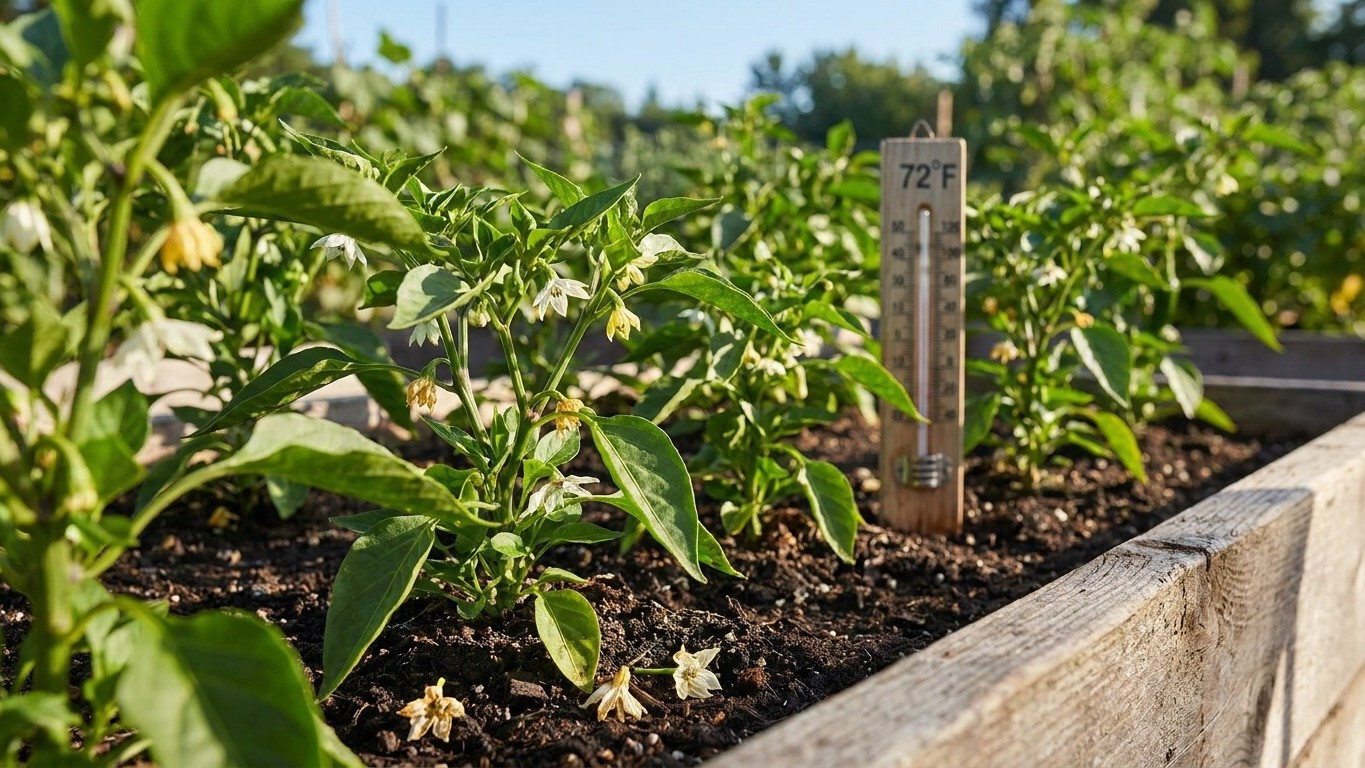
The honest answer is that nobody can tell you, from a latitude line or a climate normal for the coldest month of the year, what your actual overnight lows will be in your own community during peak pepper season. Latitude is not a temperature reading. Neither is a January average. If you want to know whether your nights are cutting into fruit set, the only reliable method is to put a min-max thermometer in your garden, or check a nearby weather station’s actual summer readings, and track it yourself through June, July, and August.
One more note on the numbers behind this page: the Canadian climate normals used here run from 1981 to 2010, while the equivalent figures for US states on this site are drawn from the 1991-2020 period. That’s not a small technicality if you’re comparing Nunavut to a state south of the border. The two datasets were built from different 30-year windows, so treat any side-by-side comparison as a rough guide, not an apples-to-apples match.
When to start seed here
Utah State University Extension’s guidance on peppers gives the basic formula: start seed indoors 8 to 10 weeks before transplanting, and don’t move plants outside until the soil has warmed to 60 F and the frost risk has passed. Here’s how that arithmetic runs for Nunavut, step by step, so you can redo it for your own community.
- Start from the average last frost date. At the Rankin Inlet A station, that date is June 19, based on Environment and Climate Change Canada’s 1981-2010 Climate Normals.
- Treat that date as a midpoint, not a guarantee. An average last frost date means that in roughly half of all years, frost arrives after June 19, not before. Planning your transplant date for June 19 itself carries real risk of losing young plants to a late frost.
- Build in a margin past that mean date. Many gardeners in cold, short-season regions push their transplant date a week or two past the average frost date specifically to cover that one-year-in-two chance of a later frost. How much margin you add depends on how much risk you’re willing to carry.
- Confirm soil temperature separately from air temperature. Frost passing does not mean the soil is ready. Peppers need soil at 60 F before transplanting, and in a cold-summer climate like Nunavut’s, soil can lag well behind air temperature for weeks after the last frost.
- Set your transplant date only once both conditions are met. Frost risk passed, and soil measured at 60 F, not estimated.
- Count back 8 to 10 weeks from that transplant date to find your seed-starting date. If your realistic, margin-adjusted transplant date falls in early July, for example, that puts indoor seed-starting in late April to early May.
- Adjust again for your own community. Rankin Inlet is one reference station. Nunavut spans a huge area, and other communities, especially those further north or at higher elevation, run their own local timing that can lag well behind Rankin Inlet’s normals.
What goes wrong here
- Blossom drop from a cool night. Pepper flowers can abort when nighttime temperatures fall below 55 F, and in Nunavut that risk runs through much of the growing season, not just at the shoulders. Since this site doesn’t track summer night minimums, watch your own garden with a min-max thermometer. If you’re seeing dropped blossoms with no fruit forming, cooler-than-ideal nights are the most likely cause here, more so than heat, given the 0.0 days-above-90 F count at the reference station.
- Blossom drop from a hot spell. Even where 90 F days are rare, a short, unusual warm stretch can still push blossoms to drop if it coincides with dry soil or heat-stressed plants. The remedy is consistent watering through any warm spell and light afternoon shade if a heat spike is forecast, even though sustained heat stress is not the dominant risk in this climate.
- Sunscald on exposed fruit. Where sun exposure is strong and foliage cover is thin, especially on plants that have lost leaves to wind or disease, fruit can develop pale, papery patches from direct sun. Keep foliage full through balanced watering and avoid over-pruning leaves that shade developing peppers.
- Blossom-end rot. This shows up as a dark, sunken patch on the bottom of the fruit and traces back to inconsistent watering disrupting calcium uptake, not a lack of calcium in the soil itself. Even, regular watering, especially important in a short growing season where every week of fruit development counts, is the practical fix.
Common questions
Can peppers even mature outdoors in Nunavut before the season ends?
The last spring frost averages June 19 at Rankin Inlet, which already compresses the outdoor window. This page doesn’t carry a first fall frost date for Nunavut, so the safest approach is to start seed indoors on the early side of the 8-to-10-week window and consider extending the season with row cover or a cold frame rather than counting on an unusually long frost-free stretch.
Does the 0.0 days-above-90 F figure mean I never need to worry about heat with peppers here?
It means sustained heat stress from days regularly topping 90 F is not the risk profile for Nunavut, based on the Rankin Inlet reference station. It doesn’t rule out an occasional unseasonably warm day, and watering consistency still matters regardless of how rare high heat is.
How do I know if my nights are too cold for fruit set, since this site doesn’t track that?
Place a min-max thermometer in your growing area and check it through the pepper season. If overnight lows are regularly dropping under 55 F when your plants are flowering, that’s the likely explanation for poor fruit set, not a soil or watering problem.
Is June 19 a safe date to transplant peppers outside?
No. It’s the average last frost date at the Rankin Inlet A station over the 1981-2010 normals period, which means frost arrives later than that in about half of all years. Treat it as the middle of a risk window and build in extra time before transplanting, rather than planning around it as a guaranteed cutoff.