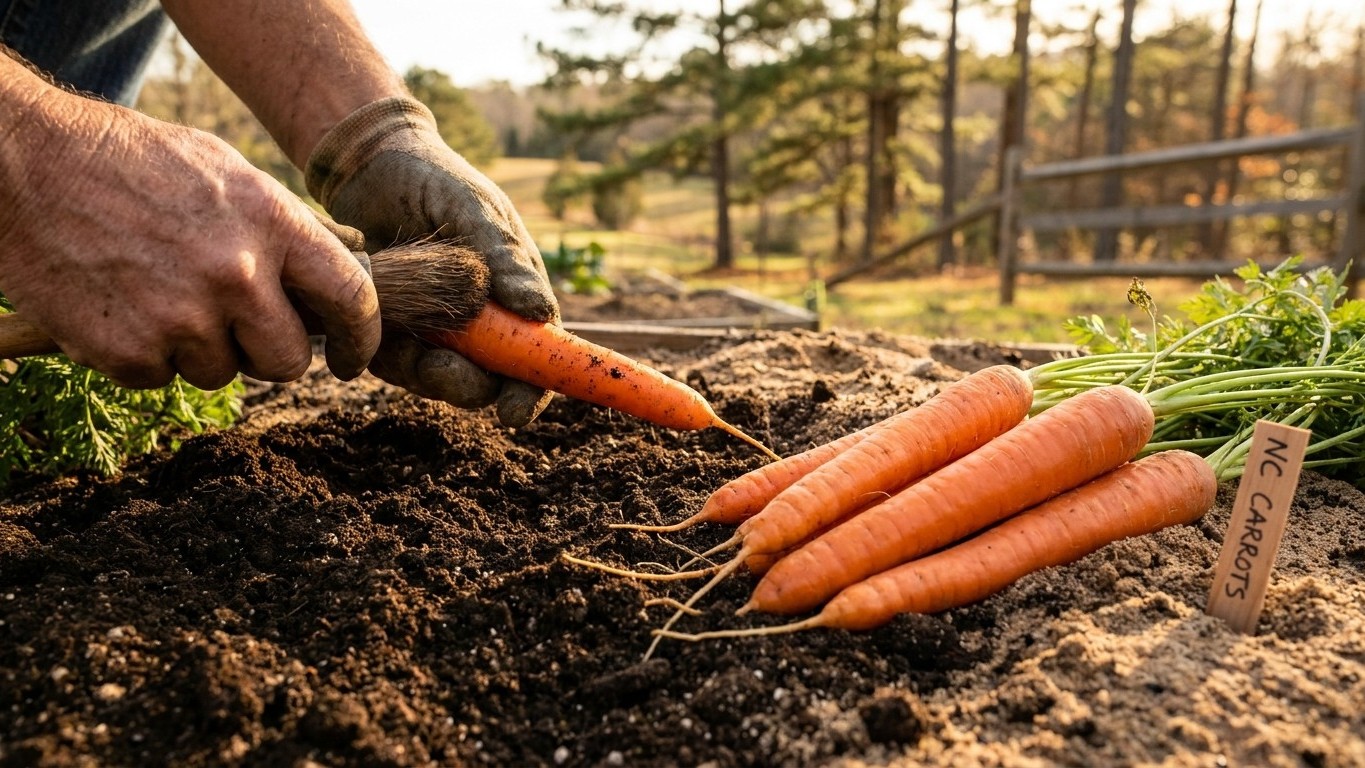

North Carolina’s representative garden soil, the Cecil series, is a sandy, acidic Ultisol that drains well but runs short on organic matter. That combination is actually kinder to carrots than the heavy clay found in many other states, and Will Carrots Fork in North Carolina Soil? is less likely on texture alone, but the low fertility and acid pH still call for compost, and possibly a raised bed if your particular yard has been compacted or filled.
The short answer
The Cecil series is what USDA lists as representative of North Carolina, and its numbers tell a specific story. The surface horizon runs 68 percent sand, 13 percent clay and 20 percent silt, a sandy loam, not the dense clay that plagues carrot growers elsewhere. It’s classed as well drained. Organic matter sits at about 0.8 percent, which is thin, and the surface pH averages around 5.5, slightly acid. It’s an old, heavily weathered, leached soil, the kind that’s been sitting under forest or pasture for a long stretch without much building up of fertility.
What does that mean for a carrot root pushing down through it? Texture-wise, this is not the forking soil Utah State University Extension warns about. Their guidance is direct: carrots want deep, sandy, well-drained ground rich in organic matter, and it’s heavy or rocky soil that makes the root fork, splitting around obstructions instead of growing straight. Cecil’s sand-heavy surface and good drainage check two of those boxes already. The catch is the third one, organic matter. At 0.8 percent, this soil is nowhere near “rich,” and thin, hungry soil grows short, forked, or stunted carrots almost as often as heavy clay does, just for a different reason: the root can’t find enough loose, fertile depth to elongate into.
The fix here isn’t a raised bed to escape clay, since clay isn’t really the problem. It’s compost, worked in generously, and a spade or fork run down twelve inches or more to loosen the profile before sowing, double digging, in the older gardening term. That builds the organic matter the native soil lacks and keeps the loose, easy-digging structure carrots need to grow long and straight, and getting When to Sow Carrots in North Carolina right still matters even after the soil prep is done. If your particular plot sits on a subsoil that’s been compacted by construction equipment or years of foot traffic, a raised bed still solves that regardless of what the county series says.
None of this is a diagnosis of your backyard. North Carolina spans hundreds of soil series across the mountains, Piedmont and coastal plain, and Cecil is simply the one USDA names as representative statewide. Your actual garden could be sandier, siltier, shallower to bedrock, or sitting on fill dirt a builder brought in. Treat these numbers as a starting point for what the region’s ground tends to do, not a substitute for digging in your own bed.
The test that settles it in your own garden
A county average can’t tell you what’s under your own raised bed or backyard plot. A short physical check will, and none of it requires a lab.
- Dig a hole about twelve inches deep in the spot you plan to sow. Note where the soil changes color or gets noticeably harder to shovel through, that tells you how much loose rooting depth a carrot will actually get before hitting resistance.
- Look at what comes out of the hole. Count visible stones and rock fragments. Carrots fork around anything solid in their path, so a handful of gravel-sized rocks in that profile is a warning sign regardless of what the soil map says.
- Grab a handful of moist soil from the hole and rub it between your fingers. Gritty and loose means sandy; slick and moldable like clay means it’ll compact and resist a root pushing through; a smooth, floury feel in between is silt.
- Fill the hole with water and time how long it takes to drain. Standing water after an hour or more points to poor drainage, a common cause of split and stunted roots even in soil that looks fine on the surface.
- Repeat the dig in two or three spots around the planned bed. Soil can change meaningfully within twenty feet, especially near foundations, driveways or wherever fill dirt was brought in during construction.
When to sow here
Carrot seed goes into the ground directly, there’s no transplanting this crop, so every count below runs from the sowing date itself, not from any later step.
- Start with your last spring frost window. For the Charlotte area, NOAA’s 1991-2020 climate normals put that window between March 23 and April 5, based on 32 F freeze probabilities. If you garden west toward the Blue Ridge, expect that date to run several weeks later; toward the coastal plain, expect it earlier.
- Carrot seed germinates best in soil between 55 and 65 F, but it will sprout in soil as cool as 40 F, just more slowly. That 40 F floor is what makes early sowing possible at all, you don’t have to wait for warm soil, just soil that’s no longer near-frozen.
- Count back two to three weeks from your last frost date. Using the early end of the Charlotte window, March 23, two to three weeks earlier lands sowing in the first week of March. Using the later end, April 5, the same math lands you in mid-to-late March.
- That gives most Piedmont gardeners a sowing window running roughly from early March into late March, adjusted earlier or later depending on where in the state you actually garden and how the soil is measuring on a thermometer rather than a calendar.
- Check soil temperature directly with a simple soil thermometer a few inches down before committing seed to the ground. A cold snap after a warm spell can drop soil back below that 40 F floor even after the calendar date has passed.
What goes wrong here
- Forking in compacted or rocky pockets. Even where the surface reads sandy loam, subsoil compacted by construction, foot traffic, or old fill can stop a taproot cold and send it forking around the obstruction. Double dig the bed to at least twelve inches before sowing, and pull out stones as you find them.
- Poor germination during a hot spell. Carrot seed struggles once soil temperatures climb well above the 55-65 F range it prefers. A late-spring heat spike right after sowing can leave a bed with thin, spotty germination. Water lightly and frequently to keep the surface cool and moist until seedlings emerge, rather than relying on one deep soak.
- Splitting from uneven watering. A dry stretch followed by heavy rain or a deep watering makes roots swell too fast and crack. Keep moisture steady with mulch and a consistent watering schedule instead of letting the bed dry out completely between waterings.
- Slow, stunted growth from low natural fertility. With organic matter around 0.8 percent in the region’s representative soil, carrots can run short on the steady nutrition they need for a full 70 to 100 days from seeding to harvest. Work compost into the bed before sowing rather than trying to correct it mid-season.
- Acidity holding back nutrient uptake. A surface pH near 5.5 is on the acid side for many root vegetables. Without site-specific numbers, a soil test is the only way to know whether lime is actually needed in your bed, and how much.
Checking this against your own county
Everything above starts from a statewide representative soil series, and that’s exactly what it is: a starting point, not a reading of your own dirt. The reliable next step is a soil test through your local Cooperative Extension office, which will return actual pH and nutrient numbers for your bed rather than a state average.
North Carolina State University Extension runs county offices across the state and can walk you through submitting a sample, reading the results, and adjusting lime or compost accordingly. They can also confirm your county’s typical frost dates than a single regional station, since the mountains, Piedmont and coastal plain diverge meaningfully in both soil and spring timing.
Common questions
Do carrots need raised beds in North Carolina soil?
Not necessarily. The state’s representative Cecil soil is sandy and well drained, which is friendlier to straight roots than heavy clay. A raised bed helps most where your specific yard has compacted subsoil, fill dirt, or standing water after rain, which a simple dig-and-drain test will reveal.
How early can I sow carrot seed in the Piedmont?
Roughly two to three weeks before your local last frost date, once soil measures at least 40 F. For the Charlotte area, that puts sowing in the range of early to late March, with mountain gardens running later and coastal plain gardens earlier.
Why do my carrots keep forking even in sandy soil?
Sandy topsoil doesn’t rule out a compacted or rocky layer underneath. Dig down twelve inches in your planting spot; if you hit resistance or find stones, that’s the likely cause, and double digging before sowing usually solves it.
Is the state’s soil pH a reliable number for my garden?
No. The 5.5 figure reflects the representative Cecil series surface horizon, not a measurement of any particular cultivated bed. A soil test through your county Extension office is the only way to know your actual pH.