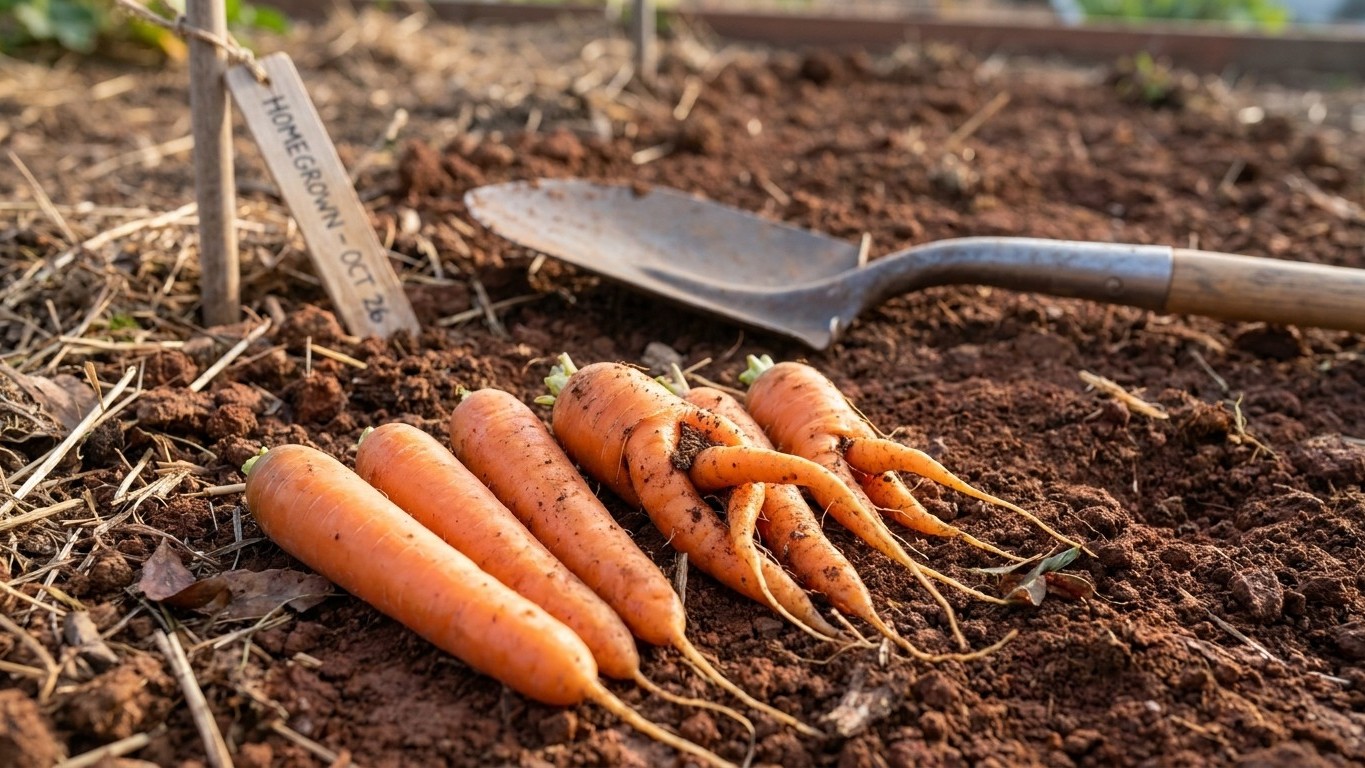

California’s official soil isn’t sandy at all — it’s a clay-heavy loam that resists a straight taproot more than it helps one. Carrots grown in ground like that tend to twist, split, or grow stubby forks instead of the long smooth root you want. The fix isn’t a different climate or a different seed catalog; it’s what you do to the top foot of soil before you sow, and when you get seed into the ground relative to Your Last Frost — a date that, in much of California, barely exists (see When to Sow Carrots in California for the specifics).
The short answer
The state soil of California, named by state law, is the San Joaquin series, an Alfisol — a forest-derived soil of moderate fertility that holds onto nutrients reasonably well. Where it’s been mapped, the surface layer runs 51 percent sand, 18 percent clay and 32 percent silt, putting it in loam-to-silt territory rather than the open, gritty ground carrots prefer. Surface pH sits around 6.1, slightly acid, and organic matter is thin, about 0.8 percent. Drainage is rated moderately well, which is a step down from the free-draining sand a carrot root wants to push through without resistance.
That texture matters because of one plain rule from Utah State University Extension: carrots want deep, sandy, well-drained soil rich in organic matter, and heavy or rocky ground makes the root fork. Eighteen percent clay isn’t extreme, but paired with only 0.8 percent organic matter and moderate drainage, it’s exactly the kind of ground that resists a taproot’s downward push and sends it splitting around a compacted layer or a stone instead. If your garden matches this profile, expect some forking unless you change the bed before you sow — see Will Carrots Fork in California Soil? for a closer look at what drives it.
The remedy is the same one Utah State University Extension gives for any heavy ground: work in plenty of compost and double dig the bed, breaking up compaction to a full spade’s depth or more so the root has nothing to deflect off. Where that’s not practical — a yard with a hardpan, or soil that stays wet — a raised bed filled with a loose, compost-heavy mix sidesteps the problem entirely rather than trying to fix native ground.
None of this is a verdict on your particular yard. California spans hundreds of mapped soil series, and the San Joaquin series is one representative sample chosen to stand for the state, not a survey of every garden in it. River bottoms, hillside soils, and any ground a builder has graded or filled will differ from it, sometimes completely. Treat these numbers as a starting point for what the region’s ground tends to do, then confirm what’s actually under your own carrots.
The test that settles it in your own garden
State-level soil data tells you what to expect in general. It doesn’t tell you what’s eight inches under your tomato bed. The only way to know if your ground will fork a carrot is to look at it yourself, and that takes a shovel, not a lab.
- Dig a test hole. Go down at least a foot in the spot you plan to sow. Carrots need that much undisturbed depth to grow straight; anything that stops the spade will likely stop the root too.
- Check for stones and hardpan. As you dig, feel for rocks, gravel, or a dense compacted layer that resists the shovel. Any of these will deflect a taproot and produce the forking Utah State University Extension warns about.
- Feel the texture. Grab a handful of moist soil and rub it between your fingers. Gritty means sand; smooth and sticky means clay; a mix that holds a loose shape but crumbles easily is closer to loam. The grittier it feels, the closer it is to what carrots want.
- Watch how water drains. Fill the test hole with water and see how long it takes to disappear. Water that lingers for hours points to the same poor drainage that can rot a root or push it sideways as it hunts for air.
- Decide from what you find. Loose, deep, well-draining soil needs little more than routine bed prep. Anything heavy, rocky, or slow to drain calls for the compost-and-double-dig approach, or a raised bed if the native ground won’t cooperate at all.
When to sow here
Carrots are sown directly in the ground, not started indoors and transplanted, so every count below runs from the seeding date itself. Getting that date right matters more in California than the calendar suggests, because the state holds two very different frost stories at once.
- Check whether frost applies to you at all. Along much of the coast and through Southern California, freezing temperatures don’t occur in an average year at all — there’s no last-frost date to count backward from, because there’s effectively no frost. In the Central Valley and the Sierra, real frost does occur, and the standard rule applies.
- Where frost exists, wait for the soil, not just the air. Carrot seed needs soil Temperature of at least 40 degrees Fahrenheit to germinate at all. Cold, wet soil below that mark will simply sit on the seed and rot it rather than sprout it.
- Sow 2 to 3 weeks before your area’s last frost date. Carrots tolerate a light frost as seedlings, which is why the sowing window opens before the last frost rather than after it. This is a general rule, not a California-specific date, and your own last-frost date will vary by county and elevation.
- Aim for the germination sweet spot. Seeds sprout best when soil temperature runs between 55 and 65 degrees Fahrenheit. In the Central Valley, that window typically opens as spring soil warms past the 40-degree minimum; along the frost-free coast and south, gardeners can often sow across a much wider stretch of the year, since there’s no frost clock forcing a narrow spring start.
- Count your harvest from seed, always. Carrots run 70 to 100 days depending on variety, counted from the day seed goes in the ground. There’s no transplant step to shift that clock.
Where no computable frost date exists at all, as recorded for the coastal and Southern California climate normals, gardeners should treat heat and water availability, not frost, as the limiting factor on timing — a very different calculation than the one a Central Valley grower makes each spring.
What goes wrong here
- Forked roots in heavy ground. The clay fraction typical of California’s state soil, and of many valley and foothill gardens, resists a straight taproot and splits it around compaction or stones. Work compost deep into the bed and double dig before sowing, or switch to a raised bed filled with a loose mix.
- Poor germination during a hot spell. Carrot seed germinates best between 55 and 65 degrees Fahrenheit, and California’s spring can swing past that quickly, especially inland. Soil that overheats or dries out at the surface stalls germination outright. Shade the row lightly and keep the top inch of soil consistently moist until seedlings appear.
- Splitting from uneven watering. Roots that grow through a dry stretch then get soaked all at once tend to crack open along the length of the carrot. Even, regular watering through the growing season prevents the swelling that causes splits, particularly important where irrigation is scheduled rather than natural.
- Stunted or forked growth from rocky or shallow soil. Even without heavy clay, a shallow topsoil layer or buried debris stops a taproot as effectively as compaction does. The test-hole check described above catches this before you sow, not after you pull a stubby, twisted root at harvest.
Checking this against your own county
State soil data and general sowing rules only go so far. For the actual conditions in your county — local frost dates where they apply, soil test results, and variety recommendations suited to your microclimate — contact the University of California Agriculture and Natural Resources (UC ANR) extension office serving your area. Extension staff and Master Gardener programs can point you to a soil test lab, confirm frost timing for your specific elevation and location, and flag conditions particular to your county that a statewide figure simply can’t capture.
Common questions
Do I need to test my soil’s pH before planting carrots in California?
The state soil’s surface pH runs around 6.1, slightly acid, but that figure describes one mapped series, not your yard. A basic soil test through your local UC ANR extension office will give you an actual number for your bed rather than a statewide estimate.
Can I sow carrots year-round on the California coast?
In areas where no freeze occurs in an average year, there’s no frost-driven planting window forcing a narrow spring start, which gives coastal and Southern California gardeners more flexibility than growers dealing with real winter frost. Heat and consistent moisture become the limiting factors instead.
Why do my carrots keep coming out forked even in a raised bed?
Forking usually traces back to something a young root hit on its way down: a stone, a clump of unbroken soil, or compost that wasn’t worked in deep enough. Double check that the bed is loose and stone-free to a full foot of depth, not just at the surface.
How long after sowing should I expect to harvest carrots in California?
Count 70 to 100 days from the day seed goes into the ground, depending on the variety. Since carrots are never transplanted, this window always starts at seeding, not at any later stage.