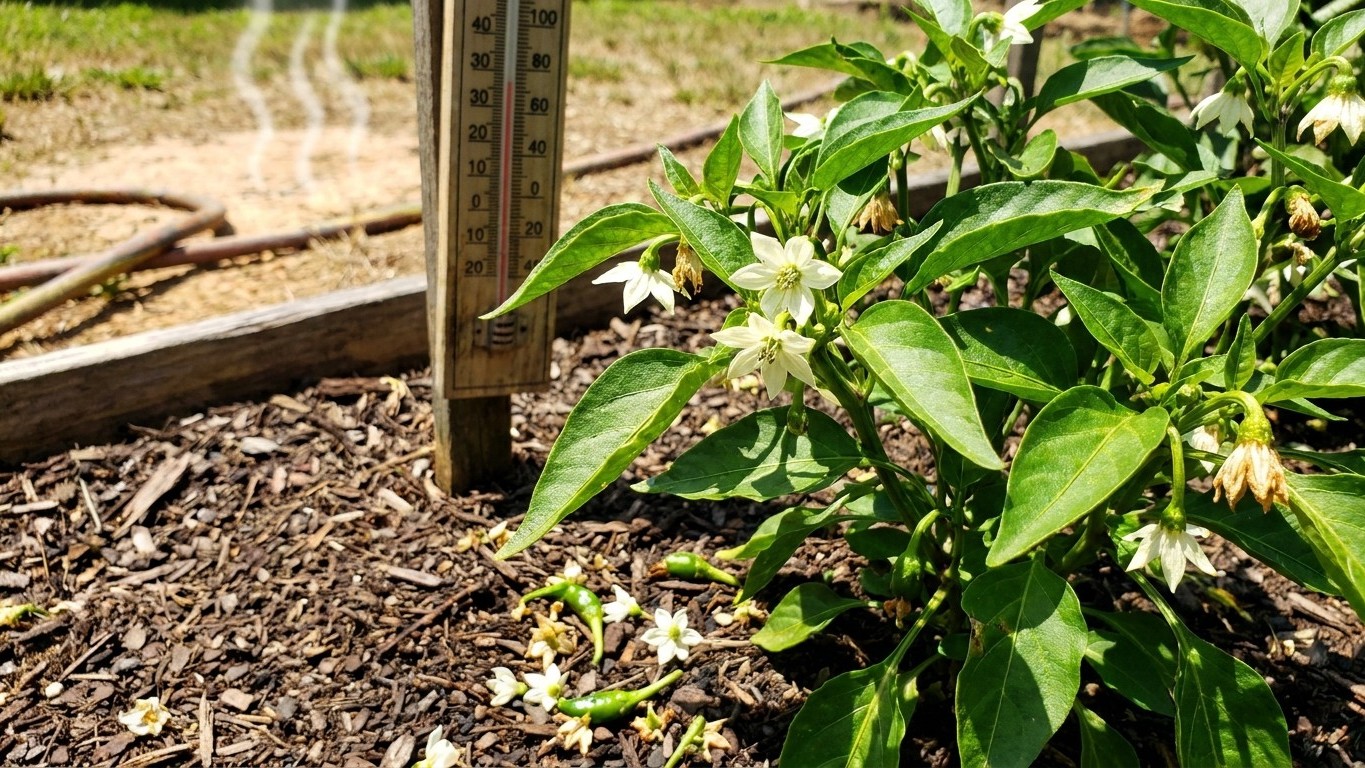

Peppers in West Virginia most often Fail to Set Fruit because the state’s growing season squeezes them between two temperature walls: cool nights early and late in the season that stall pollen, and a stretch of summer days hot enough to knock blossoms off before they ever become peppers. Getting a harvest means timing the transplant right and watching your own thermometer through July and August.
The short answer
The hot end: 16 days above 90°F
Charleston, the reference station for NOAA’s 1991-2020 Climate Normals, averages 16.0 days a year at or above 90°F. That’s not a heat wave. That’s the normal middle stretch of a West Virginia summer, and it’s exactly the range where pepper pollen starts to lose viability. Once daytime highs push past 90°F for a run of days, the plant often responds by dropping blossoms rather than pushing them into fruit. The flowers open, look fine, and fall off within a day or two. Growers sometimes blame watering or fertilizer, but the calendar usually explains it better than the soil does.
The cool end: watch your own nights
Peppers fail just as reliably at the other end of the thermometer. Nights that drop below 55°F, whether in a cold snap in late May or an early cool spell in September, interfere with pollen tube growth the same way extreme heat does. This site tracks daytime heat load, the count of days at or above 90°F, but it does not carry summer night minima for West Virginia locations. That number depends on elevation, valley drainage, tree cover, and how close you are to a ridge, and it can vary sharply within a few miles. Don’t guess at it from latitude or from how cold your winters run. Set a min-max thermometer in the bed itself during late spring and again in early fall, and read it. That’s the only way to know if your nights are the problem.
When to start seed here
Doing the math for your county
Pepper transplants need 8 to 10 weeks indoors before they go in the ground, according to Utah State University Extension, and they shouldn’t go outside until the soil has warmed to 60°F and the frost risk has passed. In West Virginia’s Kanawha Valley, NOAA NCEI puts the 32°F freeze probability window at April 9 to April 23, based on the 30 to 70 percent band at station USW00013866. That’s a starting point, not a guarantee, and it applies to the river valley around Charleston specifically. Higher elevations across the state freeze noticeably later in spring and earlier in fall, so a mountain garden needs its own local read, not this one borrowed wholesale.
- Start with your local last-frost window. For the Charleston area, that’s roughly April 9 to April 23. If you garden at higher elevation, push your working date later.
- Don’t transplant on the frost date alone. Wait until soil temperature at planting depth reaches 60°F, which in a valley location often trails the air-frost date by a week or two, especially after a wet spring.
- Once you have a realistic transplant date, count back 8 to 10 weeks for indoor seed starting. Landing on a mid-to-late April transplant puts seed-starting somewhere in mid-February for most valley gardens.
- Build in slack. Extension guidance treats 8 to 10 weeks as a range, not a fixed number, so err toward 10 weeks if your indoor setup runs cool or your light is weak, since slow-growing seedlings need the extra runway.
- Re-check both ends before you plant out. A soil thermometer costs little and settles the argument about whether the ground is actually ready, rather than guessing from the calendar alone.
What goes wrong here
Three failures show up again and again in West Virginia pepper beds, and each one traces back to the same hot-cold squeeze described above.
The three failure points
- Blossom drop in a hot spell or a cool night. Flowers open and fall within a day or two, with no fruit forming. This tracks directly with the state’s 90°F-plus days on the hot side, or with an unwatched cold night below 55°F on the other. The remedy isn’t more fertilizer. It’s timing: avoid transplanting so early that a late cool night catches young plants, and give plants afternoon shade during the hottest stretch so blossoms hold.
- Sunscald where the sun is strong. Fruit develops a pale, papery patch on the side facing direct afternoon sun, especially after a hard pruning or leaf loss exposes fruit that used to be shaded. Keep foliage full through the plant’s canopy rather than stripping leaves, and use light shade cloth during the peak of a hot stretch if fruit is already exposed.
- Blossom-end rot. A sunken, leathery patch forms at the blossom end of the fruit, usually tied to uneven watering rather than a true calcium shortage in the soil. Heat spikes make this worse because the plant loses water faster than roots can replace it. Even, consistent watering through hot stretches, backed by a few inches of mulch, does more to prevent this than any additive poured on after the fact.
Common questions
Can peppers still produce a full harvest in West Virginia despite the heat and frost swings?
Yes, most seasons allow for a solid harvest, but the window is narrower than in a milder climate. Getting the transplant timing right and watching for the two temperature extremes matters more here than in states with a longer, steadier stretch of moderate heat.
What is the last spring frost date where I garden in West Virginia?
For the Charleston area, NOAA NCEI’s 1991-2020 Climate Normals place the 32°F freeze probability window between April 9 and April 23. That figure is specific to the Kanawha Valley reference station and shifts at other elevations, so treat it as a regional anchor rather than a statewide rule.
Does elevation change the transplant math?
It does. Higher ground across West Virginia tends to see frost linger later into spring and arrive earlier in fall, which shortens the safe window on both ends. A gardener at higher elevation should push the transplant date later and count back from that later date, rather than using the Charleston window directly.
How do I know if my nights are dropping below 55°F without a weather station?
A simple min-max thermometer placed in the garden bed is the most reliable check. Set it out through the transitional weeks in late spring and again in early fall, and read the overnight low each morning. This site doesn’t carry night-minimum data for West Virginia locations, and there’s no reliable way to infer it from latitude or from winter cold, so a direct reading in your own bed is the only real answer.