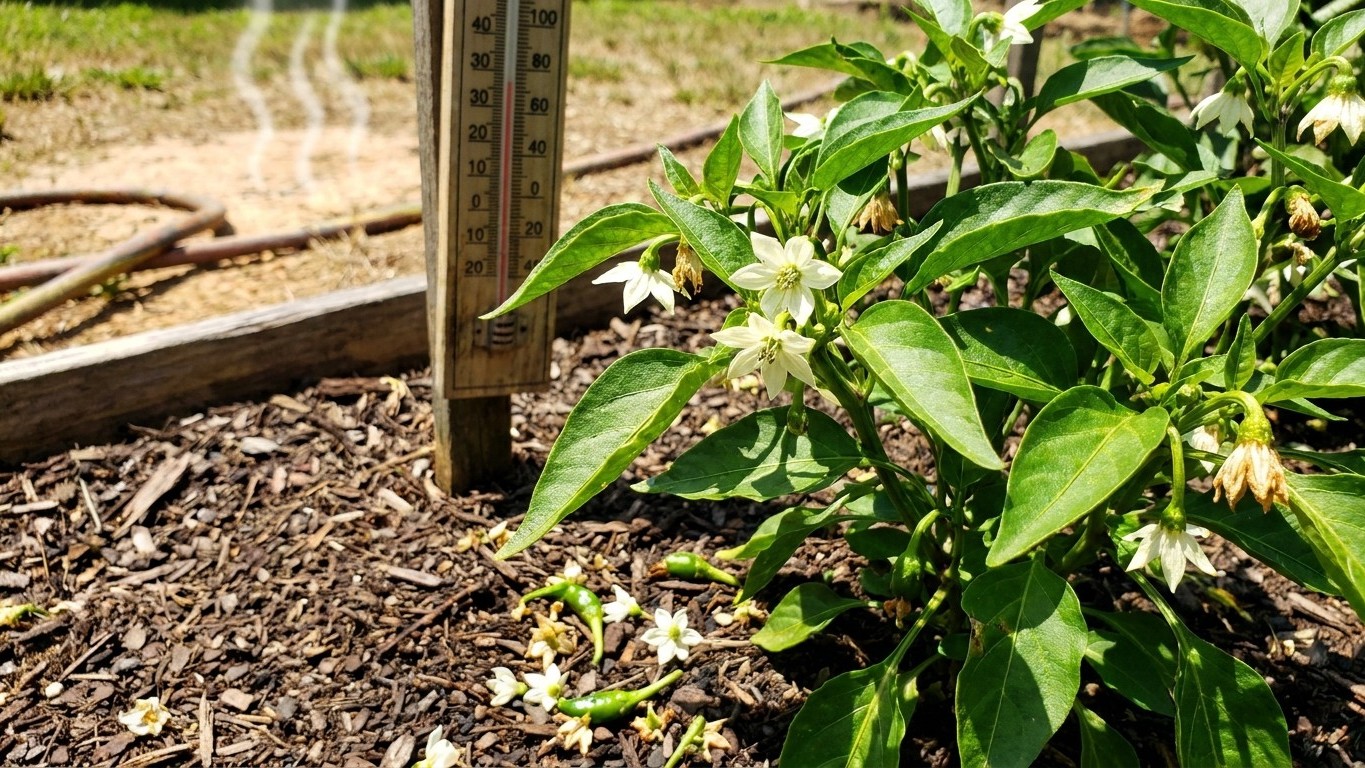

Alabama peppers usually Fail to Set Fruit for one of two reasons: a stretch of days pushing past 90 F that stalls pollen, or a run of cool nights early in the season that does the same thing from the other direction. Both extremes interrupt the same narrow window peppers need to turn a flower into a fruit, and knowing which one is hitting your plants changes what you do about it.
The short answer
Start with the number that matters most for summer heat load: the Huntsville reference station averages 58.5 days a year at or above 90 F, based on NOAA NCEI Climate Normals for 1991-2020. That’s the better part of two months where the thermometer parks itself in territory that peppers don’t tolerate well during flowering. Pepper pollen starts to lose viability once daytime highs climb into the low 90s, and when that happens for several days in a row, plants respond by dropping blossoms rather than setting fruit behind them. It’s not a disease, it’s not a nutrient problem, and spraying anything won’t fix it. The plant is simply protecting itself until conditions cool back down.
That’s the hot side of the equation, and in most of Alabama it’s the one gardeners run into first, usually in July and August when a high-pressure system parks overhead for a week or two. But heat isn’t the only way to lose blossoms. Peppers also drop flowers and Fail to Set Fruit when nights fall below 55 F, which shows up more in early spring right after transplant, or occasionally during a cool snap that slides through in early fall.
Here’s where this gets specific to your yard rather than to the state as a whole: this site tracks daytime heat extremes by location, but it does not carry summer overnight low temperatures. Latitude won’t tell you that number, and neither will the coldest month of the year, because a low-lying garden a mile from a ridge can run several degrees cooler at 3 a.m. than a spot with better air drainage. If your peppers are flowering but not setting fruit in April or May, put an actual thermometer in the garden and check what your nights are doing before you assume heat is the culprit. The fix for a cool-night problem (row cover, a warmer planting date, patience) is different from the fix for a heat problem, and guessing wrong wastes a growing season.
When to start seed here
Pepper timing in Alabama works backward from two hard requirements: the ground has to be past frost risk, and the soil itself needs to have warmed to 60 F, not just the air. Seedlings started too early sit in cold soil and stall; seedlings started too late run into that 90 F heat window before they’ve had a chance to set an early round of fruit. Here’s how to build your own schedule.
- Find your last spring frost window. At the Huntsville reference station, the 32 F freeze probability falls between March 19 and April 3, according to NOAA NCEI’s 1991-2020 Climate Normals. That’s an airport-station figure, and suburban and rural gardens typically see their last frost land later, sometimes by one to two weeks, more at higher elevation. Check your own county’s frost history rather than assuming the reference date applies to your yard.
- Add time for soil, not just air, to warm. Air temperature can climb past frost risk while the soil a few inches down is still cold. Peppers transplant best once soil reaches 60 F, which in practice usually trails your last frost date by one to three weeks depending on how much sun your bed gets and whether you’re working raised beds or ground-level rows. A simple soil thermometer, checked at planting depth in the morning, settles the question faster than a calendar guess.
- Count backward 8 to 10 weeks for indoor seed starting. Utah State University Extension recommends starting pepper seed indoors 8 to 10 weeks before that outdoor transplant date. So if your soil is likely to hit 60 F in the middle of April, count back 8 to 10 weeks from there, land somewhere in early to mid-February, and that’s your seed-starting window.
- Build in a margin for a slow spring. Because the reference frost dates run one to two weeks earlier than what many home gardens actually experience, it’s worth treating your calculated transplant date as an earliest option rather than a fixed one. Watch the forecast and the soil thermometer together in the two weeks around your target date before committing trays of seedlings to the ground.
What goes wrong here
- Blossom drop from a hot spell. When daytime highs run above 90 F for several days, especially with high humidity layered on top, flowers open and fall without setting fruit. There’s no product fix. Provide afternoon shade with row cover or shade cloth during the worst stretches, keep soil moisture even so the plant isn’t fighting drought stress on top of heat stress, and expect fruit set to resume once temperatures ease back down.
- Blossom drop from a cool night. The same dropped-flower symptom shows up when nights fall below 55 F, most often right after an early transplant or during a stray cool snap. Since this site doesn’t track summer night minima, check your own garden with a min-max thermometer before assuming heat is to blame. If nights are running cold, delaying transplant by a week or two, or covering plants overnight with row cover, is usually enough to get flowering back on track.
- Sunscald on exposed fruit. Alabama’s summer sun is strong enough to scald pepper fruit that loses its leaf cover, especially after aggressive pruning or a storm that strips foliage. Scalded spots show up as a pale, papery patch on the sun-facing side of the fruit. Leave foliage in place rather than pruning peppers hard, and if a plant has thinned out, a loose piece of shade cloth over the row during the hottest afternoons protects fruit already forming.
- Blossom-end rot. This shows up as a sunken, leathery patch on the bottom of the fruit and is driven by uneven water delivery to the plant rather than a lack of calcium in the soil itself, though it’s often mistaken for a soil nutrient problem. Mulch to keep moisture steady, water deeply and on a consistent schedule rather than letting the bed dry out between waterings, and the next flush of fruit typically comes in clean.
Common questions
Why are my pepper plants flowering but not setting fruit?
Flowers that open and drop without producing fruit almost always point to a temperature problem at one extreme or the other: daytime highs above 90 F or nighttime lows below 55 F. Check both against your own garden’s readings, since this site only tracks the daytime heat figure by location, not summer night lows.
Does watering more fix blossom drop from heat?
No. Even, adequate soil moisture helps the plant handle heat stress overall, but it won’t restore pollen viability once temperatures have climbed past the threshold where flowers abort. The blossom drop resolves on its own once the heat spell breaks.
How early can I transplant peppers outdoors in Alabama?
Not before your local soil reaches 60 F and the frost risk has passed. At the Huntsville reference station that frost window falls between March 19 and April 3, but home gardens often run one to two weeks later, so check your own county’s frost history rather than transplanting on the reference date alone.
Is blossom-end rot caused by a calcium deficiency in the soil?
It’s usually a water delivery problem rather than a true soil calcium shortage. Uneven watering interrupts how the plant moves calcium into developing fruit, so the fix is a steady watering schedule and mulch, not a calcium supplement.