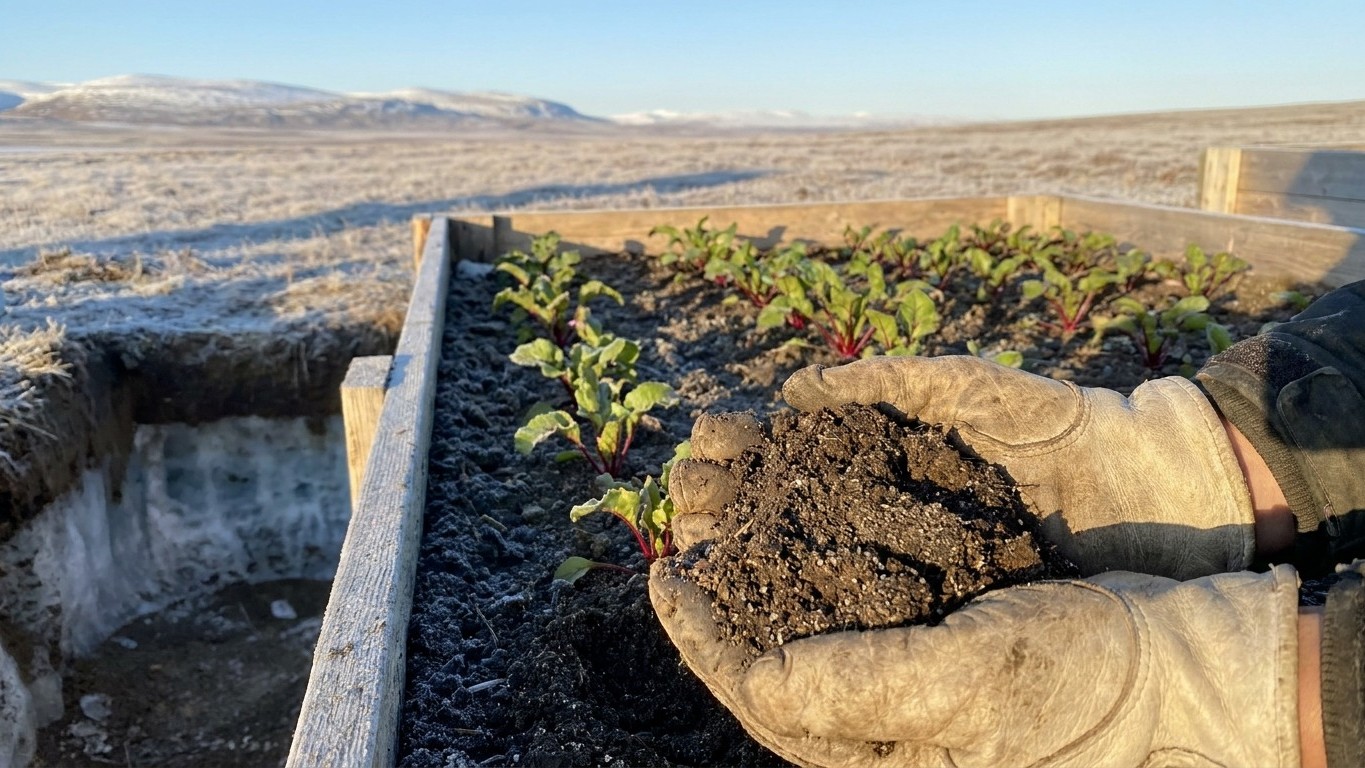

Beets can grow in the Northwest Territories, but the region’s cold, permafrost-influenced ground and its short, unpredictable spring change how you sow, water and time the harvest. The soil itself is workable loam to silt. The clock is the harder problem, and it starts ticking the moment you drop seed in the ground.
The short answer
Across the mapped agricultural surface of the Northwest Territories, the dominant soil order is Cryosol, a soil with permafrost somewhere in its profile, where only a shallow active layer thaws each summer. That accounts for 99 percent of the mapped surface, with Regosolic soils making up most of the rest. Texture on that surface runs loam to silt: 55 percent sand, 6 percent clay, 39 percent silt, with organic matter around 2.4 percent and a well-drained classification. For a closer look at what this means specifically for growing beets, see Beet Soil in Northwest Territories. No median pH is published for this surface, so don’t assume a number until you’ve tested your own bed.
For a beet, that texture is mostly good news. A loam-to-silt mix with only 6 percent clay drains cleanly and won’t turn to concrete around a swelling root. Utah State University Extension notes that beets want deep, sandy, well-drained soil rich in organic matter, and this profile is close to that description on drainage and structure. Where it falls short is depth and richness: the active layer above permafrost limits how far roots can push down regardless of how loose the topsoil feels, and 2.4 percent organic matter is on the lean side for a crop that rewards fertility. The Utah State guidance caps amendment at no more than 1 inch of composted organic matter per 100 square feet, which is a ceiling worth respecting here rather than a target to blow past.
On heat, the figures published for this page don’t include a count of days per year above 90 F for a Northwest Territories reference station, so that number isn’t stated here. What can be said plainly is that a subarctic growing season built around a permafrost soil order is not a place where extended heat above 85 F is the operating risk for beets. The more relevant threat, and the one the data does support, is water stress hitting young plants during a short, cool window, which is a different failure than the heat-driven woodiness Utah State describes for warmer climates.
None of this describes your specific yard. The Northwest Territories, like every large province, spans hundreds of distinct soil series, and river bottoms, muskeg edges and any ground that’s been graded or filled for a building lot can differ completely from the mapped agricultural median above. Treat these numbers as a starting point for what the region’s ground tends to do, then confirm your own plot with a soil test before you plan amendments, and pair that with When to Sow Beets in Northwest Territories so timing matches your actual soil conditions.
The six weeks that decide it here
Beets are typically sown 2 to 3 weeks before the last spring frost, and in the Northwest Territories that frost falls on average May 25, based on the Canadian Climate Normals 1981-2010 for station Yellowknife A. That puts a typical sowing date somewhere in the first half of May, which means the first six weeks after seeding run through the back half of May and into June, right as the region is emerging from spring thaw.
That May 25 figure is a mean, not a guarantee. Environment and Climate Change Canada’s normals describe it as the midpoint of a window: in roughly one year out of two, the last frost actually lands later than that date. Treat it as the center of a range rather than a safe line to plant against, and remember that Yellowknife is one station representing a territory where northern and upland districts run weeks behind it.
Why those first six weeks matter so much comes down to one mechanism: Utah State University Extension is explicit that water stress during this early stage causes premature flowering, meaning bolting, in beets. A post-thaw spring in this climate often means fast-draining, well-aerated soil, exactly the texture measured for the region’s mapped surface, sitting in a stretch of the calendar when meltwater is receding and steady rain hasn’t necessarily settled in yet. A well-drained, sandy-silt bed that looks perfect on paper can dry out at the surface quickly once the sun starts working on it, and a beet seedling doesn’t need long without water to lock in a bolting response it can’t undo later. This is the single window worth watching closest, more than any later heat concern.
The practical takeaway is timing your irrigation checks to that exact stretch, from seeding through roughly six weeks out, rather than assuming a naturally cool climate means the soil stays moist on its own. Well-drained ground and cool air are not the same thing as consistently moist ground.
What goes wrong here
- Bolting from early water stress. The mechanism Utah State University Extension describes, premature flowering triggered by dry conditions in the first six weeks, lines up directly with this region’s well-drained, fast-draining texture and its dry post-thaw spring stretch. Check soil moisture at the seed row every few days through that window and water before the surface visibly dries, rather than on a fixed schedule.
- Shallow rooting against the permafrost active layer. A beet wants depth to develop cleanly, and ground built on a Cryosol order only thaws to a limited active layer each season. Build a raised bed or mound the row several inches above grade so the working root zone warms and deepens faster than the surrounding native ground.
- Thin fertility from low organic matter. At roughly 2.4 percent organic matter, this soil sits below what a beet prefers for steady growth. Work in composted organic matter ahead of sowing, capped at no more than 1 inch per 100 square feet as Utah State University Extension recommends, rather than assuming more compost automatically means a better root.
- Running out of season before maturity. Beets count their 60 to 80 days from the seed going into the ground, not from a transplant, and a short subarctic summer leaves little slack for a late start or a slow germination. Sow as close to the safe early window as the soil temperature allows, and consider row cover to add growing degree-days at both ends of the season.
- Later woodiness if heat and dryness stack up. Utah State University Extension separately notes that heat above 85 F combined with water stress makes the root woody, a distinct failure from early bolting. No count of days above 90 F is published for this region on this page, but if a hot, dry stretch does arrive later in the season, keep watering consistent through root sizing rather than assuming the cooler climate makes this a non-issue.
Checking this against your own county
The Northwest Territories doesn’t divide into counties, but the same logic applies at the district or community level: the soil and frost figures on this page describe a mapped average, not your specific garden. Before you finalize sowing dates or amendment amounts, run those questions past the territorial agriculture program through the Department of Industry, Tourism and Investment, which maintains an agriculture services page at iti.gov.nt.ca/en/services/agriculture. They can speak to local frost patterns, soil variation and season-extension practices specific to your community rather than the territory-wide averages used here.
Common questions
Can beets handle a light frost after sowing?
Beet seedlings tolerate cool conditions reasonably well, which is part of why they’re sown 2 to 3 weeks ahead of the last frost date in the first place. No specific frost-tolerance threshold beyond the mean last-frost date is published on this page, so treat any frost event as a cue to check young plants for damage rather than assume a guaranteed outcome either way.
How many days does it take beets to mature from seed in this climate?
Beets generally run 60 to 80 days from seeding to maturity, counted from the day seed goes into the ground rather than from a transplant date. In a short subarctic season, that range leaves limited margin for delay, which is why an early, well-timed sowing date matters more here than in longer-season regions.
Does the region’s soil need lime or sulfur before planting beets?
No median pH is published for the mapped agricultural surface of the Northwest Territories, so there’s no territory-wide answer to give. A soil test on your specific bed is the only reliable way to know whether an amendment is needed.
Is bolting or woodiness the bigger risk for beets grown here?
Based on the climate figures available for this region, bolting from early water stress during the first six weeks is the more relevant risk, tied to the well-drained soil texture and the typically dry post-thaw spring. Woodiness from later heat above 85 F is a documented failure mode from Utah State University Extension, but no data on days above 90 F is published for this region to confirm how often that threshold is actually reached here.