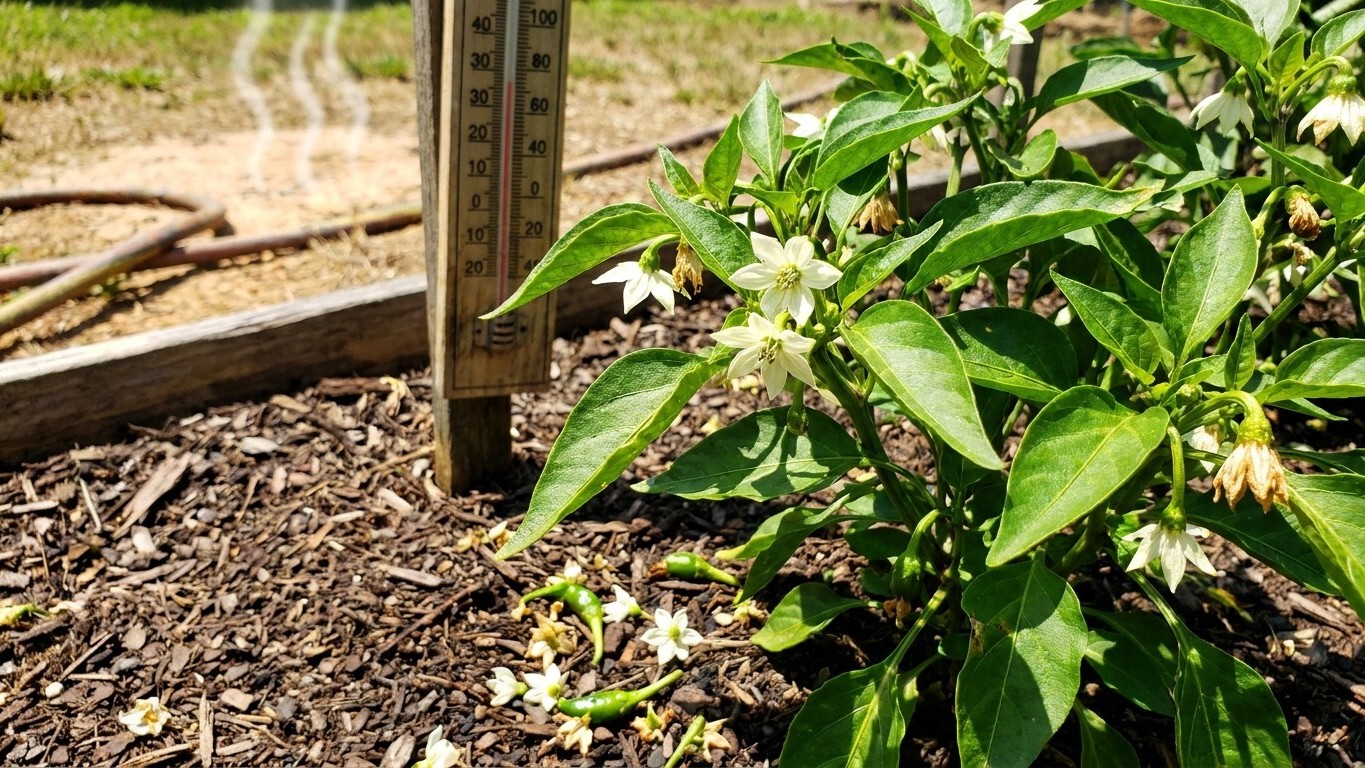

Montana peppers stall out for one of two reasons: the afternoons get too hot for pollen to stay viable, or the nights drop below the threshold peppers need to hold a blossom. Billings logs 28.3 days a year at 90 F or hotter, which is enough heat load to knock out fruit set during a bad stretch. Night temperatures aren’t tracked on this site by territory, so the cool-end risk is something every grower has to monitor at home, not something a regional average can answer.
The short answer
Start with the number that’s actually measured here: Billings averages 28.3 days a year at 90 F or above, based on NOAA NCEI Climate Normals for 1991-2020. That’s not a handful of scorching afternoons scattered across summer, it’s close to a full month, most of it clustered in July and August, when pepper plants are supposed to be setting their heaviest flush of fruit. Heat at that level does two things to a pepper plant. It can dry out pollen before it ever reaches the stigma, and it pushes the plant into a defensive mode where it drops blossoms rather than spend energy finishing them. A grower who sees flowers falling off in mid-July, with no pests and no obvious disease, is usually looking at heat stress, not a mystery ailment.
The other end of the problem doesn’t show up in the days-above-90 count at all. Pepper fruit set fails just as reliably when nights run cold, and Utah State University Extension puts that threshold at 55 F. A stretch of nights below that mark, even with warm, pleasant days on either side, is enough to stop pollen from developing properly and cause the same blossom drop that heat causes. Montana’s growing season is short enough that cool nights aren’t a rare event tacked onto the edges of summer. They can show up in June, they can show up again in late August, and in some years they interrupt the middle of the season too.
Here’s the part worth being honest about: this site carries the heat-side number for Montana territories because it’s measured and published by NOAA. It does not carry summer night minima for those same territories, and there’s no reliable way to back into that number from latitude or from how cold the winters run. A location’s coldest month tells you almost nothing about how cool its July and August nights get, mountain valleys, river bottoms, and elevation all move that number around within a single county. The only dependable fix is to actually watch a thermometer at your own garden, especially if you’re gardening anywhere near a valley floor or at elevation, where cold air pools overnight even when the daytime high felt like a normal summer day.
Put the two thresholds together and the practical takeaway is straightforward: Montana pepper growers are managing a narrower comfort band than gardeners in milder climates, squeezed between a well-documented hot side and a cool side that has to be tracked locally.
When to start seed here
Working backward from Montana’s frost and soil data gives a seed-starting date that a grower can recalculate for their own county in a few minutes.
- Start with the last spring frost. NOAA NCEI’s 1991-2020 Climate Normals put the 32 F freeze probability window for Billings at April 29 to May 10. Billings sits among the milder valleys in the state, so growers elsewhere, especially in mountain valleys, should expect that window to run later and should treat any month as fair game for a frost until they’ve confirmed otherwise locally.
- Add the soil temperature requirement. Utah State University Extension recommends transplanting pepper seedlings only after the frost risk has passed and the soil has warmed to 60 F. Air temperature climbing into the 60s doesn’t mean the soil has caught up, check it directly, a few inches down, before moving transplants outside.
- Count back 8 to 10 weeks for indoor starting. That’s the window Utah State University Extension gives for how long pepper seedlings need indoors before they’re ready to go in the ground. Using the later end of the Billings frost window (May 10) as a planning anchor, 8 to 10 weeks back lands seed-starting somewhere around late February to early March. Growers in colder valleys should push that start date earlier to match their own, later frost window.
- Recheck against your own site conditions. Elevation, slope, and proximity to water all shift both the frost date and how fast soil warms in spring. A gardener a few miles from a NOAA reporting station can still be weeks off from that station’s normals, so treat the arithmetic above as a starting point to verify, not a fixed calendar date.
The arithmetic is simple by design: local last-frost date, plus time for soil to reach 60 F, minus 8 to 10 weeks indoors, equals a seed-starting window a grower can adjust as they get more familiar with their own yard.
What goes wrong here
- Blossom drop from heat. During stretches of days at or above 90 F, common enough in Montana to average 28.3 per year in Billings, pepper flowers can drop before setting fruit. Providing afternoon shade cloth during the hottest week or two of summer, and keeping soil moisture even so the plant isn’t also fighting drought stress, reduces how many blossoms are lost.
- Blossom drop from cool nights. Utah State University Extension identifies nights below 55 F as the other failure point for pepper fruit set. Because this site doesn’t track night minima by Montana territory, growers need to keep a simple min-max thermometer in the garden through June and again in late August, when cool nights are most likely to sneak in, and use row cover or cold frames if a cold stretch is forecast.
- Sunscald on exposed fruit. Montana’s high elevation and clear skies mean intense sun exposure, and peppers that lose leaf cover, from pruning, wind damage, or disease, are prone to pale, blistered patches on the fruit where direct sun hits skin unprotected by foliage. Keeping plants full and leafy, and avoiding heavy pruning during the hottest part of summer, is the main defense.
- Blossom-end rot. Uneven watering, common when a hot, dry spell follows heavy rain or irrigation, disrupts calcium uptake and shows up as a dark, sunken spot on the blossom end of the fruit. Consistent watering on a regular schedule, rather than letting soil swing between soaked and bone-dry, addresses most cases without needing calcium sprays or amendments.
Common questions
Why are my pepper flowers falling off without ever forming fruit?
That’s blossom drop, and in Montana it usually traces to one of two causes: a run of days at or above 90 F, which Billings sees an average of 28.3 times a year, or a stretch of nights below 55 F, per Utah State University Extension. Check both a daytime high and an overnight low before assuming it’s a watering or pest problem.
How do I know when it’s safe to move pepper transplants outside in Montana?
Wait until both conditions are met: the local frost risk has passed, and soil temperature has reached 60 F. In Billings, NOAA’s 1991-2020 Climate Normals put the 32 F freeze window at April 29 to May 10, but mountain valleys elsewhere in the state can see frost much later, so confirm your own local frost pattern rather than relying on a single regional date.
Do I need to worry about night temperatures if my days are only in the 80s?
Yes. Fruit set failure isn’t only a heat problem. Nights below 55 F can stop pollen development even when daytime highs are mild, according to Utah State University Extension. Since this resource doesn’t track night minima by Montana territory, keep a thermometer in the garden overnight to know where your own site stands.
Is there a variety of pepper that handles Montana’s swings better than others?
Utah State University Extension names several pepper varieties suited to home gardens, but publishes no heat tolerance rating, days-to-maturity figure, or size comparison for any of them. Rather than choosing by an unverified heat claim, focus on managing the two thresholds directly, shade during heat spikes and monitoring or protection during cool nights, since that applies regardless of variety.