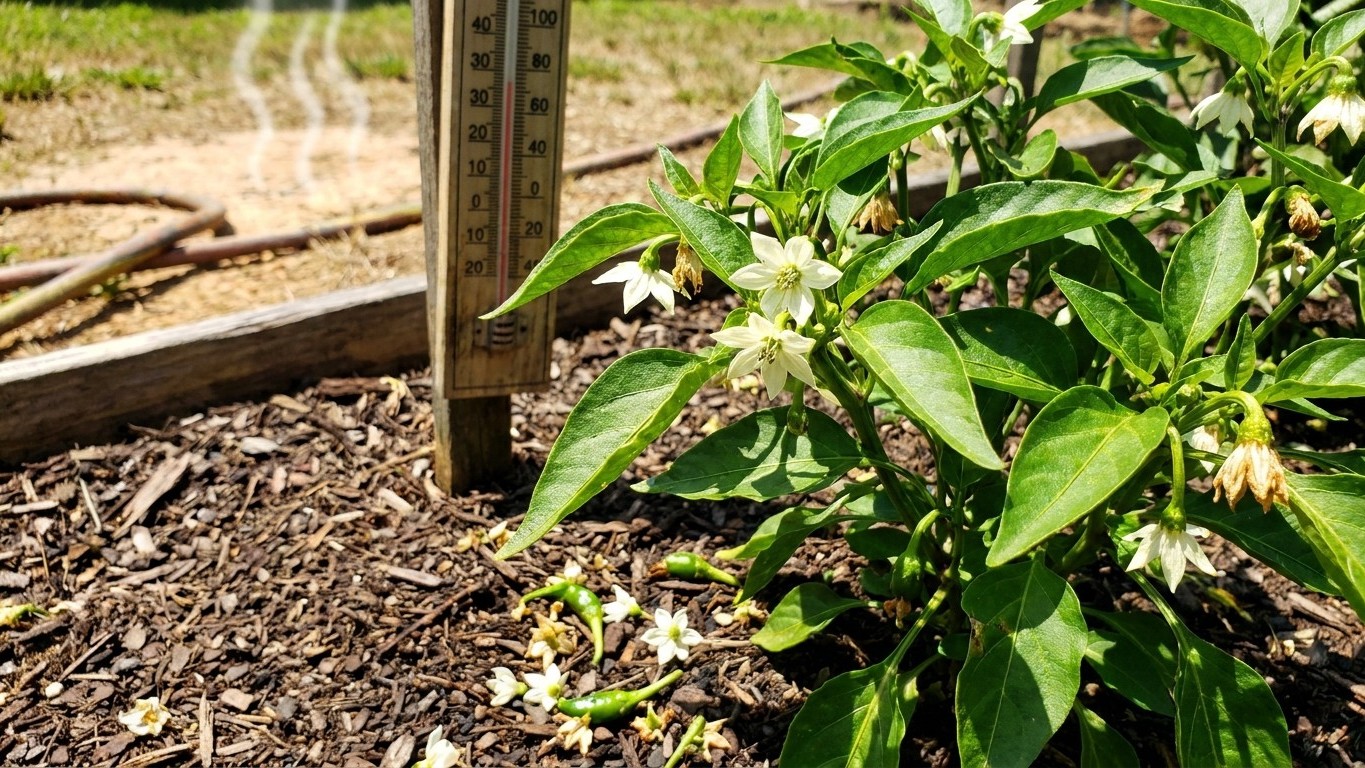

Peppers stop setting fruit in Nebraska mainly because summer heat spikes push flowers into drop mode, while cool nights earlier and later in the season do the same thing from the other direction. Add a transplant date that’s off by a couple weeks, and a plant can spend its whole season flowering without ever holding a pepper. The fix starts with knowing your own numbers, not a general planting chart.
The short answer
Omaha’s reference station logs 28.1 days a year at or above 90 F, based on NOAA’s 1991-2020 Climate Normals. That’s roughly four full weeks where afternoon heat can climb high enough to abort pepper blossoms before they ever become fruit. Pepper plants don’t fail all at once during a heat run. They shut down flower by flower, dropping buds and small blooms while the plant itself looks perfectly healthy, green, and vigorous. A gardener checking the plant a week later sees the same bushy pepper it always was, just with nothing developing on it.
Twenty-eight days doesn’t sound like much stretched across a whole growing season, but heat waves rarely spread themselves evenly. They tend to cluster in July and into August, right when a spring-set pepper plant should be loaded with blossoms turning into fruit. If your transplant’s peak flowering window lines up with one of those clusters, you can lose a big share of a season’s potential harvest in a single stretch of hot afternoons, even if the plant recovers and flowers again once temperatures ease.
The other threshold works in reverse. Pepper fruit set also fails when nights drop below 55 F, and this is where a lot of Nebraska gardening advice gets vague or just wrong. This site tracks days above 90 F for the state, but it does not carry summer night minimum temperatures, and there’s a good reason for that caution: nighttime lows vary enormously by yard, not just by region. A garden in a low spot near a creek, a plot shaded by a windbreak, or a bed on the north side of a house can run several degrees cooler overnight than a spot half a mile away in full open exposure.
Because of that, never assume your nights are warm enough just because you’re at a certain latitude, or because the coldest month of the year isn’t especially brutal where you live. Latitude tells you almost nothing about a specific June or September night in a specific backyard. The only reliable method is to actually watch your own overnight lows during the shoulder weeks of the season, whether with an outdoor thermometer, a simple weather station, or a nearby personal weather station feed. If you see a run of nights dropping into the low 50s while your peppers are flowering, expect blossom drop even though the calendar says summer.
When to start seed here
Utah State University Extension’s guidance for peppers gives you the framework: start seed 8 to 10 weeks before transplanting, and transplant only after frost has passed and the soil has warmed to 60 F. Nebraska gardeners can build their own schedule from that framework using the frost data for their specific area, working backward one step at a time.
- Find your local last spring frost window. The Omaha reference station’s data puts the 32 F freeze probability window at April 12 to April 23. That’s a range calculated from three decades of records at one airport weather station, not a promise for every yard in the state.
- Push that date later for your actual garden. Suburban and rural gardens typically see their last frost later than an airport station reading, often by one to two weeks, and more if your property sits at higher elevation or in a low-lying frost pocket. A garden that would frost-out on April 20 by the airport’s numbers might realistically clear frost closer to the first week of May.
- Add the soil temperature check. Air temperature and soil temperature don’t move together. Even once overnight frost risk has passed, soil can lag behind, especially in a spring with a wet, cool start. Peppers need that soil at 60 F before transplant shock stops being a real risk, so a soil thermometer pushed a few inches down is worth more than guessing from the calendar.
- Count backward 8 to 10 weeks from your realistic transplant date. If your adjusted, frost-safe, soil-ready transplant date lands in early May, seed starting indoors should begin somewhere between late February and early March, depending on which end of the 8 to 10 week range you use.
- Build in a buffer for a slow spring. Pepper seedlings that sit too long indoors before conditions are ready don’t just wait patiently. They can get leggy, root-bound, or stressed, which sets back fruiting even after a successful transplant. A one-week cushion in your schedule gives you room to delay transplant without wrecking the seedlings.
Redo this math with your own county’s frost data and your own yard’s soil readings, not a statewide average. Two gardens forty miles apart can have meaningfully different last-frost realities, and the seed-starting date should follow the yard, not the map.
What goes wrong here
Nebraska’s climate creates a specific, repeatable set of pepper problems tied directly to its heat pattern and its swing between cool nights and hot days. Here’s what tends to show up, and what actually helps.
- Blossom drop during a hot spell. When afternoon temperatures push into the 90s during flowering, plants abort blossoms rather than let them develop into fruit under stress. This is the direct consequence of those 28.1 annual days at or above 90 F. There’s no way to stop the heat, but afternoon shade cloth over the row during the worst stretches, along with steady, deep watering so the plant isn’t fighting drought stress on top of heat stress, gives blossoms a better shot at holding through a short heat run.
- Blossom drop during a cool night. The same failure, opposite cause: nights below 55 F during flowering stop fruit set just as effectively as heat does. Since this site doesn’t track summer night minimums, the only real defense is watching your own overnight readings during spring and early fall flowering windows and, where a cool snap is forecast, using row cover overnight to hold in a few extra degrees of warmth around the plants.
- Sunscald on exposed fruit. Once fruit does set, Nebraska’s strong summer sun can scald peppers that lose leaf cover, leaving pale, papery patches on the side facing direct light. This tends to follow aggressive pruning or leaf loss from disease or pests. Keeping the plant’s natural leaf canopy intact, and avoiding heavy pruning during the hottest weeks, protects developing fruit without any extra equipment.
- Blossom-end rot on developing peppers. This shows up as a sunken, dark, leathery patch on the blossom end of the fruit, and it’s a calcium-uptake problem tied to inconsistent watering rather than a soil calcium shortage in most gardens. Uneven watering, heavy one week and dry the next, is often the real driver, especially during a hot stretch when soil dries out fast. Even, consistent watering and a layer of mulch to slow moisture swings addresses the root cause more reliably than adding calcium products.
Common questions
Can I still get peppers to set fruit during a Nebraska heat wave?
Fruit that’s already set will usually keep developing through a heat spell. It’s new blossom set that stalls out above 90 F. Keep the plant well watered and consider afternoon shade cloth during the worst days so it’s ready to resume setting fruit once temperatures ease.
How do I know if my nights are too cool for fruit set, since this site doesn’t track that?
Watch your own yard with an outdoor thermometer or a personal weather station during the weeks your peppers are flowering. If overnight lows are dropping below 55 F, expect reduced fruit set regardless of what the daytime high was doing.
Does the April 12 to April 23 frost window apply to my whole county?
No. That range comes from one reference weather station near Omaha. Rural and suburban yards commonly see their last frost one to two weeks later than that station’s numbers, more at higher elevation, so check local conditions rather than relying on that window alone.
Is 8 to 10 weeks always the right amount of time to start pepper seed indoors?
That range comes from Utah State University Extension’s general pepper guidance and works as a solid starting framework. The exact number you use within that range should shift based on your own frost-adjusted transplant date and how quickly your particular seedlings tend to develop indoors.