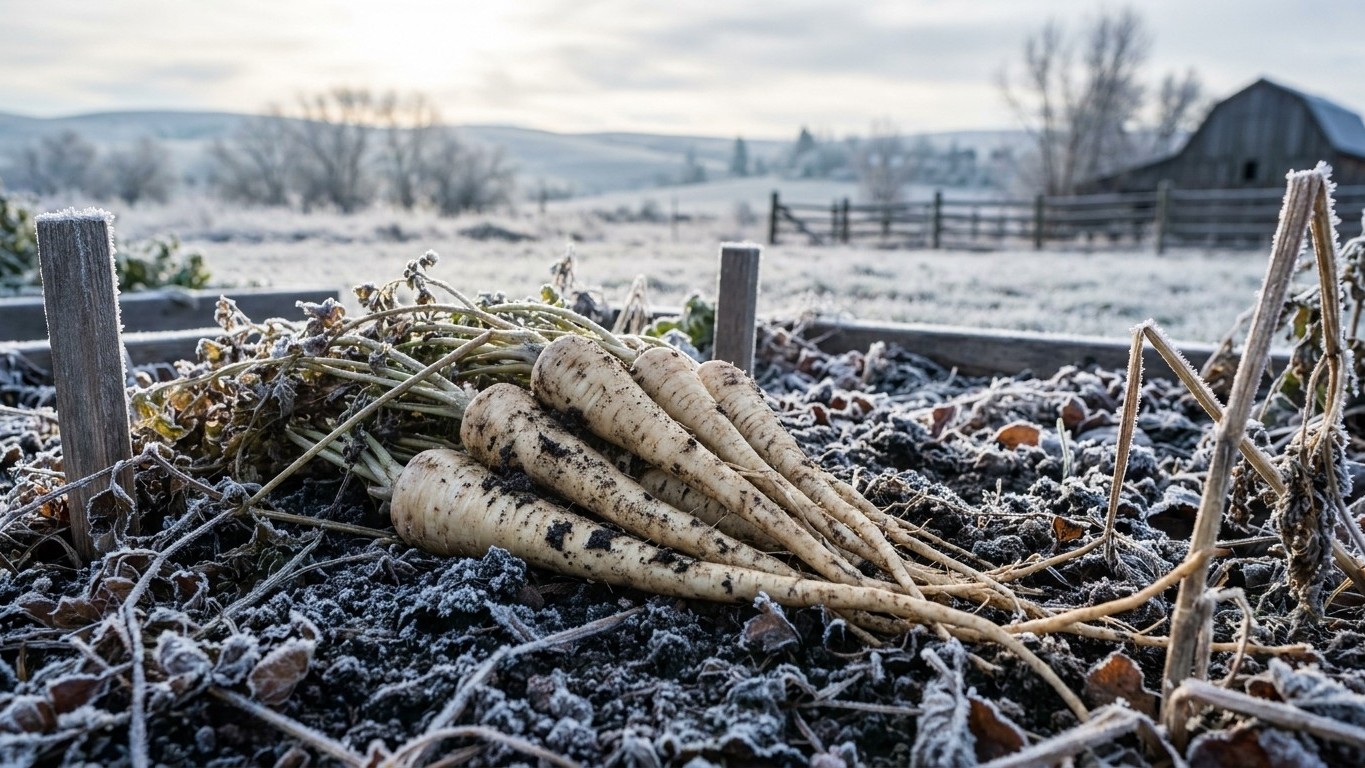

Idaho’s parsnips do sweeten, and the reason has nothing to do with the state’s cold reputation in general. It comes down to one number: the mean minimum temperature of the coldest month at the Boise reference station is 25.4°F. That’s cold enough, for long enough, to trigger the starch-to-sugar conversion parsnips need. But the details of your sowing date and your local frost calendar still decide whether you get there.
The short answer
Here’s the question that actually matters for a root vegetable that depends on cold exposure: does this place deliver several frosty weeks, not just a light chill some mornings? At the Boise reference station, the mean minimum temperature of the coldest month sits at 25.4°F, according to NOAA NCEI Climate Normals for 1991-2020. That’s a solid several degrees below freezing on an average night during the coldest stretch of the year, which means frost isn’t a rare event here. It’s routine, repeated, and stretched across weeks rather than confined to one or two cold snaps.
That distinction matters because sweetening in parsnips isn’t triggered by a single freeze. It happens gradually, as repeated cold exposure breaks down the starches stored in the root and converts them into sugars. A garden that dips below freezing once in November and then rebounds into mild weather won’t do the job. A garden where the coldest month averages a minimum in the mid-20s, night after night, will.
So the plain answer for the Boise valley and similarly situated low-elevation parts of Idaho: yes, a parsnip left in the ground through the cold season here will sweeten, not just mature. The mean minimum of 25.4°F reflects a winter cold enough to deliver the sustained chill the crop needs, not a marginal one that occasionally dips near freezing and then warms back up.
One caution deserves repeating because it trips up a lot of gardeners: this is not the same question as whether Idaho falls into a particular hardiness zone. Hardiness zones describe the coldest extreme a perennial plant might survive over winter. Sweetening in parsnips is about the ordinary, repeated cold of the coldest month, the kind reflected in a mean minimum figure, not the record low that shows up once a decade. Zone maps and frost exposure measure different things, and only one of them tells you whether your parsnips will taste sweet at harvest.
It’s also worth flagging that Boise sits in a low valley. Most of Idaho lies at higher elevation and runs colder, sometimes considerably so. If you’re gardening outside the valley floor, in the mountains or on the higher plains, your own coldest-month minimum is very likely lower than Boise’s 25.4°F. That generally works in your favor for sweetening, since more cold exposure isn’t a problem here. The bigger risk at elevation is the opposite one: a growing season too short to get the root to size before the ground locks up. That’s the tradeoff this crop presents in a state with as much elevation variation as Idaho has.
Does the season fit?
Parsnips are sown directly in the garden, not started indoors and transplanted, and the clock for maturity runs from the day the seed goes into the ground. Utah State University Extension puts the timeline at 100 to 120 days from seeding, with a sowing date 2 to 3 weeks before the last expected frost. Here’s how that timeline actually plays out against Idaho’s Boise-area frost dates.
- Start with the last spring frost. At the Boise reference station, NOAA NCEI’s 1991-2020 normals put the last spring frost (32°F) somewhere between April 23 and May 7, depending on the year.
- Count back 2 to 3 weeks for sowing. That puts your seeding window at roughly early to mid April, ahead of that late-April to early-May frost date.
- Add germination time. Parsnip seed is notoriously slow. Utah State’s guidance and standard extension practice put germination at 14 to 21 days. Don’t dig up the row and re-sow if nothing’s showing after a week. It’s normal for parsnips to sit quiet in cold soil for two to three weeks before the first thread-like leaves appear.
- Add the 100 to 120 day maturity window from seeding. Sown in early to mid April, a parsnip crop reaches maturity somewhere between mid-July (at 100 days) and mid-August (at 120 days).
- Compare that to the first fall frost. The Boise station’s first fall frost normally lands between October 7 and October 21.
- Do the arithmetic. From a last spring frost in late April to a first fall frost in mid-October is roughly 167 frost-free days, well beyond the 120 days parsnips need to mature. That leaves a comfortable margin, not just to reach harvest size but to sit in the ground afterward through several weeks of frosty nights before you pull them.
For the Boise valley, the season fits comfortably. There’s room to sow on the early side, room for slow germination, room to reach full size, and still weeks left over for the cold exposure that makes the roots sweet. At higher elevations elsewhere in Idaho, that frost-free window narrows considerably, and the arithmetic gets tighter. Check your own dates before assuming the same comfortable margin applies.
What goes wrong here
- Forked roots in heavy or stony ground. Parsnips grow a single long taproot, and anything that deflects it, a rock, a clay lens, compacted subsoil, splits it into forks. Idaho’s valley soils vary from sandy loam to heavier clay depending on the property, and heavier ground is the more common culprit. Utah State University Extension recommends deep sandy soil for parsnips, and where the soil is heavier, double digging to break up the profile before sowing.
- Forked roots from overwatering. This is a separate cause from soil texture, and it’s easy to conflate the two. Inconsistent or excessive watering encourages the root to branch as it searches for moisture unevenly distributed in the soil. The fix is steady, moderate watering rather than heavy soakings followed by dry stretches.
- A season that runs out before the root sizes up. Not a Boise valley problem given the 167-day frost-free window there, but a real one at higher elevation in Idaho, where the frost-free season shrinks and a late or delayed sowing can leave roots undersized when the ground freezes.
- A winter too mild to trigger sweetening. This isn’t the typical Idaho failure mode given the state’s cold winters, but it’s the flip side of the whole equation: a parsnip can grow to full size and still taste flat and starchy if it never experiences the sustained cold exposure that converts starch to sugar. Leaving roots in the ground through several hard frosts, rather than harvesting at the first sign of cold, is the remedy.
Every part of a parsnip plant carries a chemical risk that has nothing to do with taste or growing conditions. North Carolina Extension Gardener Plant Toolbox states it directly: “All parts of this plant contain furocoumarins which can make skin sensitive to light causing burns so be sure to wear gloves, long sleeves and long pants when dealing with it.”
The mechanism is what makes this catch people off guard. The burn doesn’t come from the sap alone. It requires sap on the skin plus sunlight hitting that same skin afterward. That two-step trigger explains why the reaction shows up on a bright day of harvesting or handling the foliage, and why it often doesn’t appear until hours later, well after the gardening is done and the sap has been forgotten. It also explains why washing your hands afterward isn’t a reliable fix once the sun has already done its part. The real protection is preventing skin contact in the first place, with gloves, long sleeves, and long pants, exactly as the extension guidance specifies, and it applies to every part of the plant, not just the leafy tops.
Checking this against your own county
The figures here come from the Boise reference station, and Idaho’s terrain shifts fast enough that a garden thirty miles away, or a few thousand feet higher, can run a noticeably shorter season and a colder coldest month. Before you commit a full row of parsnips to the ground, check your own county’s frost dates and soil conditions against what’s laid out here.
University of Idaho Extension is the state’s land-grant extension service and the right place to start. Their county offices maintain local frost date records and can advise on soil texture and sowing timing specific to your elevation and microclimate, details that a statewide or single-station figure can’t capture.
Common questions
Can I grow parsnips anywhere in Idaho, or just in the Boise valley?
The Boise figures used here reflect a low valley location. Most of Idaho sits at higher elevation with a shorter frost-free season and a colder coldest month, so the sweetening potential is often just as good or better, but the growing season margin is tighter. Check your local frost dates before assuming the same 167-day window applies.
How do I know if my parsnips have sweetened enough to harvest?
Utah State University Extension’s guidance ties sweetening to several weeks of cool, frosty weather after the root reaches maturity, not to a single freeze. Taste is the practical test: pull one after a few weeks of regular frost and compare it to one pulled earlier.
Why haven’t my parsnip seeds sprouted after a week?
Parsnip germination normally takes 14 to 21 days, which is slow compared to most garden vegetables. A bare-looking row at day seven or ten is normal, not a failed sowing.
Is the sap dangerous even if I only touch the roots, not the leaves?
The NC State Extension warning covers all parts of the plant, not just the foliage. Gloves, long sleeves, and long pants are the recommended protection whenever you’re handling any part of it in sunlight.