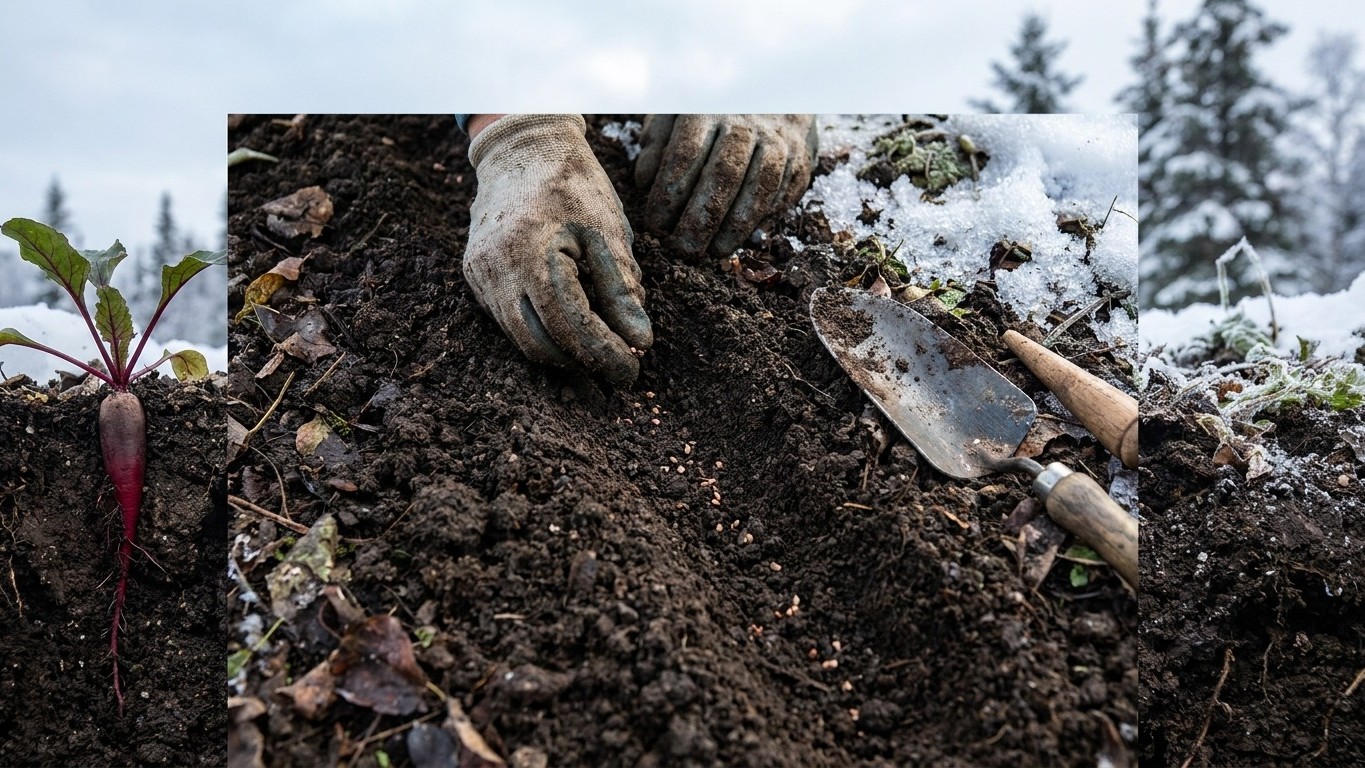

The safest window to sow beets outdoors in the Anchorage area runs from about April 12 to April 28, two to three weeks ahead of the average last spring frost of May 3 to May 12. That timing matters more than the calendar date itself, because what happens to the seed in its first six weeks in the ground decides whether you get a smooth round root or a plant that bolts before it ever forms one.
The short answer
Alaska’s representative soil, the Tanana series, is a Gelisol, meaning permafrost sits within reach of the working profile. The surface horizon runs a loam to silt texture, roughly 30 percent sand, 7 percent clay and 63 percent silt, with a surface pH around 4.7, which counts as strongly acid, an organic matter share near 90 percent, and a poorly drained rating. None of that resembles what a beet wants. Beets are looking for deep, sandy, well-drained ground rich in organic matter, and the Tanana profile gives you the organic matter but pairs it with standing moisture and cold, acid conditions that slow root expansion and can push a taproot to fork or stall.
That combination matters most at the surface, where seed sits and where a young taproot has to push down before it can widen. Cold, wet, acid ground near the surface is exactly the condition that stunts early beet growth, even before heat becomes a factor later in the season.
On the heat side, the figure that would normally matter here, how many days a year Anchorage passes 90 degrees Fahrenheit, isn’t published in the data behind this article, so no number will be guessed at. What can be said plainly is that Anchorage’s climate rarely approaches the 85 degree threshold that Utah State University Extension flags as the point where water stress starts turning a beet root woody. That particular failure is uncommon on the coast. It is not something a gardener in Alaska’s Interior, where summer heat runs considerably higher, should assume applies to them.
None of this is a diagnosis of any one backyard. Alaska spans hundreds of mapped soil series, and the ground behind a house in the Mat-Su Valley, on a hillside outside Fairbanks, or on filled lots anywhere near the coast can differ completely from the Tanana series used here as the state’s representative soil. Treat these figures as a description of what the region’s ground tends to do, hold water, run acid, warm slowly, and then get an actual soil test for the number that applies to your own bed.
The six weeks that decide it here
Sowing two to three weeks before the last frost date puts the first six weeks of a beet’s life in a specific, known stretch of the Anchorage-area spring, roughly mid-April through early June. That window covers the tail end of snowmelt and the start of the region’s driest stretch of the year, before summer rain patterns pick back up. A beet seed sown into ground that’s still cold and then left to dry out as breakup finishes is sitting in exactly the condition that Utah State University Extension identifies as the trigger for premature flowering, water stress in the first six weeks.
This is a different failure from the woodiness that comes later in the season under heat, and the two shouldn’t be lumped together as one watering problem. Bolting happens early, when a young plant reads a dry, stressed start as a signal to skip root formation and go straight to seed. Woodiness happens later, when a nearly mature root faces heat above 85 degrees combined with dry soil and toughens up instead of staying tender. In the Anchorage area, given the mild summer temperatures already noted, the six weeks right after sowing carry the greater risk of the two, simply because that stretch lines up with the driest part of the local spring.
The practical takeaway is timing water to the calendar, not to the plant’s appearance. A beet showing stress from a dry April-into-June stretch won’t visibly wilt the way a tomato does. It just quietly decides to bolt, and by the time a flower stalk shows up, the root crop for that planting is effectively over.
What goes wrong here
- Bolting from a dry breakup period. Sowing into the mid-April to early-June window without supplemental watering during dry stretches is the single most common way an Alaska beet crop fails before it starts. Keep the top few inches of soil evenly moist through those first six weeks, watering on a schedule rather than waiting for visible drought stress.
- Waterlogged, forked roots from poor drainage. A soil profile built like the Tanana series, poorly drained with permafrost influence, holds water at the surface longer than a beet root can tolerate. Raised beds or mounded rows lift the root zone above standing moisture and let excess water drain away from the taproot instead of collecting around it.
- Stunted growth from strongly acid ground. A surface pH near 4.7 is well below what beets prefer. Test your own bed’s pH rather than assuming the state’s representative figure applies, and work in lime according to that test result before sowing, not after growth has already slowed.
- Slow, uneven germination in cold soil. Seed sown into ground that hasn’t warmed from spring’s residual cold germinates unevenly or not at all. Warming the bed with clear plastic for a week or two before the April sowing window, or using a floating row cover right after sowing, gets seed into soil that’s actually ready for it.
- Shallow rooting where organic muck sits over cold subsoil. The Tanana series’ roughly 90 percent surface organic matter describes a natural peat or muck layer, not a worked garden bed, but wherever a similar organic cap sits over cold, dense subsoil, roots can run wide instead of deep. Working the bed a full spade’s depth before sowing, rather than just amending the top couple of inches, gives the taproot somewhere to actually go.
Common questions
Is April 12 to April 28 the right window everywhere in Alaska, or just Anchorage?
That range is built specifically from the Anchorage-area last frost data (May 3 to May 12) and the two-to-three-week rule ahead of it. Anchorage is one of the mildest inhabited parts of the state. The Interior and points north have shorter frost-free seasons, and a gardener there needs a local last-frost date to run the same two-to-three-week math rather than borrowing this window directly.
Should I start beets indoors and transplant them instead of sowing directly?
Beets are sown in place. The 60 to 80 day maturity window referenced by Utah State University Extension runs from the seed going into the ground, not from a transplant date. Beets don’t take well to having their taproot disturbed, so starting them indoors and moving seedlings out tends to produce forked or stunted roots rather than a head start.
Which beet varieties work in Alaska?
Utah State University Extension’s guide lists several beet varieties without attaching a specific season, color, or use to any of them, so no single variety can be recommended here as better suited to a short Alaska season than another based on that source. A seed catalog’s own days-to-maturity listing for whichever variety you choose is the more reliable number to plan a harvest around.
How do I tell if my beets are bolting instead of just growing slowly?
Bolting shows up as a tall central stalk with flower buds forming, usually well before the root has bulked up, and it tends to follow a stretch of dry weather in the first six weeks after sowing. Slow growth from cold or acid soil, by contrast, keeps the plant low and leafy without sending up a flower stalk. Once bolting starts, the root on that particular plant won’t develop further, and the fix is watering earlier next time, not waiting out the current planting.