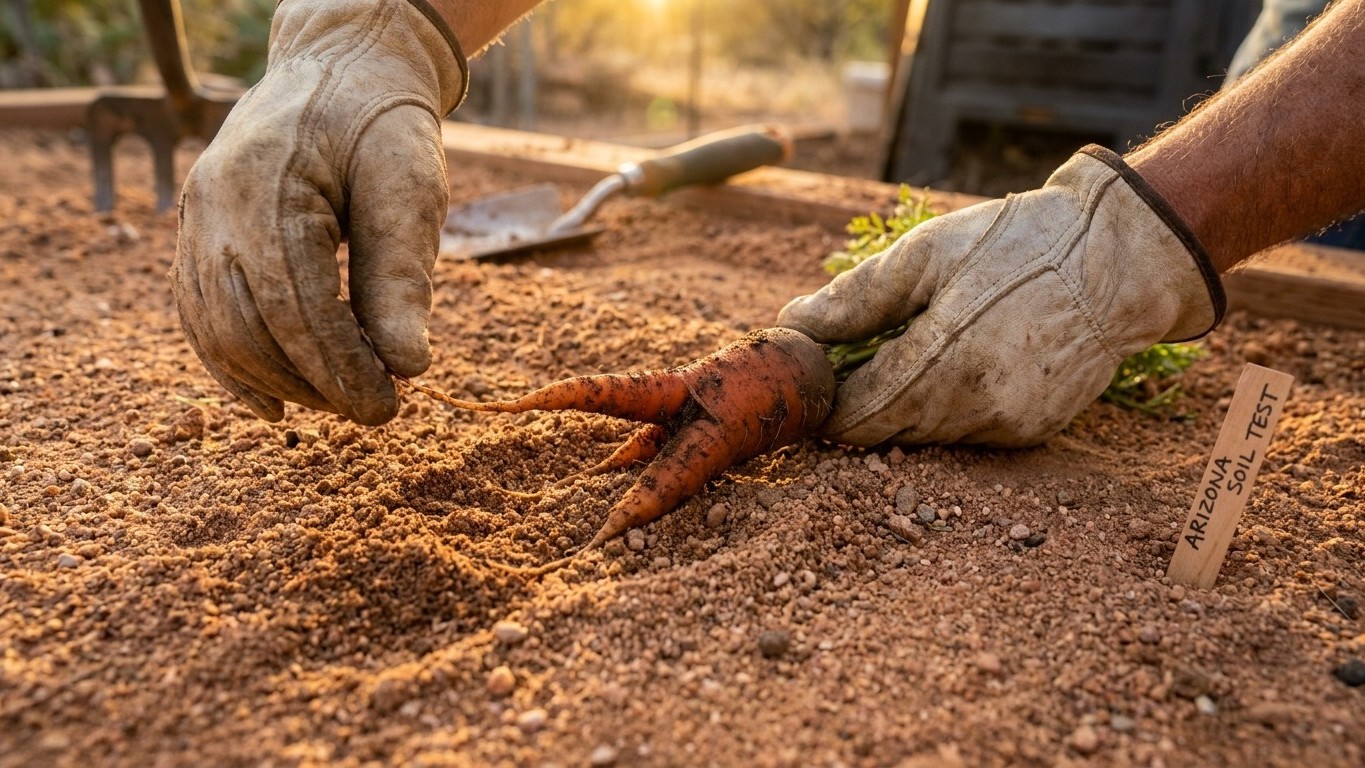

Arizona’s benchmark soil won’t fork a carrot on texture alone. The state’s representative series runs sandy, not clumped with clay, and it drains well, two traits carrots actually like. But that same ground carries almost no organic matter and skews strongly alkaline, so a straight root still depends on the gardener, not the dirt underfoot. Skip the compost, and carrots can still come out stunted or split even where clay never gets the blame.
The short answer
The soil scientists use to represent Arizona is called the Casa Grande series, an Aridisol, which is the technical name for a dry-climate soil that tends toward alkaline and often carries salts near the surface. According to the USDA NRCS Soil Survey Geographic Database, the representative surface horizon of Casa Grande runs 64 percent sand, 14 percent clay, and 22 percent silt, with a surface pH around 8.5 and organic matter around 0.8 percent. Drainage is classed as well drained.
Set that against what Utah State University Extension says carrots need: deep, sandy, well-drained soil rich in organic matter, because heavy or rocky ground is what forks the root. Casa Grande’s clay share sits at just 14 percent, nowhere near the heavy, sticky profile that squeezes a taproot sideways and splits it into legs. On texture and drainage, this soil is closer to what a carrot wants than a clay-heavy state would offer.
| Property | Casa Grande series (surface) | What carrots want |
|---|---|---|
| Sand | 64 percent | High, for loose rooting |
| Clay | 14 percent | Low, to avoid forking |
| Silt | 22 percent | Moderate |
| Organic matter | about 0.8 percent | Rich, per Utah State University Extension |
| Drainage | Well drained | Well drained |
The gap is organic matter. At under 1 percent, Casa Grande is far short of the “rich in organic matter” carrots are asking for. That doesn’t fork a root the way clay does, but it starves the plant of the loose, moisture-holding structure that grows a long, straight one. The fix here isn’t forced by heavy ground, so a raised bed is optional rather than mandatory. What isn’t optional is working compost into the bed before sowing, and double digging still pays off wherever irrigation or foot traffic has crusted the surface into a denser layer than the numbers above suggest.
None of this is a verdict on any one backyard. Arizona spans hundreds of mapped soil series, and Casa Grande is simply the one USDA lists as representative for the state under its State Soils program. A garden on a river terrace, in the hill country, or on a lot a builder graded and refilled can carry a completely different mix of sand, clay, and rock. This number is a starting point for what the region’s ground tends to do, not a reading of the soil under your own carrots.
The test that settles it in your own garden
State averages can’t tell you what’s six inches down in your own bed. A short test with a shovel and a bucket of water will.
- Dig a test hole where you plan to sow, going down as far as you’d want a carrot root to reach. Note whether the shovel meets loose ground the whole way or hits a harder, denser layer partway down.
- Spread the soil you removed on a tarp and look at it. Rock fragments, gravel, or hard clay clumps in that pile are the obstacles that force a taproot to split around them.
- Grab a handful of the moist soil from the bottom of the hole and squeeze it. Sandy soil crumbles apart right away. Clay soil holds together and can be rolled into a ribbon. Loam holds a loose ball that breaks with light pressure.
- Refill the hole partway with water and watch how it moves. Water that vanishes quickly points to fast, sandy drainage. Water that sits for a long stretch signals a denser layer underneath that will need breaking up or bypassing with a raised bed.
Run through these four checks before you commit a whole row to carrots. A bed that feels loose and drains fast in this test is telling you the state’s sandy average holds up on your own ground. A bed that stays wet, or turns up rock and hard clumps, is telling you the opposite, and that’s the bed that needs compost, double digging, or a frame built up above grade before seed goes in.
What goes wrong here
Arizona’s climate and its typical soil chemistry create their own set of failures, separate from whatever your test hole turns up.
- Forking in compacted or crusted ground. Even sandy soil like Casa Grande can crust hard at the surface under repeated shallow watering, and any denser layer a root meets partway down will split it the same way heavy clay does elsewhere. The remedy is the one Utah State University Extension gives for heavy soil generally: work in compost and double dig the bed before sowing, breaking up any crust or compacted lens the root would otherwise hit.
- Poor germination during a hot spell. Carrot seed is sown directly in place, and a sandy surface with barely 0.8 percent organic matter dries out fast once temperatures climb, leaving seed in dry soil right when it needs steady moisture to sprout. Keeping the seedbed consistently damp until seedlings are up, rather than watering on a fixed schedule, is what gets a stand established.
- Splitting from uneven watering. A well-drained, sandy soil sheds water quickly, so a bed that goes from soaked to dry and back again stresses the root and can crack it. Mulch and a steady watering routine, rather than occasional heavy soakings, keep the moisture even enough to avoid it.
Common questions
Does the alkaline pH of Arizona’s soil cause carrots to fork?
The forking mechanism Utah State University Extension describes is physical: heavy or rocky soil blocks the root and splits it. Casa Grande’s surface pH runs around 8.5, which is alkaline, but that’s a separate issue from forking. Alkalinity affects nutrient availability, not whether the root has room to grow straight down.
Is Casa Grande soil good for carrots as it comes, without amendment?
Its sand-heavy texture and good drainage are favorable, but its organic matter, at roughly 0.8 percent, falls well short of what Utah State University Extension calls for. Compost is the practical fix, whether or not the bed also needs double digging.
How long do carrots take from seeding to harvest?
Because carrots are sown directly in place rather than transplanted, that timeline runs from the seeding date, not from any later transplant date. There’s no transplant step to count from for this crop.
If my own soil doesn’t match Casa Grande at all, which number should I trust?
Your own test hole. Casa Grande is the series USDA lists as representative for Arizona, but it’s one series among hundreds mapped across the state, and a garden on fill dirt, a river bottom, or reworked ground can differ from it completely. The dig-and-feel test settles what the state figure only estimates.