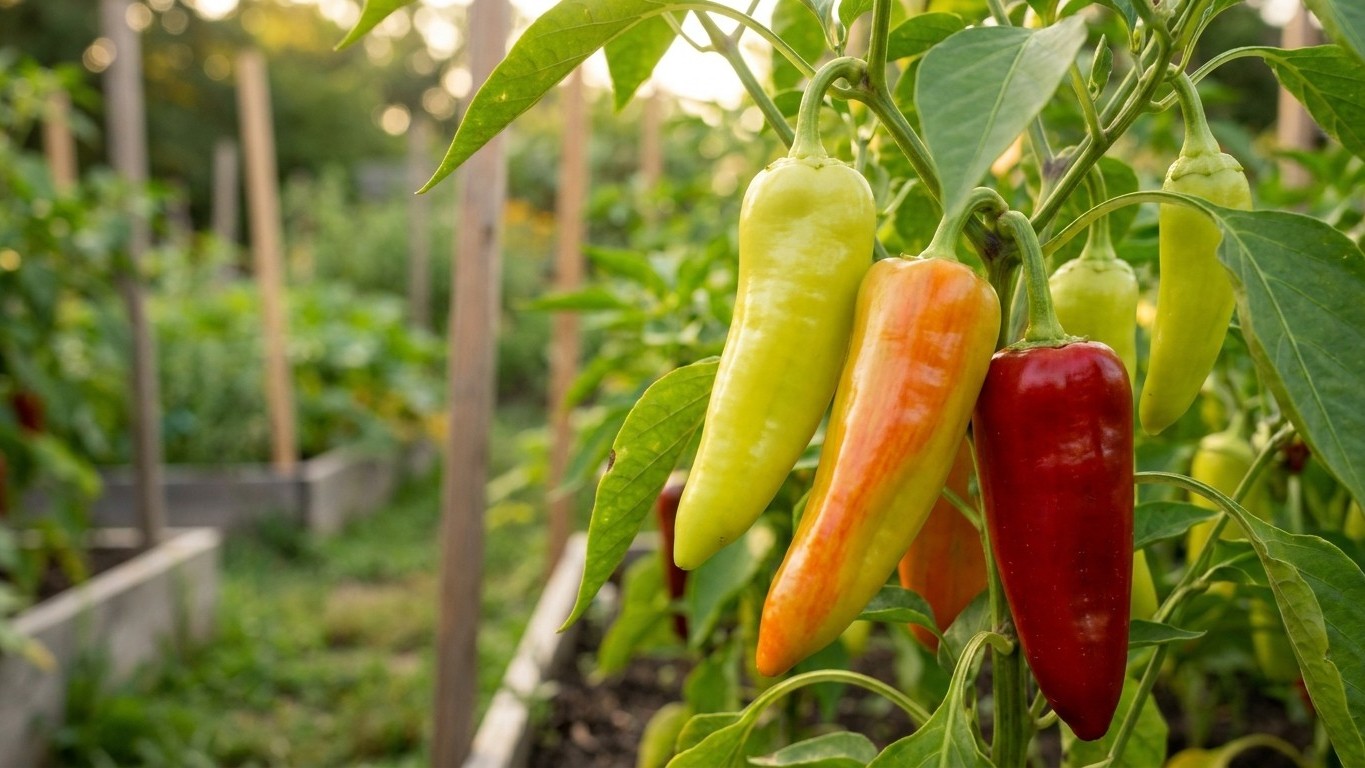

Pick peppers once the fruit has reached full size and feels firm. Clemson Cooperative Extension puts that at about 70 to 85 days after transplanting. Then keep them out of the refrigerator. A household fridge runs colder than peppers tolerate, and the cold shows up as pitted, softening skin. A cool, slightly humid room does far better, and in Arizona the picking window depends as much on summer heat as on the calendar.
Keeping them, and for how long
The Home & Garden Information Center at Clemson Cooperative Extension gives the storage conditions for peppers in its pepper factsheet: 45 to 50 °F with 80- to 90-percent relative humidity, for two to three weeks. Write that range on a sticky note. Two to three weeks is the ceiling under those ideal conditions. A pepper that was picked soft, sunburned, nicked or overripe will not get there, and neither will one stored in a room that drifts out of range.
Why does the refrigerator damage peppers?
A domestic refrigerator sits below the 45 to 50 °F range. Below about 45 °F, peppers pit and soften, a problem called chilling injury. You see small sunken spots on the skin, a limp wall and a dull color. The damage often appears after the pepper comes back to room temperature, so a pepper that looked fine in the crisper drawer can turn soft on the cutting board. Nearly everyone makes this mistake, because the fridge is where vegetables are supposed to go.
How long do picked peppers keep in dry desert air?
The humidity half of the range matters as much as the temperature. Most Arizona rooms are far drier than 80 to 90 percent, and dry air pulls moisture out of a pepper until the skin wrinkles. A loosely closed perforated bag or a lidded container with a few holes holds humidity around the fruit while letting some air move. A sealed bag with no air flow invites rot instead. Check the peppers every few days and use the soft ones first.
When are peppers ready to pick in Arizona?
Clemson counts 70 to 85 days from transplanting to harvest. Utah State University Extension adds that transplants need 8 to 10 weeks indoors, and that they should go out when the soil reaches 60 F, after frost. Each individual fruit then takes 35 to 45 days from flowering, not from sowing or transplanting, to size up.
Frost sets the calendar in cold country but hardly matters in the low desert. At the Phoenix reference station, the temperature reached 32 F in only 6 of 30 springs. When a freeze does come, it falls between late December and mid January. Heat is the real limit. The same station averages 168.9 days a year at or above 90 F. Utah State warns that pepper fruit set fails at both ends: nights below 55 F or days above 90 F. Flowers that open during a long hot stretch drop without making fruit, which is why summer plants often stand green and empty. The guide to why peppers fail to set fruit in Arizona covers that stall in detail. The cool end matters too, and the reader has to watch their own nights, because they swing a lot from one neighborhood to the next.
Ripe-for-picking signs are simple. The fruit has reached the full size of its variety, the skin is glossy and the wall feels firm when you squeeze gently. Cut the stem with pruners, leaving a short stub on the pepper, since branches snap easily when you pull. Pick in the morning, while the fruit is still cool. Fruit left hanging past ripeness invites insects and sunscald, so see what eats pepper in Arizona, and when. For the whole season, start with growing peppers in Arizona.
Where in the house that actually is
A number like 45 to 50 °F sounds easy until you try to find it in a real house. Most of the obvious spots miss.
The refrigerator is too cold. Even the crisper drawer, which runs a little milder than the main shelves, is built to hold food below the damage line. Any room kept comfortable for people runs warmer than the range. Warm air speeds up ripening and softening, so peppers kept on the counter turn wrinkled long before the two-to-three-week ceiling. A garage swings with the weather. In an Arizona summer it can run hot enough to cook the fruit, and on a rare freezing night in winter it can drop right to the edge of freezing.
The closest match is usually a cool interior spot away from outside walls, the oven, the water heater and sunny windows. A windowless pantry or a closet on the shaded side of the house is the usual candidate. Arizona houses rarely have basements, so a cellar-style room is not an option for most people.
Guessing is not enough here. Leave a thermometer in the spot for a few days before you trust it with a harvest, or you may find out the hard way with a bin of pitted peppers. Check three things:
- The temperature in the morning and again in late afternoon, to see how far it swings.
- Whether the reading ever falls below 45 °F, which pits the fruit, or climbs above 50 °F, which speeds softening.
- The humidity, if you own a small hygrometer, since desert rooms tend to run dry.
If no spot in the house holds the range, plan to use the peppers within a few days instead of storing them. Once a pepper is cut, it belongs in a closed container in the refrigerator, because the 45 to 50 °F range applies to whole, uncut fruit.
Common questions
Can I put peppers in the fridge for just a day or two?
You can, but chilling injury starts below about 45 °F, and a household refrigerator is colder than that. Short stays do less harm than long ones, yet the pitting and softening can show up afterward. If a cool pantry is available, use it. If you must refrigerate whole peppers, plan to eat them soon.
How do I know a pepper is ready to pick?
Look for full size, a glossy skin and a firm wall. Counting days helps. Clemson Cooperative Extension says peppers are ready about 70 to 85 days after transplanting, and individual fruit take 35 to 45 days from flowering. Many peppers are picked green and others are left to color up, so check what your variety does on its tag.
Why did my peppers stop setting fruit in summer?
Utah State University Extension says fruit set fails when nights fall below 55 F or days rise above 90 F. In the low desert, the Phoenix reference station reaches 90 F or higher on 168.9 days a year, so the hot limit is the usual cause. Watch your own nights as well, since the cool limit can catch plants in a cold spell.
Do peppers need picking before a freeze in the Arizona high country?
Yes. Flagstaff and the high country freeze hard, unlike the low desert, where a freeze is rare. Harvest what is full size before a hard freeze arrives, and store the fruit at 45 to 50 °F as described above. Your county extension office can tell you what to expect in your own town.