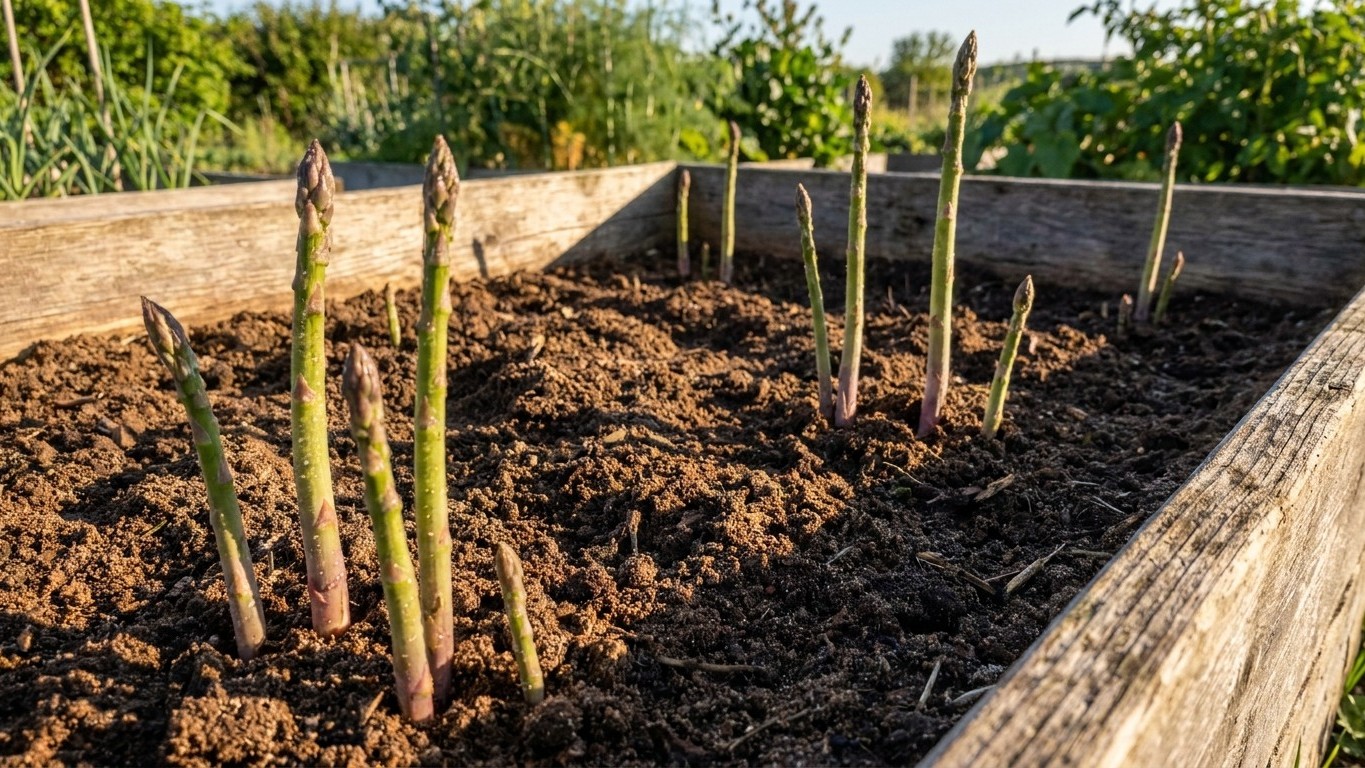

Stop cutting asparagus when most of the new spears come up thinner than a pencil. Once the spears are in your hand, they keep best at 32°F to 35.6°F with air near saturation, and they toughen fast above 50°F. In the low desert a frost date tells you little, so the spears themselves are your calendar.
When do you stop cutting asparagus each season?
Walk the bed and look at what came up that day. A few skinny spears among thick ones are normal, so keep cutting. When most of them are thinner than a pencil, the cutting is over for the year. Thin spears mean the crown’s stored reserves are running low. Every spear you leave grows into a fern, and the ferns refill the crown for next spring.
The season also lengthens as the bed ages. Utah State University Extension says asparagus is not harvested until year 3, and the bed then produces for 10 to 15 years. A young bed gets no shortcuts, so a few spears in year 2 are off the table too.
| Age of the bed | Cutting season |
|---|---|
| Years 1 and 2 | No harvest |
| Year 3 | 4 weeks |
| Following season | 6 weeks |
| Season after that | 8 weeks |
Treat those weeks as the longest the season can run. If the spears thin out sooner, the pencil test ends the season sooner.
A frost date can’t end it for you in the low desert. NOAA NCEI lists the frost-free season at Phoenix as 365 days, and the station reached 32°F in only 6 of 30 springs. A rare cold snap can bring 32°F between late December and mid January, and that is about the only freeze window. The high country around Flagstaff is a different climate and freezes hard, so spears there start later, but the pencil test still applies.
After the last cut, let the spears grow into ferns and keep them watered. Chewed or stripped ferns are a sign of trouble, and What Eats Asparagus in Arizona, and When covers who is responsible and when they show up.
Keeping it, and for how long
What temperature and humidity keep asparagus spears best?
The UC Davis Postharvest Technology Center gives an optimum storage temperature of 0°C to 2°C, which is 32°F to 35.6°F, and an optimum relative humidity of 95 to 100 percent. Its fact sheet says high humidity is essential to prevent desiccation. Spears are mostly water, and the cut end is where they lose it fastest.
The window is narrow, and both edges bite.
| Temperature | What happens to the spears |
|---|---|
| Above 50°F (10°C) | Toughening, and it happens rapidly |
| 32°F to 35.6°F | Optimum range |
| 30.9°F (-0.6°C) or lower | Freezing injury: a water-soaked look, then extreme softening |
Anything between 35.6°F and 50°F is warmer than ideal. It is still better than the counter, where a warm kitchen or a hot truck cab can push spears past 50°F within hours. Get them into the cold soon after cutting.
How long do cut asparagus spears last?
Any shelf life you read for asparagus is a ceiling. It applies only at 32°F to 35.6°F with air near saturation, and a home fridge falls short on both counts. Plan on less than the best case, and count from the moment you cut, not from the moment you put them away.
The spears will tell you more than a number can. Fresh ones have tight, firm tips and plump cut ends, and they snap cleanly when you bend them. Spears that have passed their best show soft or slimy tips, shriveled and woody butts, and stalks that bend without snapping. A water-soaked look after a night in the fridge points to the other edge of the window, freezing.
Cutting only what you will eat in the next day or two is the simplest way to stay inside the ceiling. A young bed in its first cutting year may give you only a handful of spears at a time, so cold storage rarely matters until the 6-week and 8-week seasons.
Where in the house that actually is
Which fridge shelf comes closest to the optimum?
A domestic fridge runs warmer than 35.6°F, and its door runs warmer still. Every opening lets room air in, and the door shelves get the worst of it. Cold air sinks, so the lowest shelf toward the back comes closest to the 32°F to 35.6°F target. Don’t jam the spears against the back wall. In a fridge that runs cold, that spot can drop to the freezing injury level of 30.9°F.
How do you get near-saturated air around the spears?
Fridge air is dry, and 95 to 100 percent humidity means something close to a wet wrapper. Because water leaves through the cut end first, stand the cut ends in shallow water. Skipping that step costs you limp, stringy spears within days. A few ways to do it:
- Trim a thin slice off the butts, then stand the spears upright in a jar with shallow water.
- Drape a plastic bag loosely over the tips to hold humidity around them.
- If a jar won’t fit, wrap the butts in a damp paper towel and slip the bundle into a bag.
- Set it on the lowest back shelf, never in the door.
Does an Arizona asparagus bed last long enough to be worth it?
Utah State University Extension has crowns planted in 8-inch furrows in early spring. The furrow is backfilled gradually through the year, never all at once. Most soils will do provided they are well drained, and that matters because you pick this spot for 10 to 15 years. Growing Asparagus in Arizona walks through the year-by-year plan.
Arizona’s state soil, the Casa Grande series, is an Aridisol, a dry-climate soil that is usually alkaline and often carries salts. USDA NRCS records its representative surface as 64 percent sand, 14 percent clay and 22 percent silt, with about 0.8 percent organic matter, and well drained. Desert ground tends to shed water quickly, which suits asparagus. That series represents the state, though, not your yard. River bottoms, hill country and ground a builder has scraped or filled can differ completely. A soil test gives your own answer, and Will Arizona Soil Hold an Asparagus Bed for Fifteen Years? goes deeper. If water stands in the furrow after irrigation, pick another spot or build the bed up.
Rain won’t carry the bed. NOAA NCEI normals for Phoenix show about 1.9 inches across June, July and August, and 7.2 inches over the year. June is the driest month at 0.02 inches, then July at 0.91 and August at 0.93. On sandy ground that rain drains within the day, and a single summer thunderstorm mostly runs off. Plan on irrigating, and use a rain gauge on your own plot to see what it actually gets.
Your county extension office can say which has done well locally.
Common questions
Can I cut a few spears in the first or second year?
No. Asparagus is not harvested until year 3. In those early years the spears grow into ferns that feed the crown, and cutting them takes away the reserves the bed needs to last 10 to 15 years.
Can I store asparagus in the fridge door?
The door is the warmest part of a home fridge. Above 50°F spears toughen rapidly, and even a few degrees over 35.6°F falls short of the optimum. Use the lowest back shelf, with the cut ends in water.
What happens if my fridge freezes the spears?
At 30.9°F or lower, spears show freezing injury: a water-soaked look that turns to extreme softening. A thermometer reading on the shelf will tell you if your fridge runs that cold. Move the spears away from the back wall or turn the dial up a notch.
Does Arizona soil drain well enough for asparagus?
The state soil is sandy and well drained, and most soils work if they drain. Your yard may differ. Fill a hole with water at the planting spot, and if it is still standing there long after the first fill, move the bed or build it up.