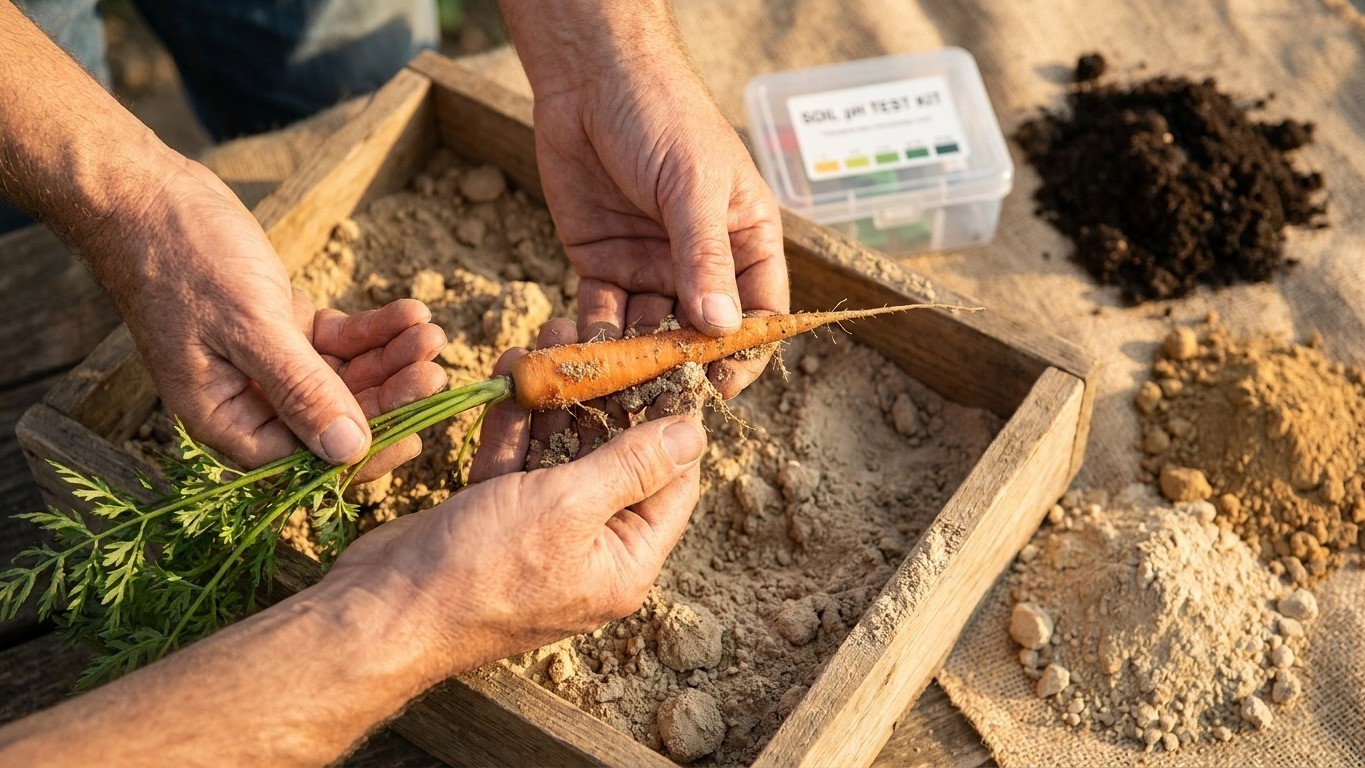

Arizona’s carrot timing hinges less on a single frost date and more on what’s under your boots. Carrots go straight into the ground as seed, with no transplanting step, so every calculation for planting runs backward from that in-ground sowing date, not from a start-tray date. But before you count days, you need to know whether the dirt you’re sowing into will let a carrot grow straight at all.
The short answer
The soil most often used to represent Arizona is the Casa Grande series, an Aridisol, the classification given to dry-climate soils that tend to run alkaline and often carry salts near the surface. The representative surface horizon runs about 64 percent sand, 14 percent clay and 22 percent silt, with a surface pH near 8.5 and organic matter around 0.8 percent. It’s classed as well drained.
That texture is, on paper, closer to what a carrot wants than a lot of gardeners assume. Utah State University Extension is blunt about what carrots need: deep, sandy, well-drained soil rich in organic matter. Heavy or rocky ground makes the root fork, splitting into two or three legs instead of growing down as one clean taproot. A soil that’s 64 percent sand and well drained doesn’t fit the profile that causes forking. The catch is the other end of that USDA description: 0.8 percent organic matter is thin. Carrots don’t fork in low-fertility dirt, but they do grow stunted and woody in it, and the alkaline pH near 8.5 can tie up some nutrients before the root ever reaches them.
So the practical fix in ground that resembles Casa Grande isn’t a raised bed to fight clay, since there isn’t much clay to fight. It’s compost, worked in before sowing, to build the organic matter the sand and the surface pH both lack. If your own ground trends heavier or shallower than this, USU’s answer holds: heavy or rocky soil calls for generous compost and double digging, or a raised bed built with a better mix from the start.
None of this is a diagnosis of your yard. Arizona spans hundreds of mapped soil series, from sandy desert washes to heavy valley clays to thin, rocky ground scraped down to caliche by a builder’s grader. Casa Grande is the series USDA lists as representative of the state under its State Soils program, not a measurement of the dirt behind your house. Treat it as a starting point, a reasonable guess about what the region’s ground tends to do, and then go check your own bed before you commit a seed packet to it.
The test that settles it in your own garden
- Dig a hole at least a foot deep where you plan to sow. Carrots push straight down, and if you hit a hardpan layer, caliche, or a shelf of rock before that depth, the root has nowhere to go but sideways or forked.
- Look at what comes out of the hole. Note any layer that changes color or hardens abruptly, and count how many stones or pebbles show up in the spoil pile. A soil riddled with gravel at root depth will produce the same forking problem as heavy clay, just for a different reason.
- Feel the texture between wet fingers. Grab a handful of moist soil and try to roll it into a ribbon between your thumb and forefinger. Soil that ribbons long and holds its shape leans clay-heavy. Soil that won’t hold together at all and falls apart into grit leans sandy. Most garden beds sit somewhere in between, and that middle ground is usually fine for carrots once compost is worked in.
- Run a drainage check. Dig a second hole about a foot deep, fill it with water, let it drain completely, then fill it again and time how long the second fill takes to disappear. Water that lingers for hours points to compaction or a clay layer trapping it below the surface. Water that vanishes almost immediately points to sand so loose it may not hold moisture long enough for even germination.
- Match what you found against the USU guidance. Deep, loose, well-drained ground with decent organic matter needs little more than a fork and some compost worked into the top several inches. Anything shallow, rocky, or slow to drain calls for the double-digging and compost routine, or a raised bed filled with a looser mix, before a single seed goes in.
What goes wrong here
- Forking in heavy or rocky ground. Any obstruction at root depth, whether it’s clay that compacts hard when it dries or a scatter of stones left behind by grading, splits the taproot into two or three legs. The remedy is the one USU gives directly: work in plenty of compost and double dig the bed, loosening and amending down a full spade’s depth rather than just scratching the surface, or build a raised bed with a looser mix from the ground up.
- Poor germination during a hot stretch. Carrot seed is small and sits shallow, and in loose, sandy ground like the Casa Grande series that top inch can dry out fast once daytime heat climbs. Seed that dries even once during germination often stalls for good. Keep the seed row shaded lightly with a board or light mulch until sprouts show, and water often enough that the surface never fully dries, rather than watering heavily on a longer interval.
- Splitting from uneven watering. A root that grows slowly through a dry spell and then takes on a sudden slug of water after a heavy irrigation or rain swells faster on the inside than the skin can stretch, and it splits. This shows up more in sandy soils, where water drains through fast enough that the ground swings between dry and saturated. A steady, even watering schedule, rather than long gaps followed by a soaking, keeps the root growing at one pace instead of lurching.
- Low fertility stunting growth even when the root grows straight. With organic matter near 0.8 percent in the representative state soil, there’s not much to feed a crop over the 70 to 100 days it takes carrots to mature from seeding. Compost worked in ahead of sowing, not applied later as a side dressing, gives the root something to grow into rather than through.
Common questions
Does Arizona’s soil naturally suit carrots?
The texture of the state’s representative soil, sandy and well drained, works in a carrot’s favor and shouldn’t cause forking on its own. The weak point is fertility: organic matter around 0.8 percent is thin, and compost worked in before sowing makes up the difference.
Should I count planting from a seed date or a transplant date?
Always from seeding. Carrots are sown directly into the garden bed and never transplanted, so there’s no separate transplant date to track. The full 70 to 100 days to maturity runs from the day the seed goes into the ground.
My soil test doesn’t match the Casa Grande numbers. Which do I trust?
Your own test. The Casa Grande series is what USDA lists as representative of Arizona overall, but the state carries hundreds of distinct soil series, and a builder’s fill, a river-bottom garden, or a plot cut into hill ground can all differ completely from that baseline. Dig, feel, and check drainage in your own bed before deciding what it needs.
Is a raised bed always necessary in Arizona?
No. If your dig test turns up loose, deep, well-drained ground, working compost into the existing bed and double digging it is usually enough, following the same guidance USU gives for any garden. A raised bed becomes the better option when the native ground is shallow, heavy, or full of rock at root depth.