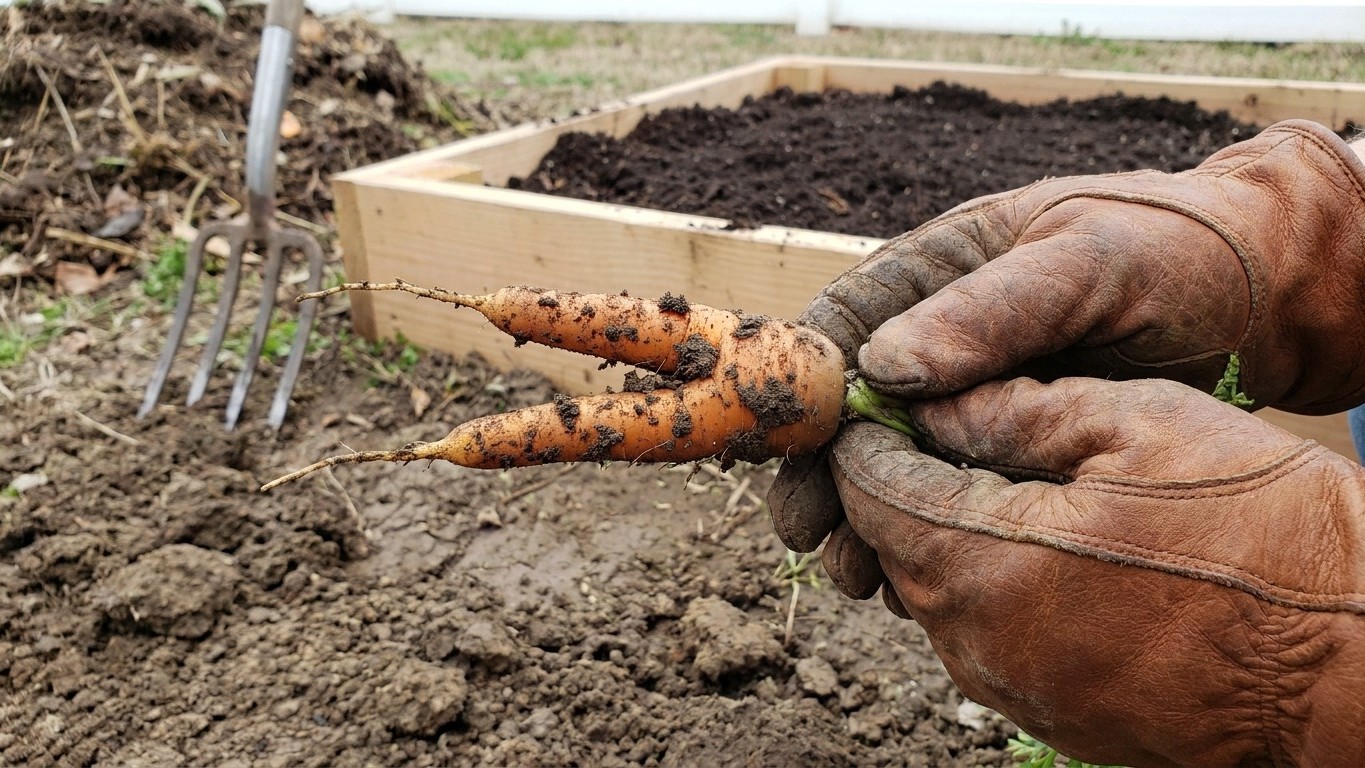

In much of Arkansas, a carrot grown without amendment will likely fork or split into stubby, forked roots. The state’s representative soil runs heavy on silt and clay and drains only somewhat, and carrots want the opposite: deep, sandy, well-drained ground loose enough for a taproot to push straight down. The fix isn’t a different variety. It’s compost, double digging, or a raised bed.
The short answer
Arkansas’s official state soil is the Stuttgart series, an Alfisol, a forest-derived soil of moderate natural fertility that holds onto nutrients reasonably well once they’re there. Sampled at the surface, it runs about 30 percent sand, 16 percent clay and 54 percent silt, which puts it solidly in loam-to-silt territory rather than anything a gardener would call sandy. Organic matter sits around 1.8 percent, which is modest, and the drainage class is listed as somewhat poorly drained, meaning water moves through slowly enough to matter. Surface pH averages about 5.6, on the acid side of neutral.
None of that reads like an ideal carrot bed. Carrots want deep, sandy, well-drained soil rich in organic matter, according to Utah State University Extension, and they say plainly that heavy or rocky soil is what makes a taproot fork. A soil built mostly of silt and clay, with drainage slow enough to earn the “somewhat poorly drained” label, is exactly the kind of ground that resists a straight-growing root. The root hits compacted, cohesive soil, meets resistance, and instead of one clean carrot you get two or three skinny legs splayed out like a dowsing rod.
The Utah State guidance is also specific about the remedy, and it isn’t picking a different seed packet. Heavy soil needs plenty of compost worked in, and it needs double digging, loosening the ground a full spade’s depth or two so the root has somewhere to go before it hits resistance. In practice that means turning over the bed to at least 12 to 15 inches, mixing in several inches of compost as you go, and breaking up any clay clods rather than just burying them. A raised bed filled with a lighter, sandier mix sidesteps the problem entirely, which is why so many carrot growers in silt- and clay-heavy regions default to raised beds instead of fighting the native ground every season.
None of this is a verdict on your particular yard. The Stuttgart series is the soil chosen to represent Arkansas as a whole, not a survey of every backyard in it. A state this size spans hundreds of distinct soil series, and river-bottom ground, hill-country ground, and anything a builder has graded, filled, or scraped for a foundation can differ from the state soil completely, in texture, in drainage, and in pH. Treat the Stuttgart numbers as a starting point that tells you what the region tends toward, heavy silt, slow drainage, mild acidity, and nothing more specific than that. The only way to know what your own carrots are actually growing in is to go dig.
The test that settles it in your own garden
- Dig a hole at least 12 inches deep where you plan to sow. Carrots need that much clear depth to grow straight, so if you hit hardpan, a clay layer, or a shelf of rock before 12 inches, that alone tells you forking is likely without loosening the ground first.
- Look at what comes out of the hole. Note any stones, gravel, or chunks of solid clay. A root pushing against a rock or a dense clay lump will bend or split around it, so the more obstructions you see, the more prep work the bed needs before seeding.
- Feel the texture between your fingers. Grab a moist handful from a few inches down. Sand feels gritty and falls apart. Silt feels smooth, almost like flour. Clay feels sticky and holds its shape when you squeeze it into a ball. Most garden soil is some blend of the three, and the more clay and silt you feel relative to sand, the closer you are to the heavy, forking-prone end of the spectrum.
- Squeeze a moist ball and press it. If it holds together in a hard clump that doesn’t crumble easily, you’re dealing with clay-dominant ground that will benefit from compost and deep loosening. If it falls apart the moment you poke it, you’re closer to the sandy, free-draining end carrots prefer.
- Watch how water drains after a hard rain. If puddles sit on the surface for hours, or the ground stays soggy a full day later, drainage is slow enough to cause problems, both for forking and for the root diseases that come with waterlogged ground. Fast-draining spots that dry within a few hours are in better shape.
What goes wrong here
- Forking in heavy, silt-and-clay ground. This is the headline problem in soil built like the Stuttgart series. A taproot meets resistance, splits, and you end up harvesting forked, misshapen carrots instead of one straight root. The remedy is the same one Utah State Extension gives for any heavy soil: work in generous compost and double dig the bed a full spade’s depth or two before sowing, or skip the native soil altogether and grow in a raised bed filled with a lighter mix.
- Poor germination during a hot, dry stretch. Carrot seed is tiny and sits near the surface, so it dries out fast once a heat spell sets in. A crusted, silt-heavy surface compounds the problem by shedding water instead of holding it. Keep the seedbed consistently moist with light, frequent watering until seedlings are up, and consider a thin covering, like burlap or a board, removed the moment sprouts appear, to hold surface moisture during the hottest days.
- Splitting from uneven watering. Roots that go through a dry stretch and then get soaked, a heavy rain after weeks of drought, for instance, can split lengthwise as the interior swells faster than the outer layer can stretch. Even, regular watering through the growing season, rather than occasional deep soaks, keeps the root growing at a steady rate and avoids the sudden swelling that cracks it open.
- Slow, sluggish growth in poorly drained spots. Ground that stays wet longer than it should, the kind the “somewhat poorly drained” label points to, starves roots of oxygen and can lead to rot as much as forking. Raised beds or beds mounded a few inches above grade let excess water shed off to the sides instead of sitting around the developing root.
Common questions
Does adding sand to clay soil fix forking on its own?
Sand alone doesn’t solve much without organic matter mixed in too. Utah State University Extension’s guidance for heavy soil calls for plenty of compost along with double digging, not sand by itself. Compost improves structure at every depth the root passes through, while a thin layer of sand on top does little for what’s happening a foot down.
Do I need to test my own soil, or is the state soil close enough?
Test your own. The Stuttgart series represents Arkansas as a state, but a state contains hundreds of soil series, and river-bottom ground, hillside ground, and any yard that’s been graded or filled can be nothing like it. The dig-and-feel test in this article gives you a real answer for your bed in about ten minutes.
How long until carrots are ready to harvest?
Carrots are sown directly in the ground, there’s no transplanting step, so the clock starts at seeding. Depending on the variety, expect roughly 70 to 100 days from seed to harvest.
Will a raised bed guarantee straight carrots?
A raised bed filled with a loose, sandy, compost-rich mix removes most of the resistance that causes forking, which is why it’s a common workaround in heavy-soil regions. It’s not an absolute guarantee, since stones or clumps left in the fill, or a bed that isn’t deep enough, can still cause trouble, but it stacks the odds heavily in your favor compared to sowing straight into unamended native ground.